The GAAP Principles Simulation is an interactive, online learning tool that immerses students and professionals in realistic financial reporting scenarios, requiring the hands-on application of U.S. Generally Accepted Accounting Principles to produce accurate financial statements.

GAAP Principles Simulation
In this GAAP Principles Simulation, participants act as corporate financial controllers, applying Generally Accepted Accounting Principles to complex, real-world transactions to produce accurate, compliant, and decision-useful financial statements.

GAAP Principles Simulation Overview
The GAAP Principles Simulation is a dynamic, scenario-based training tool developed by finance practitioners and academics. Participants step into the role of financial accountants or controllers within a simulated corporation facing a series of evolving business events. Each decision round introduces new transactions: such as revenue recognition dilemmas, lease accounting changes, or impairment assessments.
Moving beyond textbook theory, this simulation forces participants to make judgment calls under time constraints, interpret nuanced standards, and see the direct impact of their accounting choices on the financial statements and key metrics. It bridges the gap between knowing the rules and applying them in a pressurized, business-relevant context.
This simulation is ideal for university accounting programs, CPA training, corporate finance onboarding, and executive education, providing an immersive experience in the practical art and science of financial reporting.

GAAP Principles Simulation Concepts
Participants work through realistic scenarios, which can be customized to emphasize or exclude specific topics depending on the learning goals. This modular structure allows the simulation to be tailored to any type of session. Key concepts include:
- Revenue Recognition
- Lease Accounting
- Financial Instruments
- Business Combinations
- Fair Value Measurement
- Income Taxes
- Impairment of Long-Lived Assets
- Expense Recognition and Accruals
- EPS Calculation
- Financial Statement Articulation

Gameflow
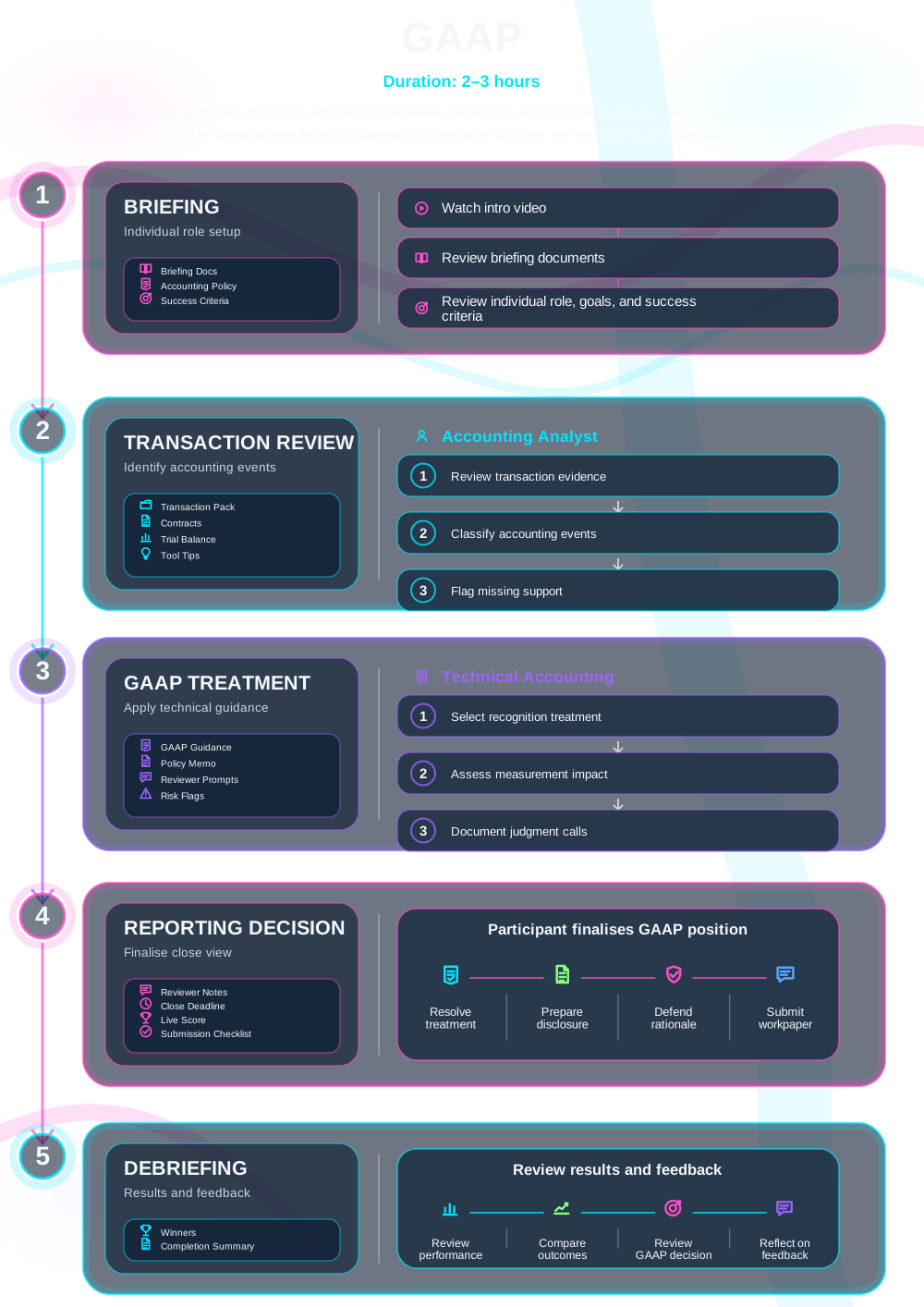

What Participants Do
In the simulation, participants will:
- Analyze business transactions and contracts to identify relevant accounting issues.
- Research and apply the correct GAAP standards to each transaction.
- Make critical judgments and estimates within the bounds of accounting principles.
- Prepare and adjust journal entries that reflect their accounting decisions.
- Generate key financial statements (Income Statement, Balance Sheet, Cash Flow) after each round.
- Review the financial impact of their choices on ratios and performance metrics.
- Defend or present their accounting treatment in a simulated audit or management review.
- Adapt their approach as new transactions and regulatory updates are introduced.

Learning Objectives
By the end of the simulation, participants will be able to:
- Demonstrate proficiency in applying core GAAP standards to common and complex business transactions.
- Develop professional judgment in areas of accounting estimation and policy choice.
- Articulate the direct link between accounting entries, financial statements, and key business metrics.
- Enhance critical thinking and analytical skills to solve unstructured accounting problems.
- Improve collaboration and communication by discussing and justifying accounting positions within a team.
- Build confidence in handling the pace and ambiguity of real-world financial reporting cycles.
- Understand the strategic and ethical implications of financial accounting decisions.
How the GAAP Principles Simulation Works
This simulation can be run individually or in teams in academic or corporate contexts. Each cycle represents a stage of getting through a pressing financial situation.
1. Receive a Transaction Brief Participants are introduced to new business events with supporting documentation (contracts, invoices, board minutes).
** 2. Research and Analyze** Teams determine the relevant accounting issues and research the appropriate GAAP guidance.
3. Make Accounting Decisions Participants decide on the proper treatment, prepare journal entries, and note necessary disclosures.
4. Execute and Report Decisions are entered into the simulation platform, which instantly generates updated financial statements and ratios.
5. Review Feedback The system provides feedback on the accuracy and compliance of choices, explaining optimal treatments.
6. Present and Defend Teams may present their financial results and key accounting decisions to a simulated board or audit committee.
7. Progress to Next Period A new set of transactions is introduced, often building on the consequences of prior decisions, and the cycle repeats.
Frequently Asked Questions
Assessment
Assessment of participant performance can be tailored according to the host institution’s objectives (business school, corporate training, assessment centre). Typical assessment criteria include:
- Correct identification and application of GAAP standards to transactions.
- Accuracy and integrity of the generated Income Statement, Balance Sheet, and Cash Flow Statement.
- Quality of estimates and policy applications across reporting periods.
- Ability to interpret and explain the impact of accounting choices on financial ratios and business health.
- Clarity and persuasiveness in presenting or defending accounting treatments in written memos or verbal presentations.