It's ideal for finance students (BSc, MSc, MBA), aspiring investment bankers, equity research analysts, corporate finance professionals, and anyone who needs to master practical valuation skills.

Free Cash Flow to Firm Simulation
In this simulation, participants directly calculate and analyze Free Cash Flow to the Firm, transforming financial statements into a clear view of a company’s true cash-generating power for investors and managers.

Free Cash Flow to Firm Simulation Overview
The Free Cash Flow to Firm Simulation is a dynamic, applied learning experience developed by corporate finance professionals. It replicates the rigorous process analysts and investors use to derive FCFF from real financial data. Participants move beyond textbook formulas to grapple with the practical adjustments and assumptions that impact valuation.
Students engage with authentic company financials, income statements, balance sheets, and cash flow statements to systematically calculate operating cash flow, adjust for capital expenditures and working capital changes, and arrive at the crucial FCFF figure. The simulation introduces dynamic market and operational scenarios, challenging participants to forecast FCFF and understand how strategic decisions directly influence a company’s valuation and financial health.
Although ideal for undergraduate and graduate finance courses, executive training, and corporate finance skill workshops, the simulation is modular and scalable, allowing instructors to vary complexity.

Free Cash Flow to Firm Simulation Concepts
Participants work through realistic scenarios, which can be customized to emphasize or exclude specific topics depending on the learning goals. This modular structure allows the simulation to be tailored to any type of session. Key concepts include:
- The definition and critical importance of FCFF in valuation and capital budgeting
- The step-by-step calculation of FCFF from GAAP/IFRS financial statements
- Adjustments for non-cash items, changes in net working capital, and capital expenditures
- Distinguishing between Free Cash Flow to the Firm and Free Cash Flow to Equity
- Using FCFF as the foundation for Discounted Cash Flow valuation models
- Analyzing the drivers of cash flow and their impact on firm value
- Forecasting future FCFF under different operational and economic scenarios
- Sensitivity analysis: Understanding how changes in assumptions affect valuation

Gameflow
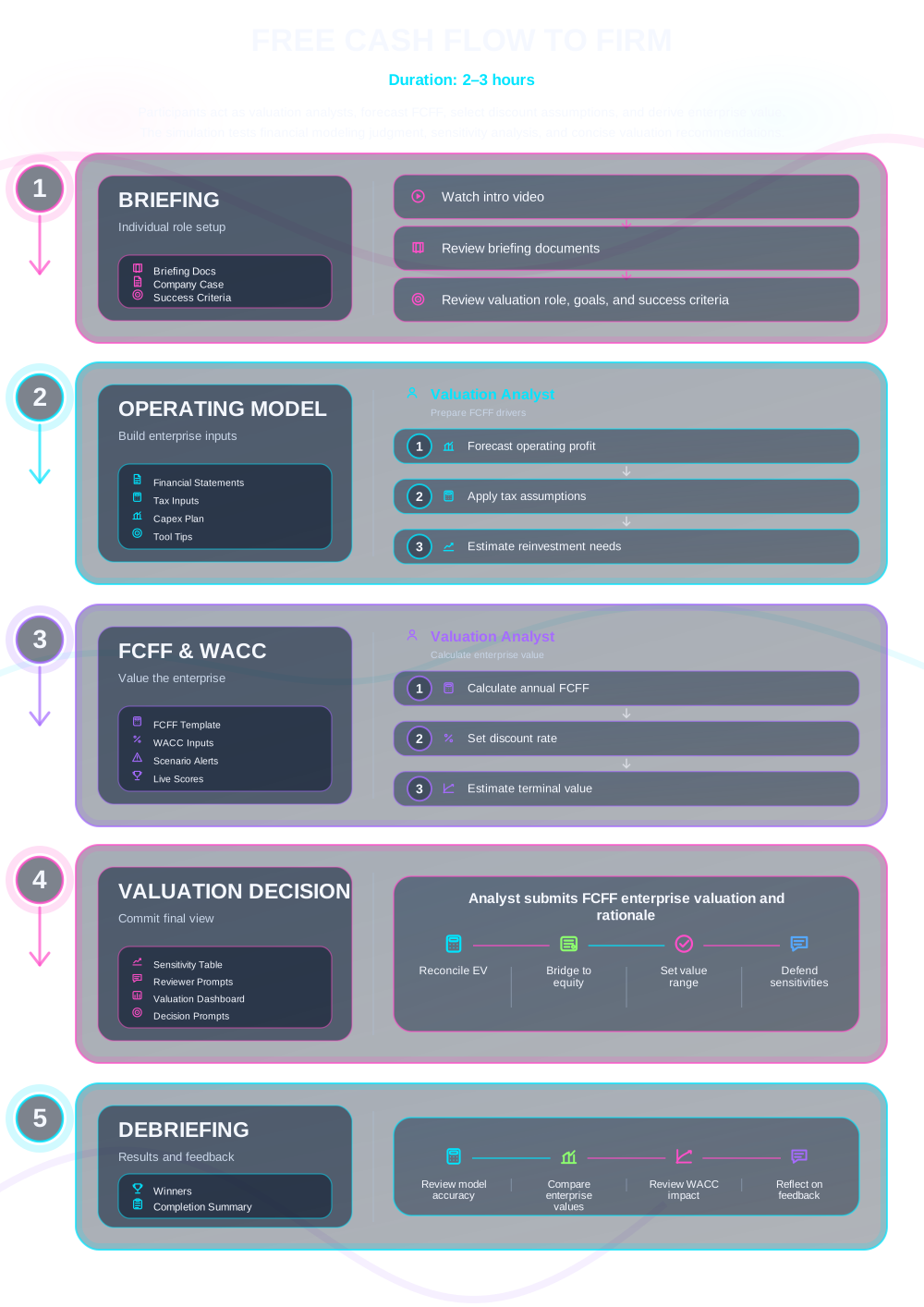

What Participants Do
In the simulation, participants will:
- Extract and analyze data from provided financial statements.
- Perform the detailed calculation to derive FCFF for a target company.
- Make informed judgments on necessary adjustments and normalizations.
- Build assumptions to forecast future FCFF over a multi-year period.
- Utilize their FCFF forecast as the basis for a DCF valuation model.
- Test the sensitivity of their valuation to changes in key drivers like WACC and growth rates.
- Present or defend their valuation assumptions and conclusions.
- Reflect on the quality and sustainability of the company's cash flows.

Learning Objectives
By the end of the simulation, participants will be able to:
- Explain the significance of FCFF as a measure of corporate financial performance.
- Correctly calculate FCFF from income statement and balance sheet data.
- Identify and justify standard adjustments made during the FCFF calculation process.
- Construct a basic DCF valuation model using projected FCFF.
- Evaluate how operational decisions (CAPEX, working capital management) impact firm value.
- Conduct sensitivity analysis to understand valuation risks and drivers.
- Communicate a valuation thesis grounded in cash flow analysis.
- Apply FCFF concepts to real-world investment and analysis scenarios.
How the Free Cash Flow to Firm Simulation Works
This simulation can be run individually or in teams in academic or corporate contexts. Each cycle represents a stage of getting through a pressing financial situation.
1. Receive Company Materials Participants are provided with the complete financials and business background of a case company.
** 2. Analyze Historical Performance** They dissect past financial statements to understand the company's cash flow history and trends.
3. Calculate Baseline FCFF Participants perform the full FCFF calculation for a base year, ensuring all adjustments are correctly applied.
4. Make Forecast Assumptions Teams develop coherent assumptions for revenue growth, margins, and investment needs to project future FCFF.
5. Build and Test the DCF Model They input their projections into a valuation framework, calculating a present value. They then run sensitivity analyses on key inputs.
6. Review and Reflect Feedback from the platform highlights calculation accuracy, assumption rationale, and the financial impact of decisions. Performance is compared across the cohort.
Frequently Asked Questions
Assessment
Assessment of participant performance can be tailored according to the host institution’s objectives (business school, corporate training, assessment centre). Typical assessment criteria include:
- Correct application of the FCFF formula and DCF mechanics.
- The logic and justification behind forecasting assumptions.
- Depth of analysis on cash flow drivers and valuation sensitivity.
- Clarity in presenting or documenting the valuation case.
- The simulation platform provides detailed performance data and rankings, facilitating easy grading. Instructors can also incorporate peer reviews of valuation pitches or written reports for a comprehensive assessment.