It is ideal for undergraduate finance students, MBA candidates, and professionals in roles like equity research, investment banking, corporate development, or financial planning & analysis who need to master intrinsic valuation.

Free Cash Flow to Equity Simulation
Experience the core of equity valuation by stepping into the shoes of a financial analyst to master Free Cash Flow to Equity calculations and build intrinsic valuation models in a competitive, hands-on environment.

Free Cash Flow to Equity Simulation Overview
The Free Cash Flow to Equity Simulation is a practical training tool designed to transform the complex principles of equity valuation into an engaging, competitive experience. Crafted by seasoned corporate finance professionals, this simulation immerses participants in the authentic process of analyzing financial statements, forecasting future performance, and determining a company's true equity value.
Participants assume the role of analysts tasked with valuing a target company. They must navigate through real-world financial data, separating operating from financing activities, making critical assumptions about growth, and applying the FCFE valuation model to arrive at a justified share price.
The simulation replicates the pressure and rigor of professional valuation work, requiring participants to defend their assumptions and compete against peers to produce the most accurate and well-reasoned valuation. This multiplayer format emphasizes not just technical skill, but also critical thinking, judgment, and the ability to communicate financial rationale under time constraints.

Free Cash Flow to Equity Simulation Concepts
Participants work through realistic scenarios, which can be customized to emphasize or exclude specific topics depending on the learning goals. This modular structure allows the simulation to be tailored to any type of session. Key concepts include:
- The mechanics and logic of the Free Cash Flow to Equity calculation
- Analysis and adjustment of financial statements
- Distinguishing between operating and financing cash flows
- Forecasting future revenue, expenses, capital expenditures, and changes in net working capital
- Understanding the link between growth, reinvestment, and Return on Equity
- Estimating the cost of equity using models like CAPM
- Building a multi-stage valuation model
- Sensitivity analysis and assessing the impact of different assumptions on final value
- Comparing intrinsic valuation to market-based valuation multiples

Gameflow
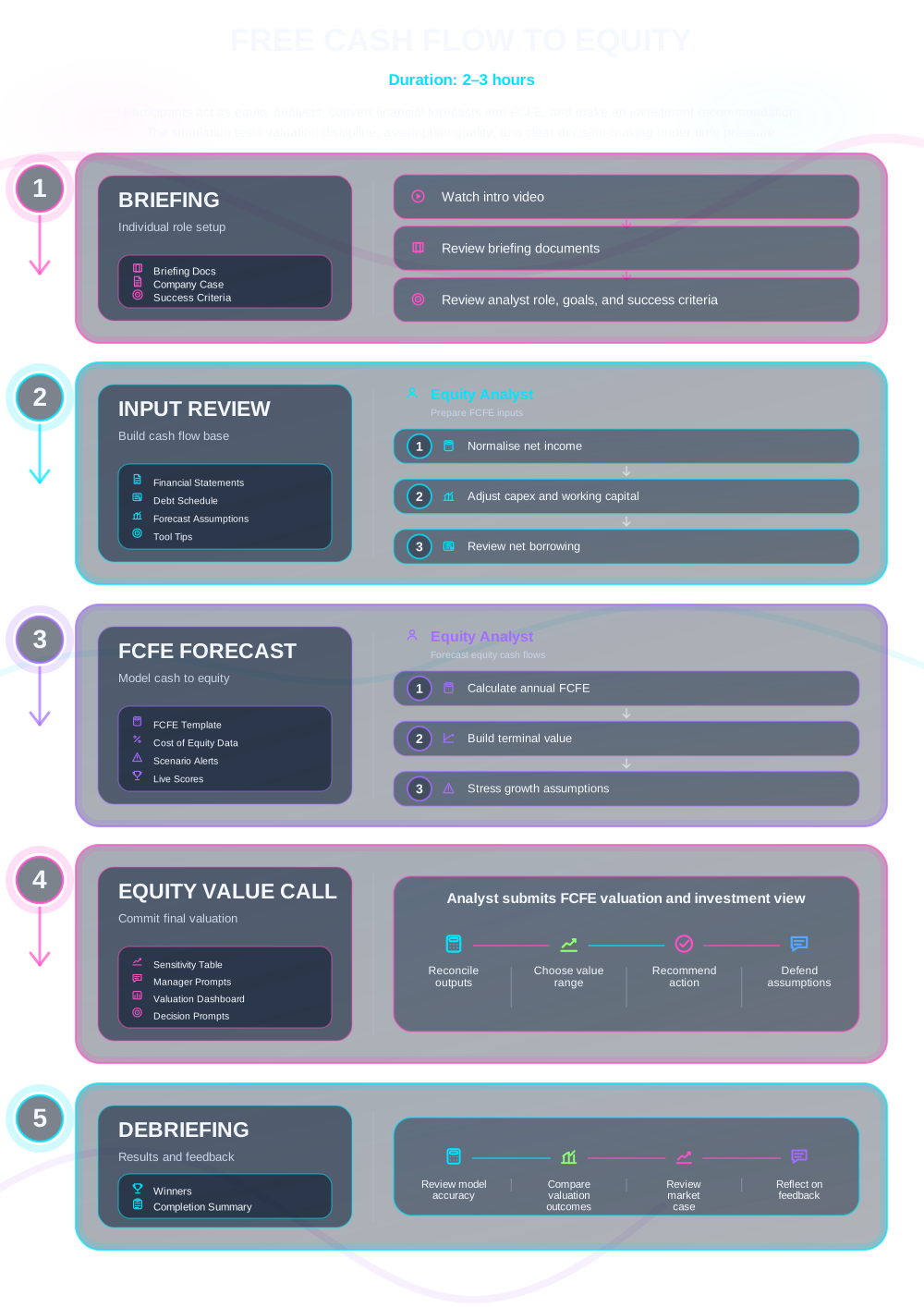

What Participants Do
In the simulation, participants will:
- Analyze provided historical financial statements of a target company.
- Calculate historical FCFE and identify key drivers and trends.
- Make informed forecasts for future financial performance based on a market brief.
- Build a detailed, multi-year FCFE projection model.
- Determine an appropriate cost of equity and terminal value.
- Calculate the intrinsic value per share and justify their key assumptions.
- Collaborate, debate assumptions, and prepare a summary of their valuation case.
- Compare their valuation outcome with peers and market prices, reflecting on discrepancies.

Learning Objectives
By the end of the simulation, participants will be able to:
- Confidently compute Free Cash Flow to Equity from financial statements.
- Construct a robust, assumption-driven FCFE forecast model.
- Apply the principles of time value of money to discount projected FCFE.
- Estimate the cost of equity and defensible terminal growth rates.
- Synthesize forecasts into a final intrinsic equity valuation.
- Critically evaluate how changes in growth, margins, and risk assumptions impact valuation.
- Articulate and defend the key drivers behind their valuation in a clear, professional manner.
- Understand the practical application and limitations of the FCFE valuation model in real-world analysis.
How the Free Cash Flow to Equity Simulation Works
This simulation can be run individually or in teams in academic or corporate contexts. Each cycle represents a stage of getting through a pressing financial situation.
1. Introduction and Briefing Participants receive a company profile, historical financials, and an industry/market overview. Introductory videos explain core FCFE concepts.
** 2. Historical Analysis Phase** Using the simulation's interface, participants calculate past FCFE to understand the company's cash flow generation history.
3. Forecasting and Modeling Phase Participants input their future assumptions for key line items. The simulation's built-in model instantly projects the full financial statements and resulting FCFE.
4. Valuation and Decision Phase Participants enter their cost of equity and terminal value parameters. The simulation calculates the present value and value per share.
5. Feedback and Competition A leaderboard ranks participants or teams based on the realism and defensibility of their valuation compared to a facilitator-defined benchmark or peer average.
6. Debrief Instructors can review aggregated results, highlight common errors, and lead a discussion on valuation judgment and the importance of assumptions.
Frequently Asked Questions
Assessment
Assessment of participant performance can be tailored according to the host institution’s objectives (business school, corporate training, assessment centre). Typical assessment criteria include:
- Correct calculation of historical and projected FCFE components.
- Reasonableness and justification of growth, margin, and cost of capital estimates.
- The defensibility and robustness of the final intrinsic value.
- Understanding of how the valuation changes with key drivers.
- Clarity and persuasiveness in presenting or memo-writing about the valuation case.