Absolutely. The simulation is designed with a learning curve in mind. It includes tutorial materials and is guided by an instructor, making it accessible for undergraduate, MBA, and executive education students new to fixed income.

Fixed Income Analyst Simulation
The Fixed Income Analyst Simulation brings participants into the world of bonds and debt markets. Move beyond textbook theories and learn to navigate the complex interplay of interest rates, credit risk, and macroeconomic events in real-time.

Fixed Income Analyst Simulation Overview
In today's volatile economic climate, the ability to analyze and manage fixed income securities is a critical skill for any finance professional. This simulation provides a dynamic, hands-on environment where participants act as fixed income analysts and portfolio managers for a fictional asset management firm.
You will be responsible for building and managing a portfolio of government and corporate bonds. You will analyze company financials and macroeconomic data to assess credit risk, make buy/sell decisions based on your interest rate outlook, and manage portfolio duration and convexity to optimize returns while mitigating risk. The simulation reacts to inside economic cycles, central bank announcements, and corporate events, mirroring the unpredictable nature of real-world debt markets.
Although ideal for undergraduate and graduate finance courses, executive training, and corporate finance skill workshops, the simulation is modular and scalable, allowing instructors to vary complexity.

Fixed Income Analyst Simulation Concepts
Participants work through realistic scenarios, which can be customized to emphasize or exclude specific topics depending on the learning goals. This modular structure allows the simulation to be tailored to any type of session. Key concepts include:
- Bond Valuation and Pricing
- Yield Curve Analysis
- Interest Rate Risk
- Credit Analysis
- Macroeconomic Factors
- Portfolio Management
- Structured Products

Gameflow
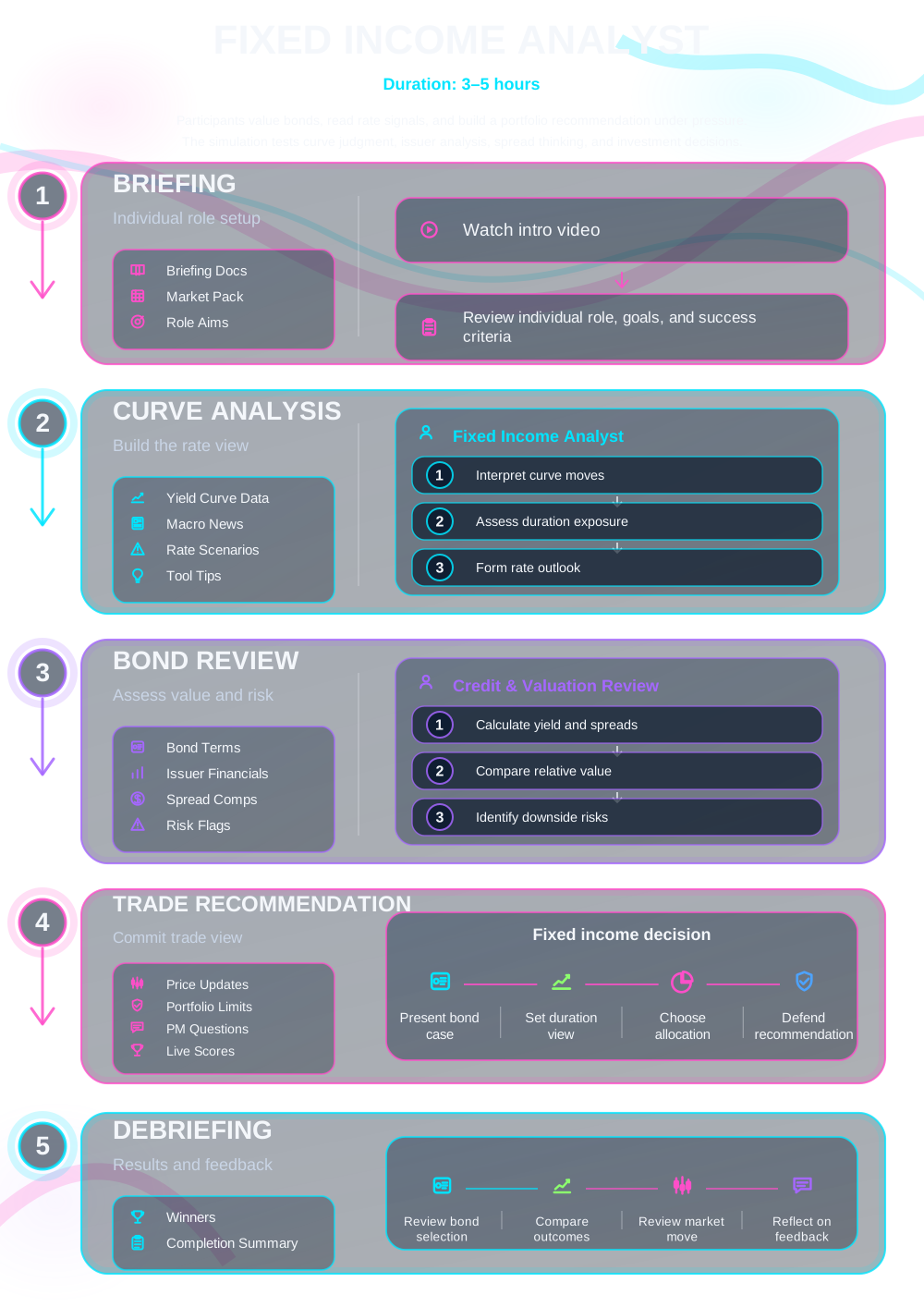

What Participants Do
In the simulation, participants will:
- Analyze the financial health of various corporate bond issuers to determine default risk.
- Forecast the direction of interest rates and adjust portfolio strategy accordingly.
- Execute trades in government bonds, corporate bonds, and potentially structured products.
- Actively manage the duration and convexity of the portfolio to hedge against interest rate movements.
- Monitor economic news and data releases, reacting to events like Fed rate decisions or inflation surprises.
- Compete against other teams to achieve the highest risk-adjusted return for your portfolio.
- Write an investment memo justifying your portfolio strategy and key positions.

Learning Objectives
By the end of the simulation, participants will be able to:
- Value a variety of fixed income securities and calculate key risk metrics.
- Assess credit risk by performing fundamental analysis on corporate issuers.
- Formulate an interest rate outlook and translate it into an actionable portfolio strategy.
- Manage interest rate risk by strategically applying duration and convexity.
- Construct a diversified fixed income portfolio aligned with a specific investment mandate.
- Articulate and defend investment decisions in a professional context.
How the Fixed Income Analyst Simulation Works
This simulation can be run individually or in teams in academic or corporate contexts. Each cycle represents a stage of getting through a pressing financial situation.
1. Introduction and Mandate Your team is assigned a specific investment mandate.
2. Market Access You gain access to the simulation platform, which features a live trading screen, real-time portfolio analytics, and a research terminal with company financials and economic data.
3. Analysis and Decision-Making You will analyze potential investments, monitor your existing portfolio, and place trades based on your strategy.
4. Rounds The simulation progresses through several "periods," each representing a quarter. At the start of each new period, new economic data is released, and the market environment evolves.
5. Performance and Debrief Your performance is ranked based on risk-adjusted returns against other teams. A comprehensive debrief session led by the instructor connects the simulation experience to core fixed income principles.
Frequently Asked Questions
Assessment
Assessment of participant performance can be tailored according to the host institution’s objectives (business school, corporate training, assessment centre). Typical assessment criteria include:
- Portfolio Performance is ranked based on risk-adjusted returns and adherence to the assigned investment mandate.
- Team's strategy, analysis of key holdings, performance attribution, and lessons learned.
- Assessment of individual contribution within the team, based on peer reviews and facilitator observation.
- Quizzes on Core Concepts