A Financial Reporting Simulation is an interactive learning tool that replicates the process of creating and analyzing financial statements, allowing participants to practice real-world accounting in a risk-free, competitive environment.

Financial Reporting Simulation
Master the language of business. Our Financial Reporting Simulation transforms complex accounting standards into an engaging, competitive experience where participants learn by building, analyzing, and defending real financial statements.

Financial Reporting Simulation Overview
In today’s fast-paced business environment, the ability to accurately construct, interpret, and utilize financial statements is a fundamental superpower. This simulation plunges participants into the dynamic role of a corporate finance team.
Over several rounds, teams must record transactions, apply key accounting principles, and prepare core financial statements (Income Statement, Balance Sheet, Cash Flow Statement) for a simulated company facing realistic market challenges. They must then use their reports to make strategic decisions, present to a simulated "board," and respond to auditor inquiries. Unlike passive learning, this hands-on exercise bridges the gap between theoretical knowledge and practical application, highlighting the direct impact of accounting choices on business perception and valuation.
Although ideal for undergraduate and graduate finance courses, executive training, and corporate finance skill workshops, the simulation is modular and scalable, allowing instructors to vary complexity.

Financial Reporting Simulation Concepts
Participants work through realistic scenarios, which can be customized to emphasize or exclude specific topics depending on the learning goals. This modular structure allows the simulation to be tailored to any type of session. Key concepts include:
- The Accounting Equation and Double-Entry Bookkeeping
- Accrual vs. Cash Accounting
- Revenue Recognition and Matching Principles
- Depreciation and Amortization Methods
- Inventory Valuation
- Liability and Equity Accounting
- Preparation of the Three Core Financial Statements
- Inter-statement Linkages and Articulation
- Financial Ratio Analysis and Interpretation
- Internal Controls and Audit Preparedness

Gameflow
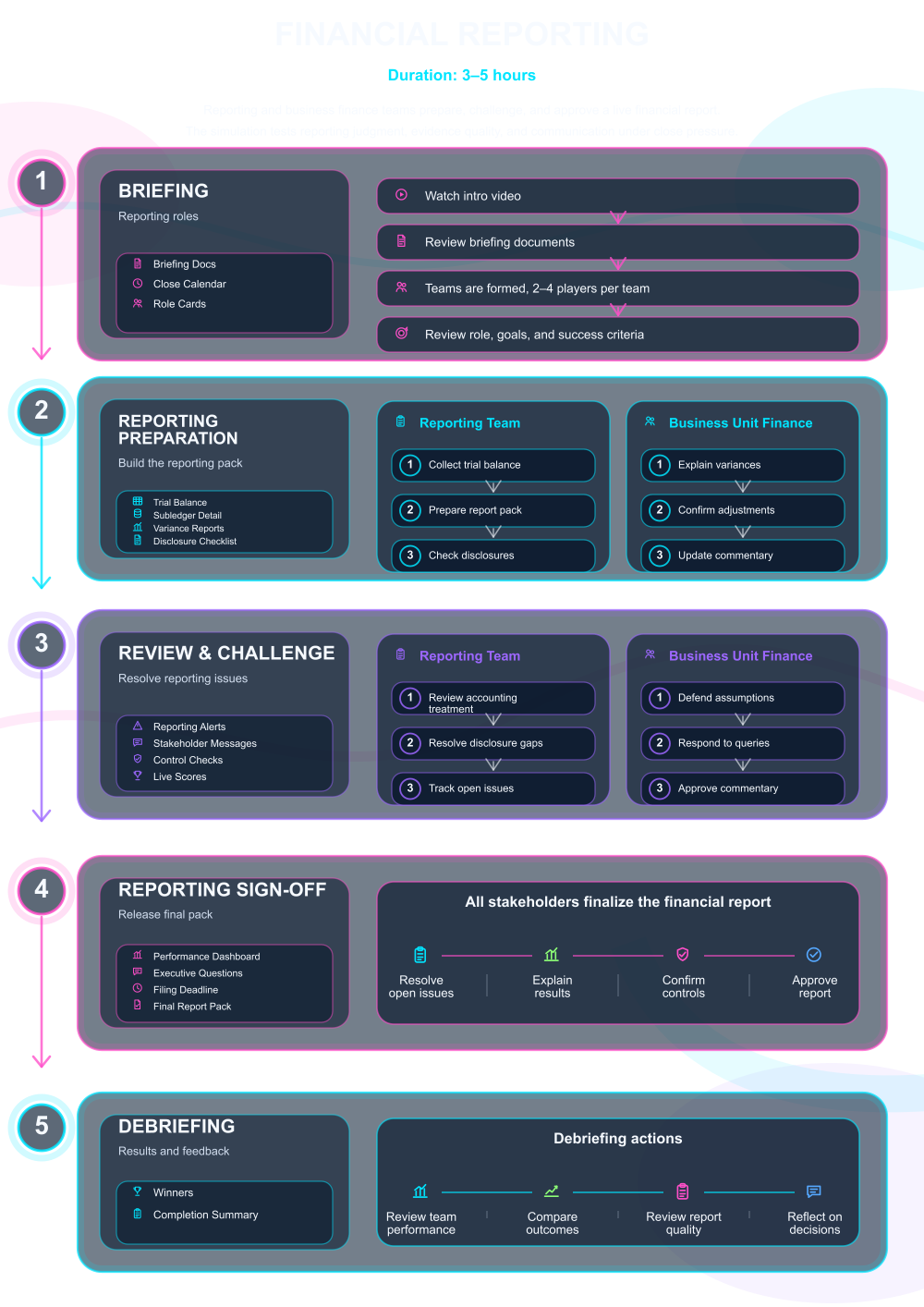

What Participants Do
In the simulation, participants will:
- Record complex business transactions using a general ledger.
- Apply appropriate accounting standards to various scenarios.
- Prepare accurate, GAAP-compliant Income Statements, Balance Sheets, and Statements of Cash Flows.
- Analyze financial results to calculate key performance and health ratios.
- Present financial results and justify accounting decisions to “stakeholders».
- Reconcile discrepancies and answer auditor-style challenge questions.
- Use financial reports to recommend strategic business actions.

Learning Objectives
By the end of the simulation, participants will be able to:
- Develop fluency in the mechanics and rationale behind financial reporting.
- Understand how operational decisions translate into financial outcomes.
- Build the ability to critically analyze financial statements to assess company performance.
- Strengthen the skills needed to present financial information clearly and defend accounting choices.
- Foster teamwork and collaboration under the pressure of reporting deadlines.
- Appreciate the importance of ethics and internal controls in financial integrity.
How the Financial Reporting Simulation Works
This simulation can be run individually or in teams in academic or corporate contexts. Each cycle represents a stage of getting through a pressing financial situation.
1. Team Formation and Introduction Participants are divided into finance teams for a virtual company. They receive the company’s opening trial balance and background.
** 2. Transaction Rounds** Each simulation round represents a reporting period (a quarter). Teams receive a packet of new business events (sales, purchases, investments, financing) they must accurately record.
3. Statement Preparation Using their updated ledgers, teams prepare the three core financial statements and key ratios.
4. Analysis and Decision-Making Teams analyze their reports to answer strategic questions about company performance and future direction.
5. Presentation and Audit Defense Teams submit their reports and present key findings. They may face challenges from instructors or other teams acting as auditors or board members, requiring them to justify their accounting treatments.
Frequently Asked Questions
Assessment
Assessment of participant performance can be tailored according to the host institution’s objectives (business school, corporate training, assessment centre). Typical assessment criteria include:
- Technical correctness of journal entries and statements
- Quality of ratio calculation and interpretation
- Effectiveness of business recommendations based on financials
- Clarity and justification of accounting choices