It is ideal for university finance and economics programs, MBA students, executive education cohorts, corporate training for finance professionals, and any organization seeking deep insight into risk management and economic cycles.

Financial History Simulation
Our Financial History Simulation immerses participants in the pivotal crises and breakthroughs that shaped the modern world, from the South Sea Bubble to the 2008 Global Financial Crisis.

Financial History Simulation Overview
This innovative simulation transports participants across centuries of financial evolution. Unlike static case studies, it creates a dynamic, time-pressured environment where teams manage institutions, set policies, and react to unfolding economic shocks based on real historical data and narratives.
Participants will confront the same incomplete information, herd mentality, and systemic fragilities that defined eras like the Great Depression or the Latin American Debt Crisis. By blending historical context with competitive financial decision-making, the simulation creates a profound, visceral understanding of how markets, psychology, and regulation interact. It’s not just about learning history; it’s about living it and understanding the timeless patterns of financial behavior.
Although ideal for undergraduate and graduate finance courses, executive training, and corporate finance skill workshops, the simulation is modular and scalable, allowing instructors to vary complexity.

Financial History Simulation Concepts
Participants work through realistic scenarios, which can be customized to emphasize or exclude specific topics depending on the learning goals. This modular structure allows the simulation to be tailored to any type of session. Key concepts include:
- Market Manias and Crashes
- Monetary Policy and Central Banking
- Financial Innovation and Systemic Risk
- Regulatory Response and Arbitrage
- Sovereign Debt and Currency Crises
- Liquidity vs. Solvency Crises
- Moral Hazard
- Historical Parallels

Gameflow
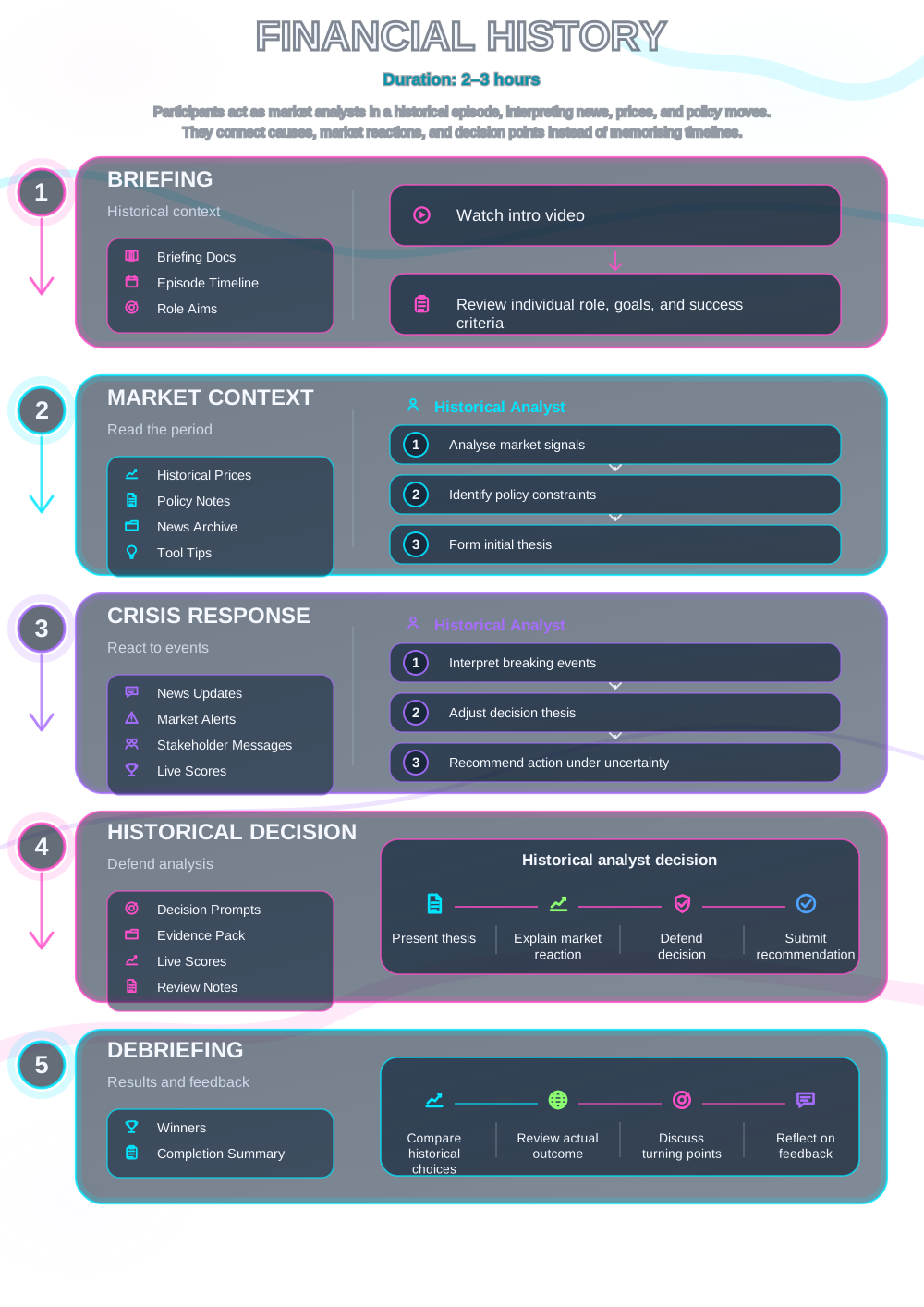

What Participants Do
In the simulation, participants will:
- Assume roles such as Central Bank Governor, Investment Bank CEO, Regulatory Head, or Sovereign Debt Manager.
- Set interest rates, approve mergers, issue new securities, design bailout packages, or impose capital controls.
- Interpret period-accurate financial statements, economic indicators, and news flashes.
- Form alliances with other teams, negotiate bailout terms, or lobby for regulatory changes.
- Balance short-term survival with long-term stability for your institution.
- Justify your team’s decisions to a mock historical "oversight committee".

Learning Objectives
By the end of the simulation, participants will be able to:
- Identify the root causes and transmission mechanisms of major historical financial crises.
- Evaluate the trade-offs and unintended consequences of different policy and regulatory responses.
- Articulate how financial innovation can simultaneously drive growth and amplify systemic risk.
- Analyze the psychological and behavioral factors (greed, fear, herd behavior) that drive market cycles.
- Develop frameworks for crisis management and decision-making under extreme uncertainty.
- Draw informed parallels between historical financial events and modern market conditions.
How the Financial History Simulation Works
This simulation can be run individually or in teams in academic or corporate contexts. Each cycle represents a stage of getting through a pressing financial situation.
1. Era Selection and Briefing Teams are assigned a specific historical era and receive background on their roles, objectives, and starting financial positions.
2. Decision Rounds The simulation progresses through chronological "rounds," each representing a key phase or year. Each round, teams analyze new economic data and news, then submit strategic decisions via the simulation platform.
3. Market Resolution The facilitator inputs all team decisions into the simulation engine, which calculates outcomes based on historical economic models and inter-team dynamics. Results are broadcast to all.
4. Crisis Injects Unscripted "crisis events" (like a major default or bank run) are triggered, forcing teams to react in real-time.
** 5. Debrief and Historical Comparison** The facilitator-led debrief is crucial. Teams’ results are compared to the actual historical outcome, sparking discussion on why decisions led to different or similar results.
Frequently Asked Questions
Assessment
Assessment of participant performance can be tailored according to the host institution’s objectives (business school, corporate training, assessment centre). Typical assessment criteria include:
- Financial stability, profitability, and risk management outcomes relative to their historical objectives.
- Quality of the Final Debrief Presentation
- Ability to adapt and revise valuations in light of news shocks or changes
- Collaboration, division of work, integration of roles, and final coherence
- Rating by peers and self-reflection on approach and decisions