The simulation is designed to be completed in approximately 3-4 hours, depending on your prior experience.

Financial Data Cleaning and Modelling Simulation
In the real world of finance, pristine data sets are a myth. Most of analysts and associates’ time is spent on cleaning and structuring the data into a reliable foundation for analysis. A single modelling error can lead to million-dollar mistakes.

Financial Data Cleaning and Modelling Simulation Overview
The Financial Data Cleaning & Modelling Simulation is a hands-on learning experience that thrusts participants into the heart of this challenge. They are tasked with sourcing their own data from ambiguous financial statements, cleaning inconsistent entries, and reconciling mismatched figures. All while constructing a dynamic, three-statement financial model from scratch.
During the simulation “news events” (sector shocks, regulatory changes, competitive earnings surprises) are introduced at key moments that help participants isolate bits of data and recognise their importance.
Although ideal for undergraduate and graduate finance courses, executive training, and corporate finance skill workshops, the simulation is modular and scalable, allowing instructors to vary complexity.

Financial Data Cleaning and Modelling Simulation Concepts
Participants work through realistic scenarios, which can be customized to emphasize or exclude specific topics depending on the learning goals. This modular structure allows the simulation to be tailored to any type of session. Key concepts include:
- Data Sourcing and Reliability
- Data Integrity Validation
- Data Cleaning Techniques
- Financial ReconciliationThree-Statement Modelling
- Assumption-Driven Forecasting
- Error-Checking and Auditing
- Data Visualization

Gameflow
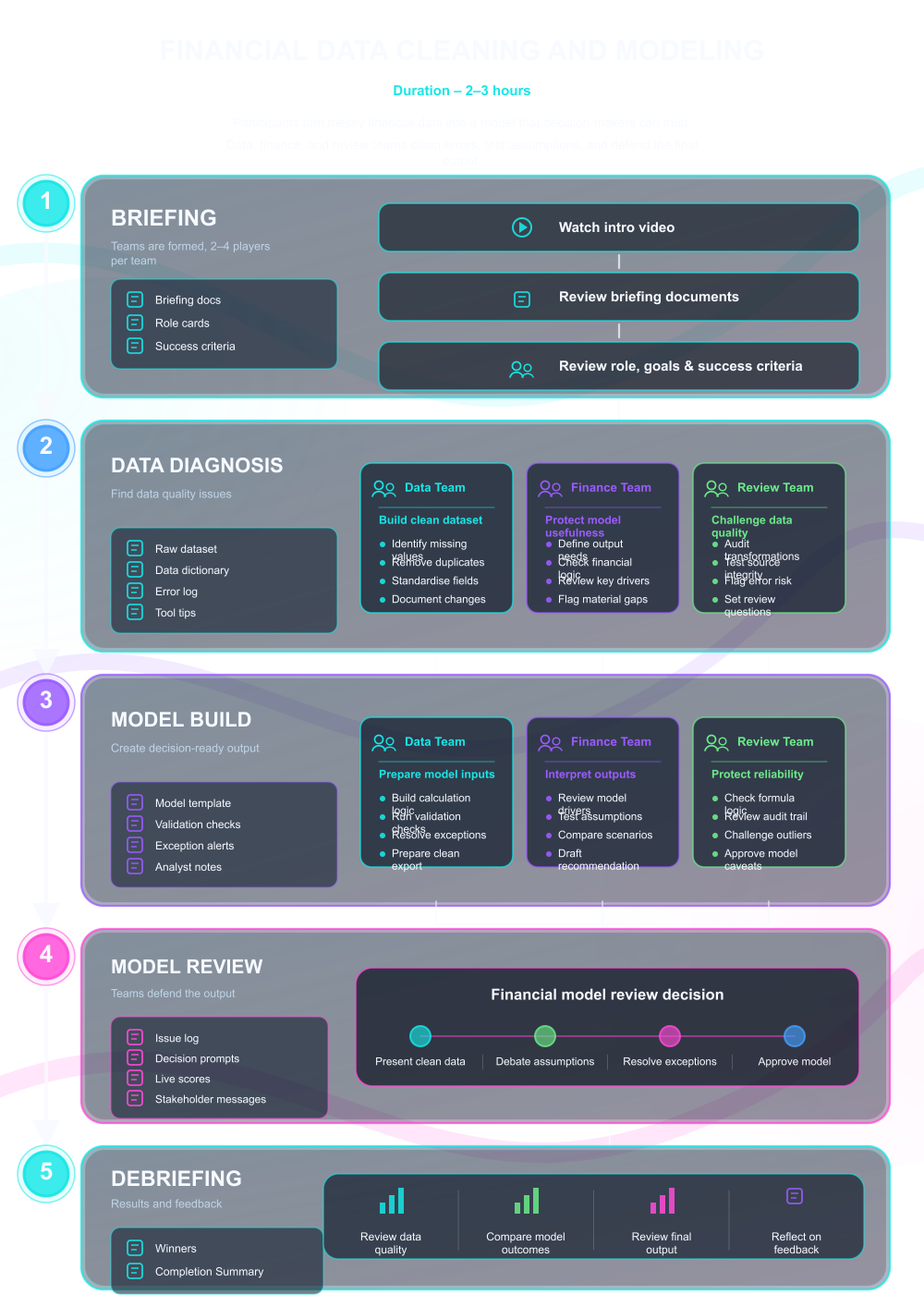

What Participants Do
In the simulation, participants will:
- Source Raw Data by extracting financial data from a "messy" annual report PDF.
- Identify and correct inconsistencies, format dates, standardize categories, and fill data gaps.
- Manually ensure the integrity of the Income Statement, Balance Sheet, and the links between them.
- Construct a fully integrated three-statement model from your cleaned data.
- Create forward-looking projections based on clearly defined and justified operational and financial assumptions.
- Test the sensitivity of your model to changes in key drivers (growth rates, margins).
- Create a Final Dashboard by summarizing key findings, financial ratios, and valuation outputs in a management-ready format.

Learning Objectives
By the end of the simulation, participants will be able to:
- Apply a systematic framework for cleaning and validating raw financial data.
- Construct a robust, integrated three-statement financial model from unstructured data.
- Identify and resolve common data integrity issues that plague financial analysis.
- Develop logical and defensible forecasting assumptions to drive a financial model.
- Enhance the accuracy, transparency, and reliability of your financial analyses.
- Boost your efficiency and confidence when handling complex data tasks in Excel.
How the Financial Data Cleaning and Modelling Simulation Works
This simulation can be run individually or in teams in academic or corporate contexts.
1. Assess the Data Participants will log in to our simulation platform and receive a company case study and a set of "messy" data files.
2. Source and Clean Using provided tools and guides, participants will clean the raw data, resolving inconsistencies and preparing it for modelling
3. Construction the Model Participants will follow a structured, step-by-step process to build the three-statement model with automated error-checking hints.
4. Forecast and Analyze Participants will input their financial and operational assumptions to project the company's future performance and run scenario analyses.
5. Submit the Report Participants will finalize their models and generate a summary dashboard of your key findings and valuation output.
Frequently Asked Questions
Assessment
Assessment of participant performance can be tailored according to the host institution’s objectives (business school, corporate training, assessment centre). Typical assessment criteria include:
- Accuracy of cleaned and reconciled raw data.
- The technical correctness of participant’s three-statement model and its formulas.
- The defensibility of participant’s forecasting assumptions and scenario analysis.
- The organization, clarity, and auditability of participant’s final model
- Collaboration, division of work, integration of roles, and final coherence
- Rating by peers and self-reflection on approach and decisions
Assessment may incorporate peer and self-review components, facilitator scoring, and debrief discussion. Results may feed into grades, executive feedback, certification or development plans.