It is ideal for undergraduate and graduate finance programs, business schools, certification courses, and corporate training for banks and wealth management firms.

Finacial Planing Simulation
The Financial Planning Simulation is an immersive, experiential learning tool designed for finance students, aspiring financial planners, and professionals.

Finacial Planing Simulation Overview
In this hands-on simulation, participants are tasked with developing and executing comprehensive financial plans for diverse virtual clients. Each client presents unique goals, risk profiles, and life circumstances—from saving for education and retirement to managing debt, insurance, and investment portfolios.
Participants step into the role of a certified financial planner, managing client portfolios, navigating real-world economic shifts, and making critical decisions to secure their clients' financial futures. Through realistic scenarios and dynamic market conditions, the simulation builds essential skills in client advisory, risk assessment, and holistic wealth management.
Participants must analyze financial statements, assess risk tolerance, allocate assets, and adjust strategies in response to simulated market events, regulatory changes, and personal client milestones. The simulation emphasizes the integration of multiple financial disciplines, ethical decision-making, and client communication, providing a risk-free environment to practice the art and science of financial planning.

Finacial Planing Simulation Concepts
Participants work through realistic scenarios, which can be customized to emphasize or exclude specific topics depending on the learning goals. This modular structure allows the simulation to be tailored to any type of session. Key concepts include:
- Client Profiling and Goal Setting
- Cash Flow and Budget Analysis
- Investment Planning and Asset Allocation
- Risk Management and Insurance
- Retirement Planning
- Tax-Efficient Planning
- Estate Planning Fundamentals
- Behavioral Finance

Gameflow
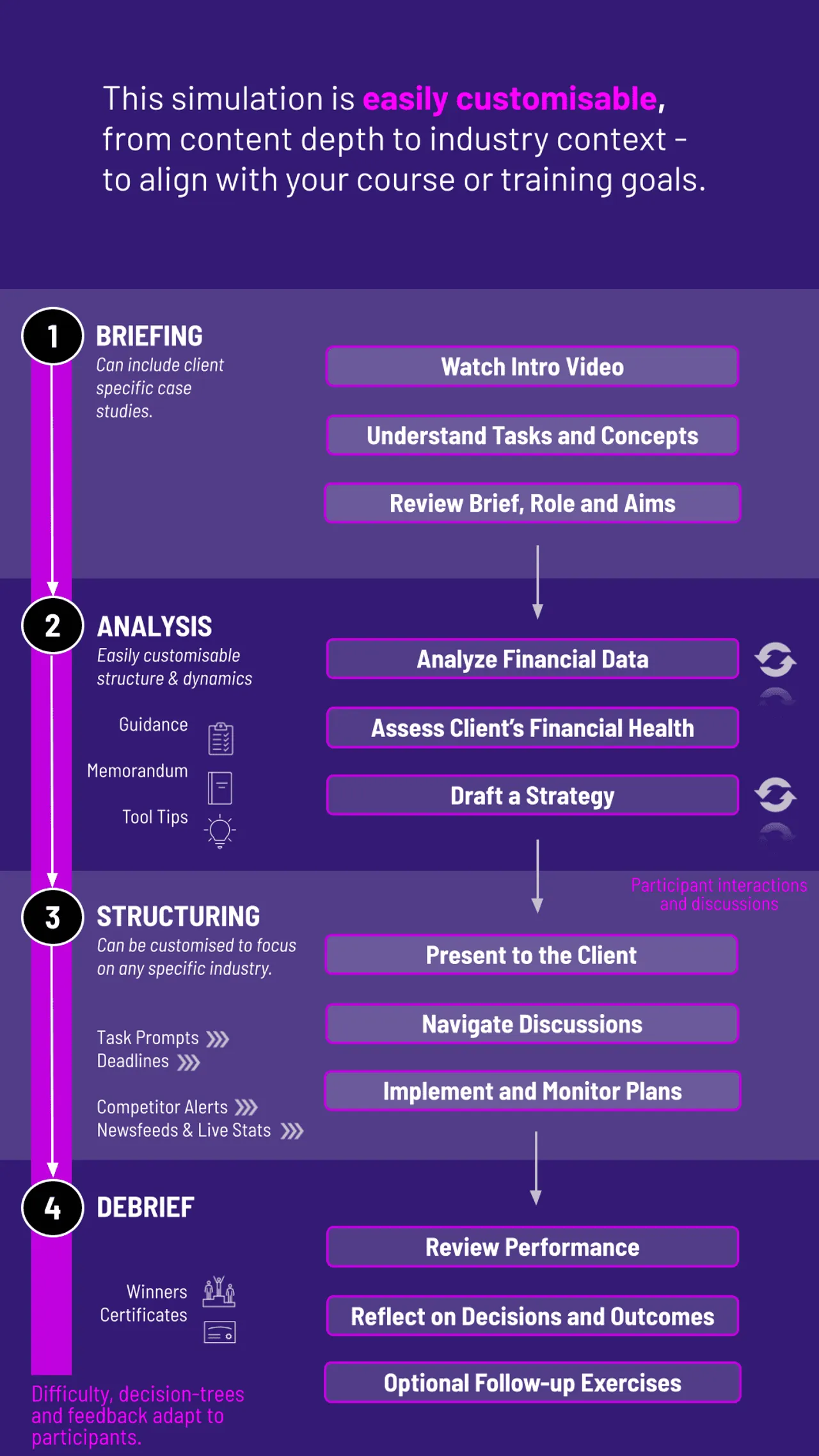

What Participants Do
In the simulation, participants will:
- Conduct initial client consultations to gather data and define goals.
- Analyze complete financial pictures, including balance sheets and cash flow statements.
- Develop tailored financial plans with specific recommendations.
- Implement investment strategies by selecting from various asset classes.
- Monitor plans and rebalance portfolios in response to simulated economic updates.
- Present plan rationale and adjustments to "clients" (instructors or peers).
- Navigate ethical dilemmas and regulatory compliance scenarios.
- Review plan performance and write client review summaries.

Learning Objectives
By the end of the simulation, participants will be able to:
- Synthesize financial planning concepts into coherent, client-focused strategies.
- Apply technical skills in budgeting, investment analysis, and retirement modeling.
- Develop client communication and advisory skills.
- Evaluate and mitigate financial risks through appropriate product and strategy selection.
- Demonstrate adaptive decision-making in response to changing market and life conditions.
- Understand the fiduciary responsibility and ethical standards of the profession.
How the Finacial Planing Simulation Works
This simulation can be run individually or in teams in academic or corporate contexts. Each cycle represents a stage of getting through a pressing financial situation.
1. Setup and Analysis Phase Participants are assigned one or more client cases with detailed profiles. Using provided dashboards and tools, participants diagnose the client's financial health.
2. Planning Phase Participants create a written plan with specific, actionable recommendations.
3. Implementation and Monitoring Participants input decisions (investment allocations, insurance purchases) into the simulation platform.
4. Scenario Rounds The simulation advances through quarterly or annual rounds, introducing market events, interest rate changes, or client life events.
5. Adjustment Participants re-evaluate and adjust the financial plan, documenting their rationale.
6. Review and Debrief Final plans and performance metrics are assessed. An instructor-led debrief connects simulation experiences to theoretical knowledge.
Frequently Asked Questions
Assessment
Assessment of participant performance can be tailored according to the host institution’s objectives (business school, corporate training, assessment centre). Typical assessment criteria include:
- Scores based on the health of the client's financial plan, progress toward goals, and efficient use of capital.
- Financial plans are evaluated for completeness, accuracy, and professionalism.
- Participants present and critique each other’s plans, fostering collaborative learning.
- Instructors lead discussions on key decision points, linking simulation outcomes to core financial planning theories.