Not necessarily. The simulation includes onboarding content to explain ETF basics, replication methods, and benchmark tracking.

Exchange Traded Funds Simulation
Students become ETF portfolio managers, designing and rebalancing index-tracking funds while responding to market shifts, investor flows, and tracking error in our Exchange Traded Funds Simulation.

Exchange Traded Funds Simulation Overview
The Exchange Traded Funds Simulation puts students in charge of managing real-time portfolios that track major indices and sector themes using ETF principles.
Designed by portfolio strategists and ETF market makers, this simulation provides a hands-on introduction to the mechanics of ETF construction, replication strategies, and portfolio rebalancing. Students experience the tension between precision tracking and cost control while responding to market events, investor behaviour, and benchmark adjustments.
Ideal for investment strategy, asset management, or financial markets courses, this simulation builds both technical knowledge and strategic awareness of one of the fastest-growing investment vehicles in the world.

Exchange Traded Funds Simulation Concepts
Students gain applied understanding of how ETFs operate and perform, including:
- ETF Structures: Physical replication, synthetic replication, and sampling
- Benchmark Tracking: Tracking error, index rebalancing, and drift
- Portfolio Construction: Weighting methods (market cap, equal weight, thematic)
- Liquidity and Market Impact: Bid-ask spreads, creation/redemption mechanisms
- Investor Behaviour: Flows, demand shifts, and pricing deviations
- Cost Management: Expense ratios, transaction costs, and slippage
- Performance Attribution: Understanding excess return and tracking precision

Gameflow
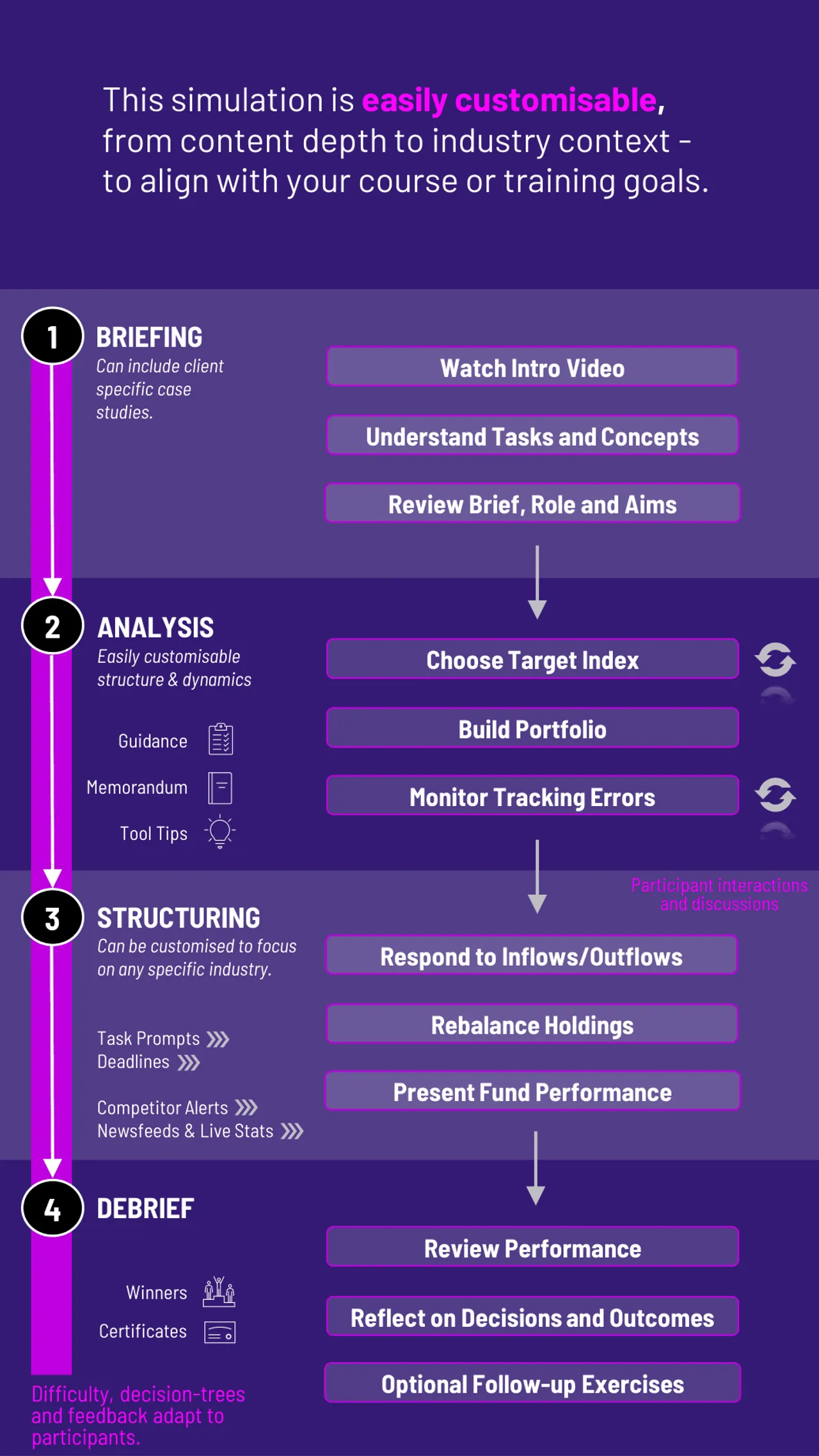

What Students Do
In this simulation, students act as ETF portfolio managers. Working solo or in teams, they will:
- Choose a target index or strategy to replicate
- Build a fund portfolio based on liquidity, costs, and exposure needs
- Monitor performance against the benchmark and manage tracking error
- Rebalance holdings in response to index changes and market shifts
- Respond to inflows/outflows and adjust positions for liquidity
- Present fund performance, tracking rationale, and lessons learned

What Students Learn
The simulation gives students direct experience managing passive investment products under real-world constraints. They will learn how to:
- Construct and rebalance ETF portfolios effectively
- Analyze the trade-offs between tracking accuracy and cost efficiency
- Interpret flows, volatility, and benchmark changes
- Recognize how market microstructure affects ETF pricing
- Communicate ETF strategy clearly to investors and internal teams
- Appreciate the strategic and operational complexity of "passive" investing

Why This Exchange Traded Funds Simulation Works
ETFs are often presented as simple products - but managing them is anything but. This simulation gives students a front-row seat to the operational, strategic, and market-facing decisions behind ETF performance.
By navigating rebalancing, investor flows, and market volatility, students learn that tracking an index is not a passive act - it’s an active process requiring judgment, timing, and risk awareness.
Perfect for finance, investment, or portfolio strategy courses, this simulation helps students master one of the most relevant investment tools of today’s markets.