It is designed for finance students (MSc, MBA, advanced undergraduates) and professionals in roles related to trading, derivatives, asset management, hedge funds, and corporate treasury who need to understand or use equity derivatives.

Equity Swaps Simulation
In this Equity Swaps Simulation, participants act as financial engineers and asset managers - structuring, pricing, and executing equity swap agreements to hedge risk, gain synthetic exposure, and achieve strategic portfolio objectives in dynamic markets.

Equity Swaps Simulation Overview
Participants step into the role of financial professionals tasked with utilizing equity swaps, a cornerstone of modern financial engineering. The simulation replicates the high-stakes environment where these over-the-counter derivatives are negotiated and managed. Over several rounds, teams or individuals engage with evolving market conditions, counterparty requirements, and regulatory frameworks.
They must analyze underlying equity performance, calculate floating interest rate payments (like LIBOR/SOFR plus a spread), and structure swap terms that align with specific strategic goals—whether for cost-efficient exposure, regulatory capital relief, or portfolio hedging. The simulation emphasizes the intricate balance between risk mitigation and return enhancement, blending quantitative analysis with strategic counterparty negotiation.
This simulation is ideal for advanced undergraduate programs, MBA courses, Master's in Finance, and corporate training for professionals in trading, asset management, and corporate treasury. It demystifies complex derivative instruments by placing participants in the driver's seat of real-world deal-making and risk management scenarios.

Equity Swaps Simulation Concepts
Participants work through realistic scenarios, which can be customized to emphasize or exclude specific topics depending on the learning goals. This modular structure allows the simulation to be tailored to any type of session. Key concepts include:
- Mechanics and structure of equity swap agreements
- Pricing and valuation of equity swaps
- Counterparty credit risk and collateral management
- Using swaps for synthetic exposure and portfolio hedging
- Regulatory considerations for derivatives
- Asset allocation and strategic asset liability management
- Interest rate risk within equity derivative structures
- ESG integration through sustainable equity linked swaps
- Performance measurement and attribution for swap-enhanced portfolios
- The role of investment banks as swap dealers and intermediaries

Gameflow
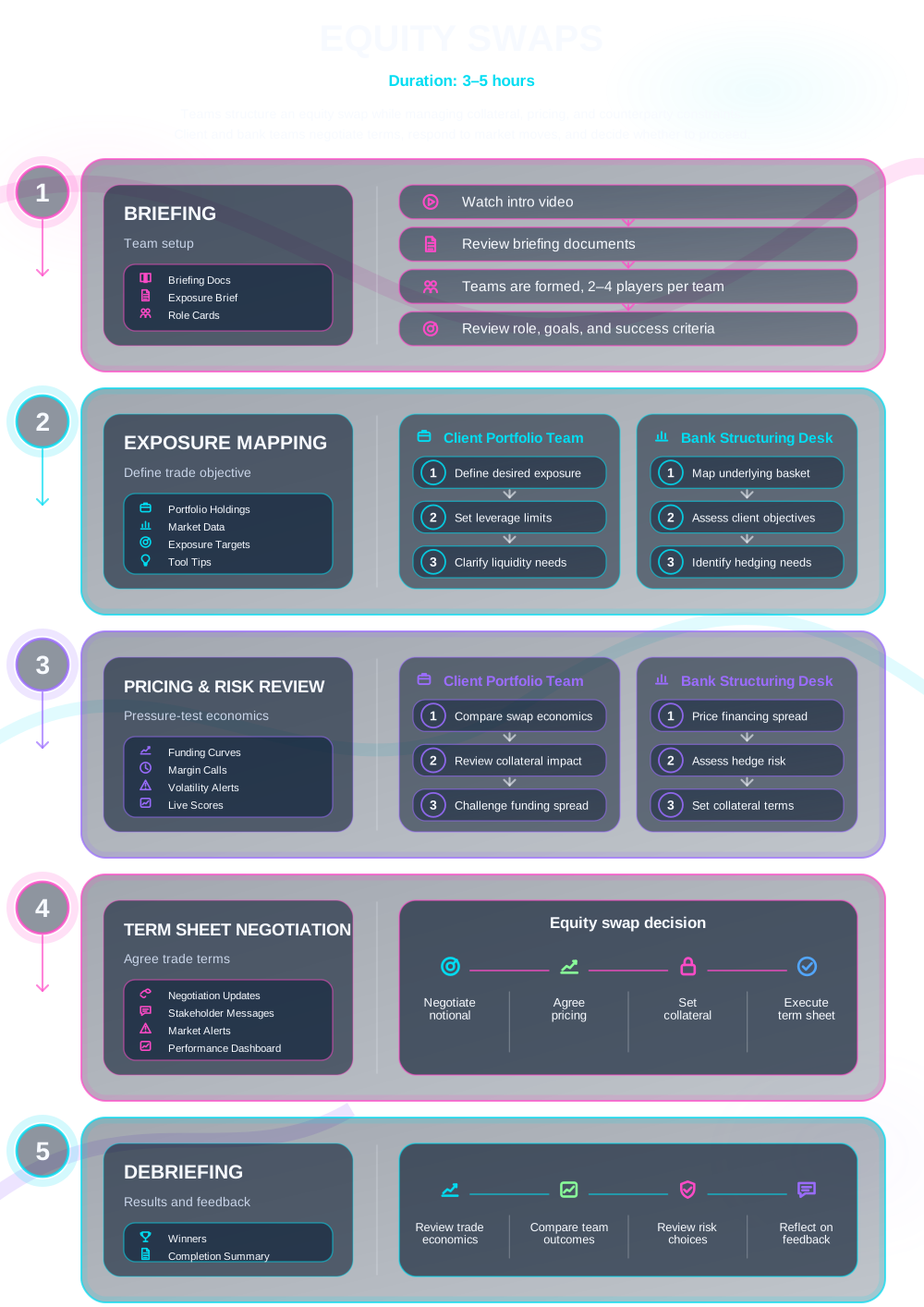

What Participants Do
In the simulation, participants will:
- Analyze client objectives to propose tailored equity swap solutions.
- Structure swap terms, including notional amount, tenor, payment frequencies, and reset dates.
- Price swaps and negotiate spreads with counterparties.
- Hedge the residual risks of their swap book.
- Manage collateral requirements and respond to margin calls.
- Adjust or unwind positions in response to market moves and corporate actions.
- Communicate the value and risk profile of swap positions to stakeholders.

Learning Objectives
By the end of the simulation, participants will be able to:
- Understand the fundamental mechanics and applications of equity swaps.
- Structure an equity swap to meet specific investment or hedging objectives.
- Apply pricing and valuation techniques for equity swap contracts.
- Assess and manage the counterparty credit risk associated with OTC derivatives.
- Navigate the key regulatory requirements impacting the derivatives market.
- Synthesize how equity swaps integrate into broader portfolio and corporate finance strategies.
- Develop negotiation skills for agreeing on terms with counterparties.
- Build confidence in using complex financial instruments to solve real-world problems.
How the Equity Swaps Simulation Works
This simulation can be run individually or in teams in academic or corporate contexts. Each cycle represents a stage of getting through a pressing financial situation.
1. Receive a Client Mandate or Market Scenario Participants are introduced as a swap dealer facing a client request or a specific market environment.
** 2. Analyze and Structure** They review the underlying equity data, interest rate curves, client credit profile, and strategic needs to model potential swap structures.
3. Price and Negotiate Participants calculate a fair-value price, determine an appropriate bid-ask spread, and negotiate terms with a counterparty (another team or the system).
4. Execute and Manage Upon execution, they must manage the live swap, monitoring its mark-to-market value, posting collateral, and considering re-hedging activities.
5. Respond to Market Shocks New rounds introduce market volatility, corporate actions (like mergers or special dividends), or changes in credit ratings, forcing participants to adapt.
6. Review and Reflect Comprehensive feedback highlights P&L, risk exposure, capital efficiency, and the strategic rationale behind decisions, allowing for iterative learning.
Frequently Asked Questions
Assessment
Assessment of participant performance can be tailored according to the host institution’s objectives (business school, corporate training, assessment centre). Typical assessment criteria include:
- The profitability and risk-adjusted returns of their managed swap portfolio.
- The accuracy and sophistication of their swap pricing and hedging models.
- The strategic rationale and suitability of swap structures for given client objectives.
- The terms achieved during counterparty negotiations.
- The clarity and persuasiveness of communication explaining swap strategies and results.