It is ideal for MBA students, finance graduates, junior analysts in investment banks, hedge funds, or asset management, and corporate treasury teams seeking practical experience in derivatives.

Equity Derivatives Simulation
The Equity Derivatives Simulation plunges participants into the role of a derivatives trading desk, where they must use options, futures, and structured products to hedge risk, speculate on market movements, and generate alpha.

Credit Equity Derivatives Simulation Overview
This hands-on simulation replicates the core challenges faced by an equity derivatives desk at a major investment bank or hedge fund. Participants are tasked with managing a book of derivatives positions amid fluctuating stock prices, changing volatility, and evolving client demands. They will encounter real-world scenarios such as market crashes, volatility spikes, dividend announcements, and corporate actions.
The simulation moves through multiple market phases, requiring teams to adjust their strategies continuously. Using a state-of-the-art platform that mirrors live trading terminals, participants will price exotic options, construct delta-neutral and volatility arbitrage strategies, manage Greek exposures, and decide when to hedge versus when to take directional risk. Success depends not just on mathematical prowess, but on risk management, strategic insight, and the ability to adapt under pressure.
Although ideal for undergraduate and graduate finance courses, executive training, and corporate finance skill workshops, the simulation is modular and scalable, allowing instructors to vary complexity.

Credit Equity Derivatives Simulation Concepts
Participants work through realistic scenarios, which can be customized to emphasize or exclude specific topics depending on the learning goals. This modular structure allows the simulation to be tailored to any type of session. Key concepts include:
- Options Pricing and The Greeks
- Volatility
- Trading Strategies
- Risk Management
- Arbitrage
- Market Making

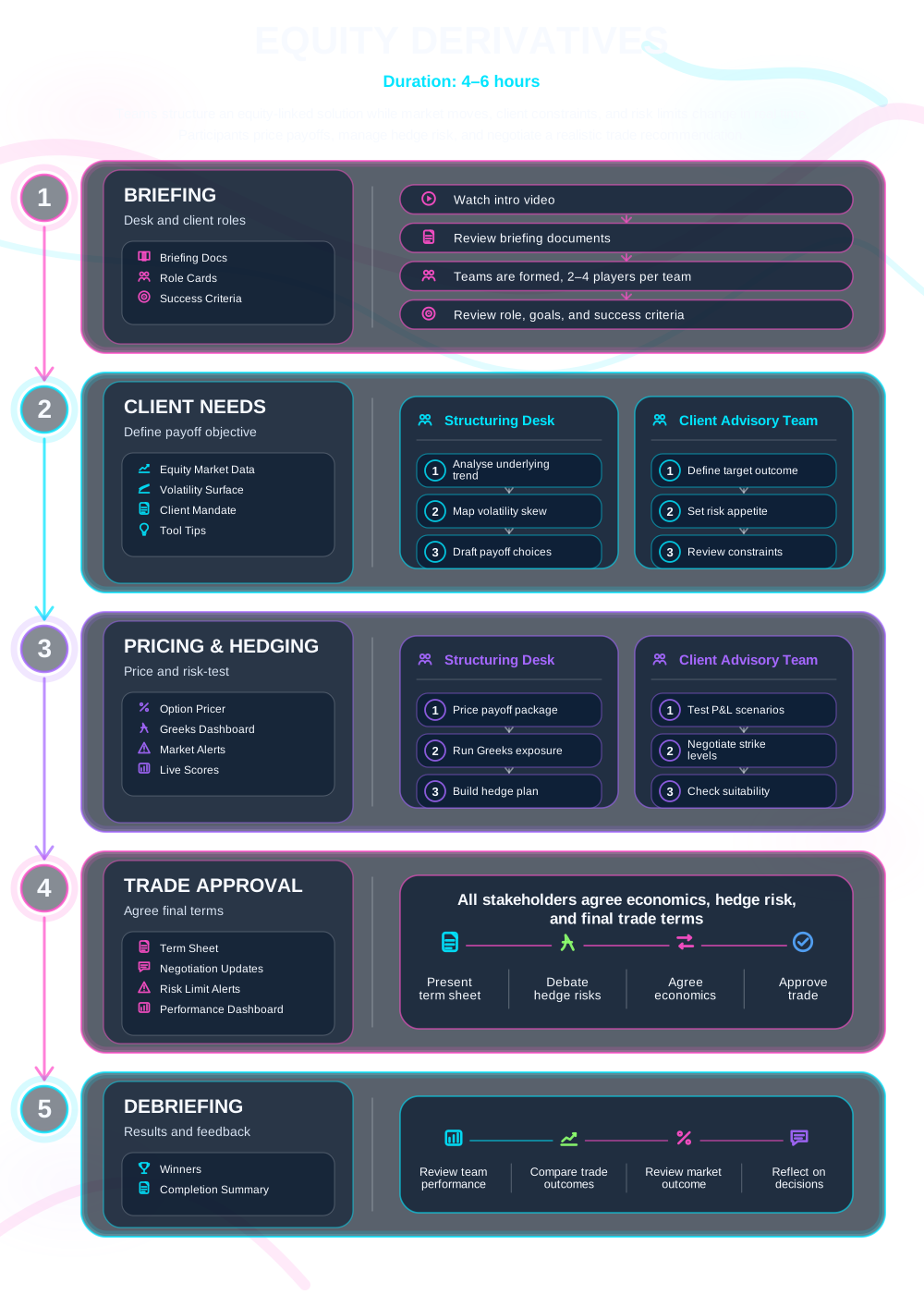
Gameflow

What Participants Do
In the simulation, participants will:
- Price vanilla and exotic options using model inputs.
- Execute trades to implement specific market views or arbitrage opportunities.
- Hedge an existing portfolio of derivatives to neutralize specific risk factors.
- Manage a live "book" through multiple market cycles, adjusting positions as conditions change.
- Analyze the P&L impact of market moves and their hedging decisions.
- Compete with other desks to achieve the highest risk-adjusted return.

Learning Objectives
By the end of the simulation, participants will be able to:
- Explain the payoff structures and applications of common equity derivatives.
- Apply option pricing models and interpret the "Greeks" for risk assessment.
- Design and execute options-based strategies to express bullish, bearish, or neutral market views.
- Construct and maintain a delta-hedged or volatility-hedged position.
- Identify sources of P&L for a derivatives portfolio.
- Make informed trading decisions by analyzing volatility surfaces and market data.
- Articulate the role and risks of a derivatives desk within a financial institution.
How the Equity Derivatives Simulation Works
This simulation can be run individually or in teams in academic or corporate contexts. Each cycle represents a stage of getting through a pressing financial situation.
1. Team Formation Participants are grouped into competing trading desks.
** 2. Initial Briefing** Teams receive capital, an initial book of positions, and market data (stock prices, volatility curves, interest rates).
3. Market Rounds The simulation progresses through several rounds, each representing a trading period.
4. New Market Data Underlying prices move, volatility updates, and news events are released.
5. Trading and Hedging Window Teams analyze their exposures, decide on new trades, and execute hedges.
6. Risk Report Teams receive an updated report showing their Greek exposures, P&L, and risk metrics.
7. Client Flow Intermittent "client" requests challenge teams to structure products or provide quotes.
8. Debrief and Scoring Final performance is evaluated based on risk-adjusted return, not just raw profitability. A comprehensive debrief links in-game decisions to core financial theory.
Frequently Asked Questions
Assessment
Assessment of participant performance can be tailored according to the host institution’s objectives (business school, corporate training, assessment centre). Typical assessment criteria include:
- Risk-Adjusted Return (Sharpe Ratio)
- Strategic Analysis
- Peer and Facilitator Evaluation
- Comprehensive Analytics Dashboard
- Skills Gap Identification