It's ideal for students and professionals pursuing careers in investment banking, corporate development, private equity, or any finance role involving M&A and capital allocation.

EPS Accretion and Dilution Simulation
In this EPS Accretion and Dilution Simulation, participants learn to build, analyze, and negotiate deals with a sharp focus on how strategic decisions impact earnings per share and ultimately, shareholder value.

EPS Accretion and Dilution Simulation Overview
This simulation plunges participants into the high-stakes world of corporate transactions where every financial decision is scrutinized for its impact on earnings. Acting as advisors, you will evaluate potential acquisitions, assess different financing mixes, and negotiate deal terms, all while forecasting and defending the transaction's effect on EPS.
Participants navigate through multiple rounds of a dynamic deal scenario, responding to market shifts, competitive bidding, and evolving company data. The simulation emphasizes the practical application of accretion/dilution modeling—a cornerstone of investment banking and corporate development. You will learn not just to calculate the numbers, but to interpret them, make strategic recommendations, and communicate complex financial outcomes to stakeholders clearly and persuasively.
Crafted by seasoned finance professionals, this simulation is ideal for university finance programs, MBA courses, and corporate training workshops, providing an unparalleled, hands-on understanding of a fundamental deal metric.

EPS Accretion and Dilution Simulation Concepts
Participants work through realistic scenarios, which can be customized to emphasize or exclude specific topics depending on the learning goals. This modular structure allows the simulation to be tailored to any type of session. Key concepts include:
- Core EPS accretion/dilution calculation and interpretation
- Deal financing structures: cash, stock, and debt
- The impact of purchase price and purchase price allocation on EPS
- Synergy analysis and modeling (cost vs. revenue synergies)
- Pro forma financial statement creation and analysis
- Weighted Average Cost of Capital and cost of financing
- The role of earnings yield in stock-for-stock transactions
- Analyzing the trade-offs between accretion, balance sheet impact, and risk
- Communicating financial implications to boards and investors

Gameflow
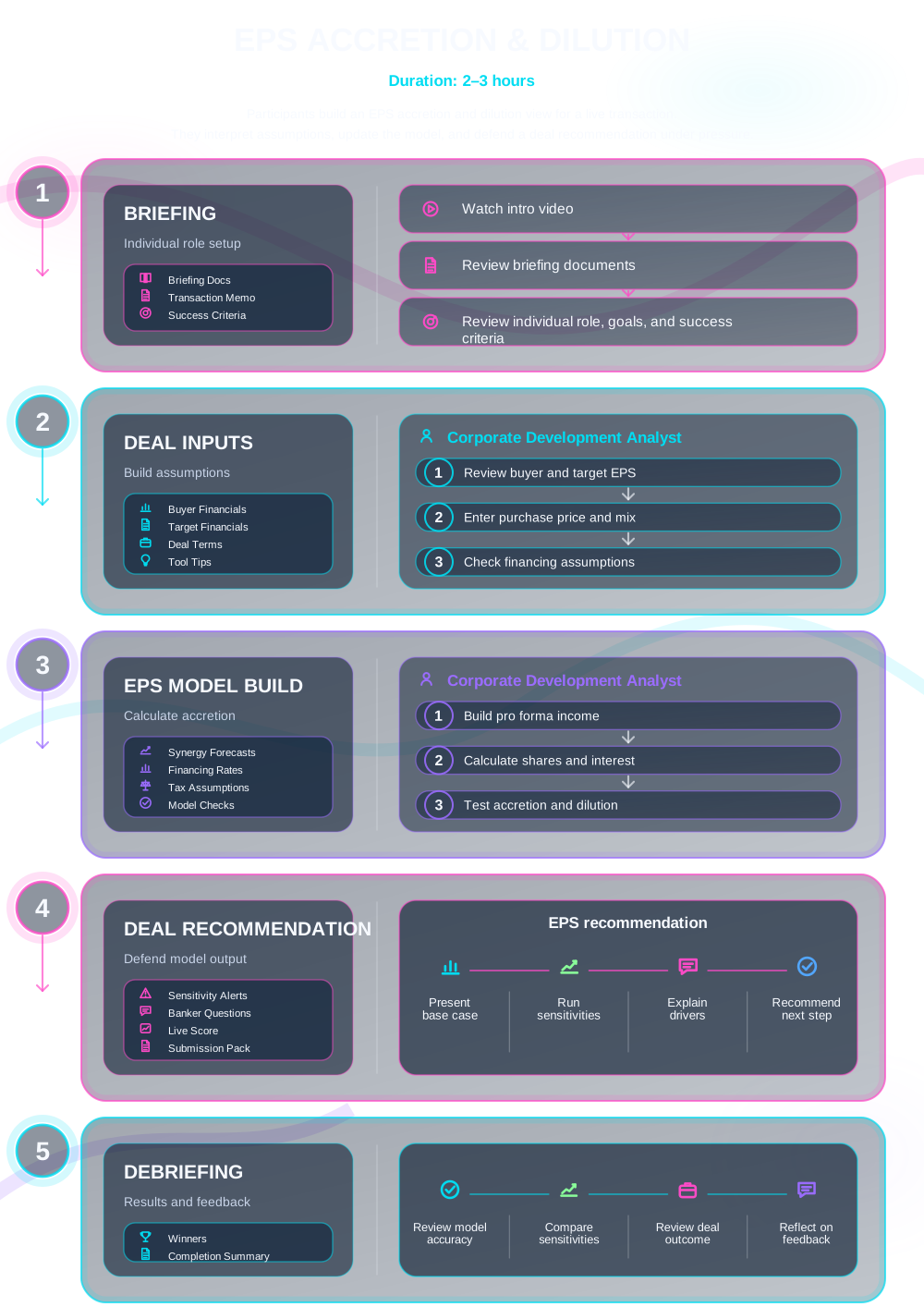

What Participants Do
In the simulation, participants will:
- Build and refine pro forma accretion/dilution models from scratch.
- Analyze target company financials and strategic fit.
- Test different financing scenarios to optimize outcomes.
- Model and evaluate the financial impact of operational synergies.
- Negotiate key deal terms under time pressure and new information.
- Craft and deliver a clear, compelling investment rationale based on the EPS analysis.
- Defend their recommendations in a competitive team setting.

Learning Objectives
By the end of the simulation, participants will be able to:
- Construct a robust and dynamic EPS accretion/dilution model.
- Confidently analyze and recommend optimal financing structures for a deal.
- Quantify and integrate the financial impact of synergies into deal analysis.
- Interpret pro forma financial outcomes and their implications for shareholder value.
- Articulate the strategic trade-offs between accretion, balance sheet strength, and dilution.
- Develop persuasive communication skills to present complex financial analysis.
- Exercise sound judgment and critical thinking in a simulated high-pressure transaction environment.
How the EPS Accretion and Dilution Simulation Works
This simulation can be run individually or in teams in academic or corporate contexts. Each cycle represents a stage of getting through a pressing financial situation.
1. Receive the Deal Brief Teams are introduced to an acquisition opportunity, including financials for the acquirer and target.
** 2. Analyze and Model** Participants conduct initial analysis, build a base-case accretion/dilution model, and identify key value drivers.
3. Make Strategic Decisions Teams decide on an initial offer price, propose a financing mix, and model associated synergies.
4. Negotiate and Adapt In multiplayer mode, teams negotiate terms. New market data or a competing bid may be introduced, forcing a strategic pivot.
5. Finalize and Communicate Participants finalize their model, prepare a one-page investment summary or a short presentation outlining their recommendation.
6. Review and Reflect Instructors and the simulation platform provide feedback on financial accuracy, strategic logic, and the persuasiveness of the final deliverable.
Frequently Asked Questions
Assessment
Assessment of participant performance can be tailored according to the host institution’s objectives (business school, corporate training, assessment centre). Typical assessment criteria include:
- The accuracy and functionality of their pro forma accretion/dilution model.
- The strategic rationale and defensibility of their chosen financing structure.
- The quality of their investment summary or final presentation.
- Their ability to adapt recommendations to new information during negotiations.