It's ideal for students and professionals interested in commercial banking, corporate lending, fixed income investing, credit analysis, or risk management.

Default Risk Simulation
In the Default Risk Simulation participants act as credit analysts, investment officers, or risk managers making critical judgment calls.

Default Risk Simulation Overview
In the Default Risk Simulation, participants step into the high-stakes world of credit risk management, acting as either lenders or investors assessing the financial health of companies. Crafted by corporate finance professionals, this multiplayer simulation accurately replicates the analytical rigor and strategic negotiation involved in real-world credit decisions.
Each round introduces dynamic market conditions, evolving company fundamentals, and unforeseen economic shocks, requiring participants to constantly re-evaluate default probabilities and adjust their strategies. You will navigate the complete credit analysis cycle from initial due diligence and financial modeling to structuring terms, setting credit spreads, and negotiating covenants.
The simulation emphasizes how subtle insights into a company's circumstances, industry position, and liquidity can lead to superior risk assessment and financial advantages. Ideal for university finance programs and corporate training workshops, it brings to life the critical balance between seeking yield and managing potential loss.

Default Risk Simulation Concepts
Participants work through realistic scenarios, which can be customized to emphasize or exclude specific topics depending on the learning goals. This modular structure allows the simulation to be tailored to any type of session. Key concepts include:
- Credit Analysis Fundamentals
- Default Probability Modeling
- Debt Structuring
- Covenant Analysis
- Credit Spreads and Pricing
- Impact of Economic and Industry Shocks
- Liquidity and Solvency Risk
- Workout and Distressed Scenarios
- Portfolio Risk Management
- Regulatory Capital Considerations

Gameflow
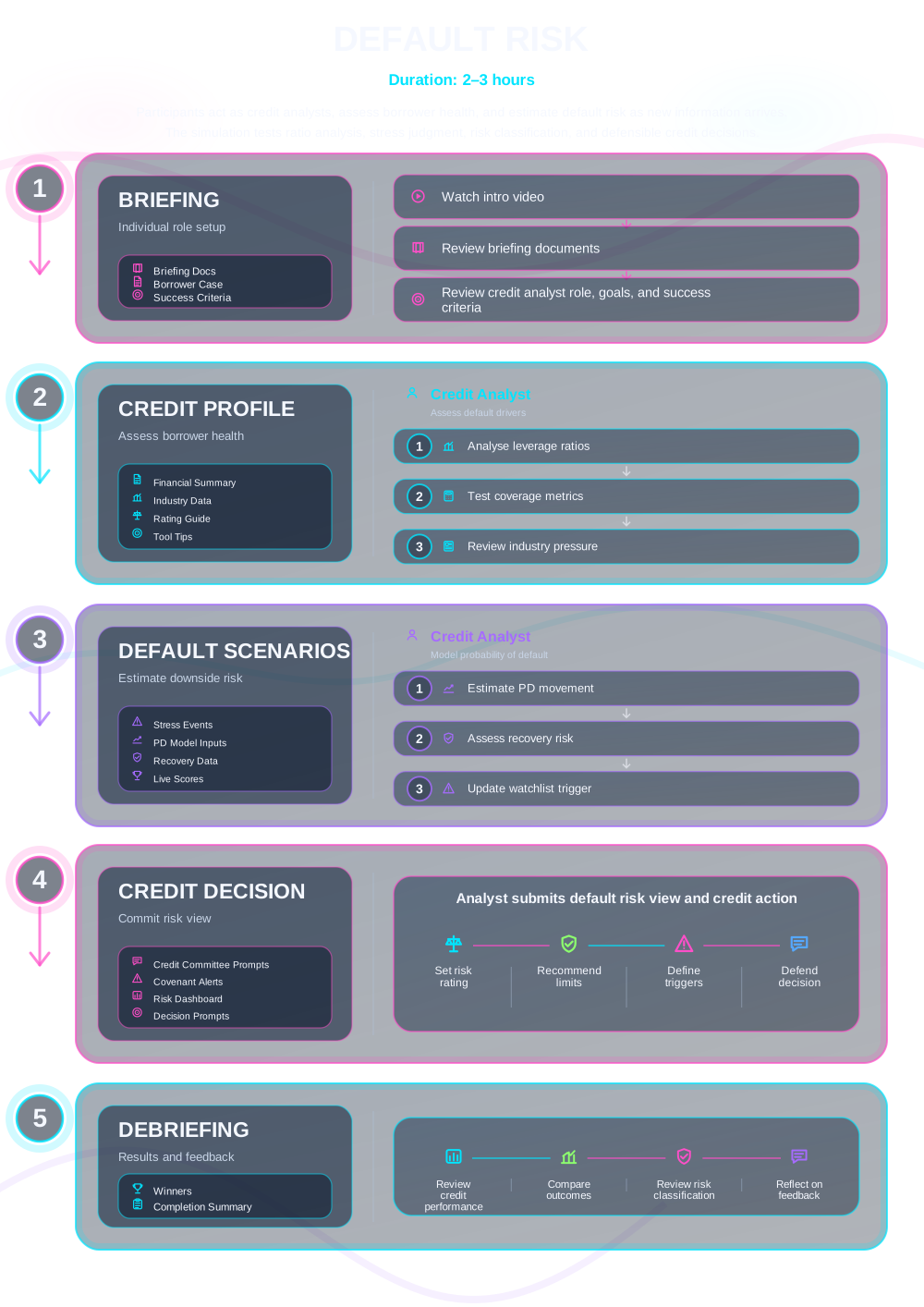

What Participants Do
In the simulation, participants will:
- Perform in-depth financial analysis on borrower companies to assess credit health.
- Build models to estimate probabilities of default and potential loss given default.
- Structure debt terms, including covenants, collateral, and pricing (credit spreads).
- Negotiate deal terms with counterparties (e.g., borrowers or other lenders).
- Monitor credit exposures and react to simulated economic downturns or company-specific shocks.
- Decide when to extend new credit, amend existing terms, or initiate recovery procedures.
- Present credit recommendations and defend their risk assessments to a committee or investors.

Learning Objectives
By the end of the simulation, participants will be able to:
- Understand the end-to-end process of credit risk assessment and management.
- Apply fundamental and quantitative techniques to model default risk.
- Structure debt agreements with appropriate risk-mitigating terms.
- Negotiate credit terms that balance risk and return objectives.
- Respond strategically to deteriorating credit scenarios and market volatility.
- Communicate credit decisions and risk rationale clearly and persuasively.
- Recognize the systemic impact of credit risk on financial markets and institutions.
- Develop confident judgment under conditions of financial uncertainty.
How the Default Risk Simulation Works
This simulation can be run individually or in teams in academic or corporate contexts. Each cycle represents a stage of getting through a pressing financial situation.
1. Receive a Scenario Participants are introduced to a company seeking financing or an existing credit that requires monitoring, complete with financials and a market backdrop.
** 2. Analyze the Credit** Teams review financial statements, industry data, and qualitative information to build a credit thesis.
3. Make Risk Decisions Participants model default risk, propose a credit rating, structure deal terms, and set a price for the risk.
4. Negotiate and Collaborate Teams may role-play as lenders and borrowers to negotiate covenants, spreads, and other key terms.
5. Manage the Portfolio In subsequent rounds, new economic data or company events force a re-assessment of the credit and potential strategic actions.
6. Review and Reflect The simulator provides real-time feedback on the quality of credit decisions, pricing accuracy, and portfolio performance relative to peers.
Frequently Asked Questions
Assessment
Assessment of participant performance can be tailored according to the host institution’s objectives (business school, corporate training, assessment centre). Typical assessment criteria include:
- The quantitative accuracy of their default risk models and pricing.
- The effectiveness and defensibility of their debt structuring and covenant packages.
- The risk-adjusted performance of their credit portfolio.
- The clarity, persuasiveness, and depth of their credit committee memos or presentations.
- The simulator provides detailed analytics and benchmarking data, facilitating easy grading. Peer and self-assessment tools can also be integrated.