While stock games focus on returns, our simulation emphasizes the process of decision-making. You are judged not just on profitability, but on the quality of your analysis, risk management, and ability to defend your strategy in the face of ambiguity and bias.

Critical Thinking Simulation
In today's complex and volatile financial markets, technical skills are a given, but the true differentiator is critical thinking. This simulation challenges participants to analyze ambiguous data and question assumptions under pressure.

Critical Thinking Simulation Overview
The Critical Thinking in Finance Simulation is an advanced, competitive learning platform that immerses participants in a dynamic market environment. Unlike traditional simulations that focus on a single financial discipline, this program integrates elements of hedge fund strategy, investment banking analysis, and corporate finance.
The core challenge is not just to build a profitable portfolio or execute a single deal, but to navigate a landscape filled with incomplete information, conflicting analyst reports, and market-moving news driven by behavioral economics.
Participants act as a team of portfolio managers or financial analysts. They are given a set of initial data on various asset classes and companies, but the real work begins as the simulation unfolds. They must identify their own informational needs, discern signals from noise, and construct a coherent investment thesis while constantly re-evaluating their strategies against evolving market conditions and the actions of their competitors.

Critical Thinking Simulation Concepts
Participants work through realistic scenarios, which can be customized to emphasize or exclude specific topics depending on the learning goals. This modular structure allows the simulation to be tailored to any type of session. Key concepts include:
- Cognitive Biases in Finance
- Information Asymmetry and Analysis
- Scenario Planning and Stress Testing
- Behavioral Finance
- Strategic Decision-Making
- Quantitative vs. Qualitative Synthesis
- Risk Management Under Uncertainty
- Thesis Formulation and Pitching

Gameflow

What Participants Do
In the simulation, participants will:
- Analyze a starting portfolio of equities, bonds, and derivatives with incomplete initial data.
- Research and request specific data on company financials, industry trends, and macroeconomic indicators.
- Execute Trades based on their evolving investment thesis, reacting to real-time market updates.
- Evaluate a potential M&A deal or capital raising opportunity, assessing strategic fit and valuation.
- Manage Risk by adjusting asset allocation and using derivatives to hedge against potential downsides.
- Compete against other teams, whose collective actions influence market prices and volatility.
- Present their final strategy and performance to a "board of directors," justifying their critical thinking process.

Learning Objectives
By the end of the simulation, participants will be able to:
- Identify common cognitive biases in financial decision-making and develop strategies to counteract them.
- Source and synthesize disparate pieces of financial and qualitative information to form a holistic view.
- Construct a logical and defensible investment or corporate finance thesis under time constraints.
- Evaluate the potential impact of unforeseen market events and adjust strategy accordingly.
- Demonstrate improved judgment in capital allocation and risk-taking.
- Articulate a complex financial strategy clearly and confidently, emphasizing the thought process over just the outcome.
How the Critical Thinking Simulation Works
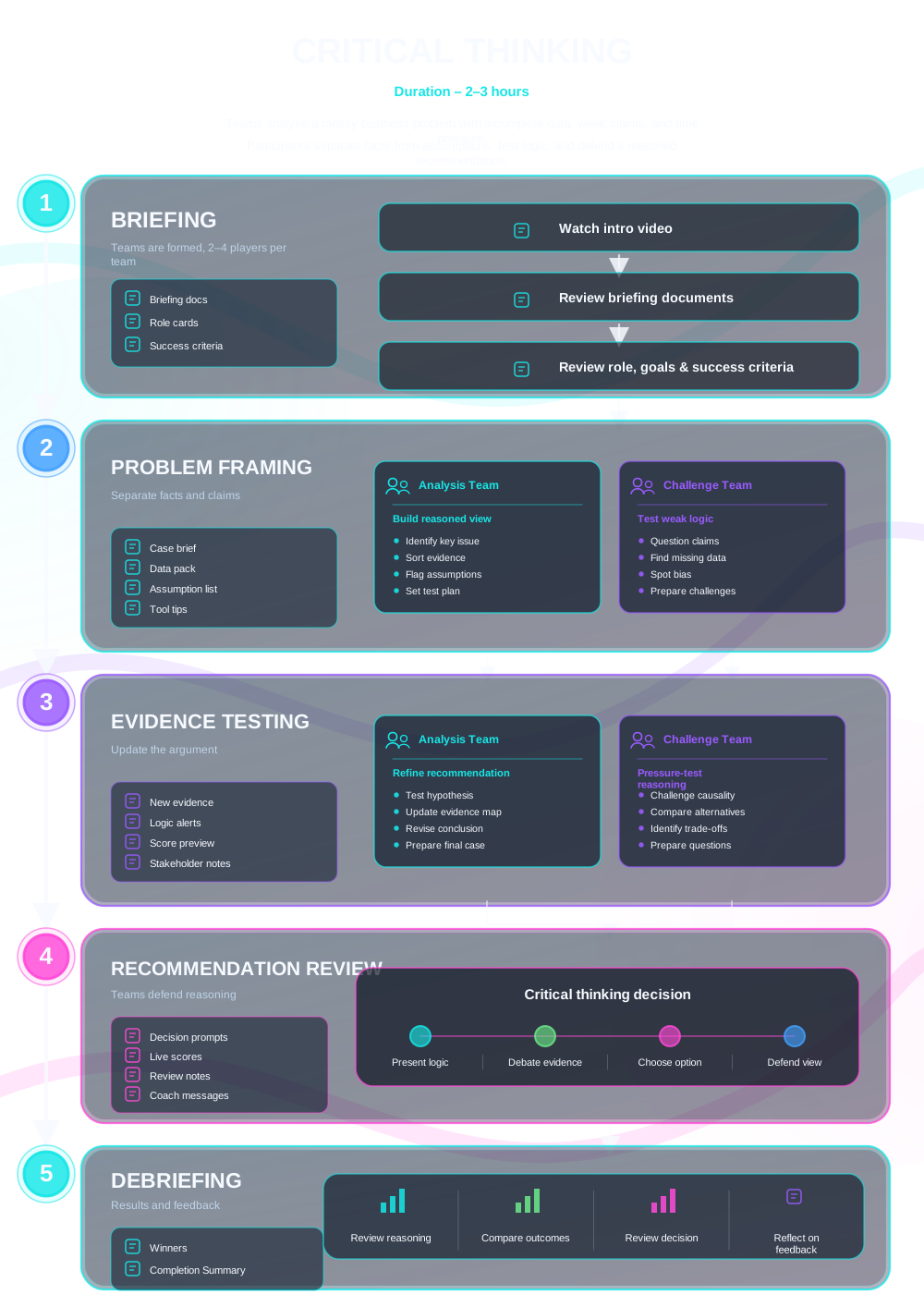
This simulation can be run individually or in teams in academic or corporate contexts. Each cycle represents a stage of getting through a pressing financial situation.
1. Team Formation and Briefing Participants are divided into competing funds or advisory teams. They receive the initial case materials and access to the simulation platform.
2. Initial Analysis Phase Teams conduct their first analysis, identifying knowledge gaps and requesting specific data packs from the simulation moderator.
3. Market News and Data Drops New information is released, including earnings reports, economic data, and geopolitical events.
4. Decision Period Teams analyze the new data, adjust their models, and execute trades or deals.
5. Results and Feedback Teams see their performance metrics (Sharpe ratio, alpha, ROE) and receive qualitative feedback on their strategy.
6. The Shock Event A mid-simulation unexpected event tests teams' risk management and adaptability.
7. Final Review and Presentation The simulation concludes with teams preparing a final report and presentation, justifying their decisions and the critical thinking framework they employed throughout the exercise.
Frequently Asked Questions
Assessment
Assessment of participant performance can be tailored according to the host institution’s objectives (business school, corporate training, assessment centre). Typical assessment criteria include:
- Risk-Adjusted Returns (Sharpe Ratio, Sortino Ratio)
- Maximum Drawdown and Volatility Management
- Consistency of Performance vs. Benchmark
- Quality of the Initial Investment Thesis
- Rationale for Strategic Pivots and Trade Decisions
- Demonstrated Understanding of Biases and Risk Factors
- Coherence and Depth of the Final Strategic Report
- Clarity, Structure, and Persuasion of the Final Presentation
- Ability to Field Challenging Questions and Defend Decisions Under Scrutiny
Assessment may incorporate peer and self-review components, facilitator scoring, and debrief discussion. Results may feed into grades, executive feedback, certification or development plans.