No. The simulation is suitable for learners with basic business knowledge and can be scaled in difficulty.

Crisis Management Simulation
In this high-stakes Crisis Management Simulation, participants lead decision-making during reputational, financial, and operational crises. They must assess risk, align stakeholders, and communicate clearly - all under intense time pressure.

Crisis Management Simulation Overview
The Crisis Management Simulation places participants in leadership roles within a company experiencing real-time disruption - anything from financial fraud or cyberattacks to product failures or regulatory breaches. Their challenge: contain the fallout, protect the brand, and steer the business through turbulent waters.
Participants must make urgent decisions across departments - risk, finance, communications, legal, and operations - while responding to incoming data and media coverage. Each action has consequences. They must evaluate trade-offs, align internal teams, and communicate effectively with external stakeholders.
Co-developed with risk consultants and crisis communication experts, the simulation is immersive and emotionally engaging. It equips participants to manage ambiguity, navigate pressure, and lead with composure when it matters most.

Crisis Management Simulation Concepts
Participants work through realistic crisis scenarios, which can be customized to emphasize or exclude specific topics depending on the learning goals. This modular structure allows the simulation to be tailored into any required type of session. Key concepts include:
- Crisis Identification & Response Planning
- Stakeholder Prioritisation: Internal teams, regulators, media, customers, shareholders
- Communication Strategy: Tone, timing, transparency
- Financial & Legal Risk: Containment and regulatory implications
- Cross-Functional Alignment: Coordinating finance, ops, HR, and legal
- Media and Reputation Management: Handling public fallout
- Post-Crisis Review: Root cause analysis and long-term rebuilding
- Scenario Planning & Resilience Building

Gameflow

What Participants Do
Participants are part of a crisis leadership team. In each scenario, they:
- Receive a breaking event and review real-time updates
- Assess the facts, risks, and unknowns across business functions
- Develop and execute response plans under time pressure
- Communicate with stakeholders - customers, board, regulators, media
- Manage cross-functional decision-making with limited information
- Reassess strategies as new developments emerge
- Reflect on what worked, what failed, and how future resilience can be built
- Crises may include cybersecurity breaches, PR disasters, product recalls, leadership misconduct, financial distress, or activist interventions.

Learning Objectives
By the end of the simulation, participants will be more confident in:
- Leading under uncertainty and pressure
- Making fast, high-impact decisions with limited data
- Communicating clearly and confidently in tense situations
- Balancing competing interests and time-sensitive risks
- Managing internal alignment and coordination in chaotic environments
- Thinking strategically during short-term volatility
- Applying structured thinking to unpredictable scenarios
- Handling reputational risk and stakeholder trust
- Learning from crisis to build long-term institutional resilience
This is especially powerful for future managers, business leaders, and professionals in high-responsibility roles. The simulation’s flexible structure ensures that these objectives can be calibrated to match the depth, duration, and focus areas of each program.
How the Crisis Management Simulation Works
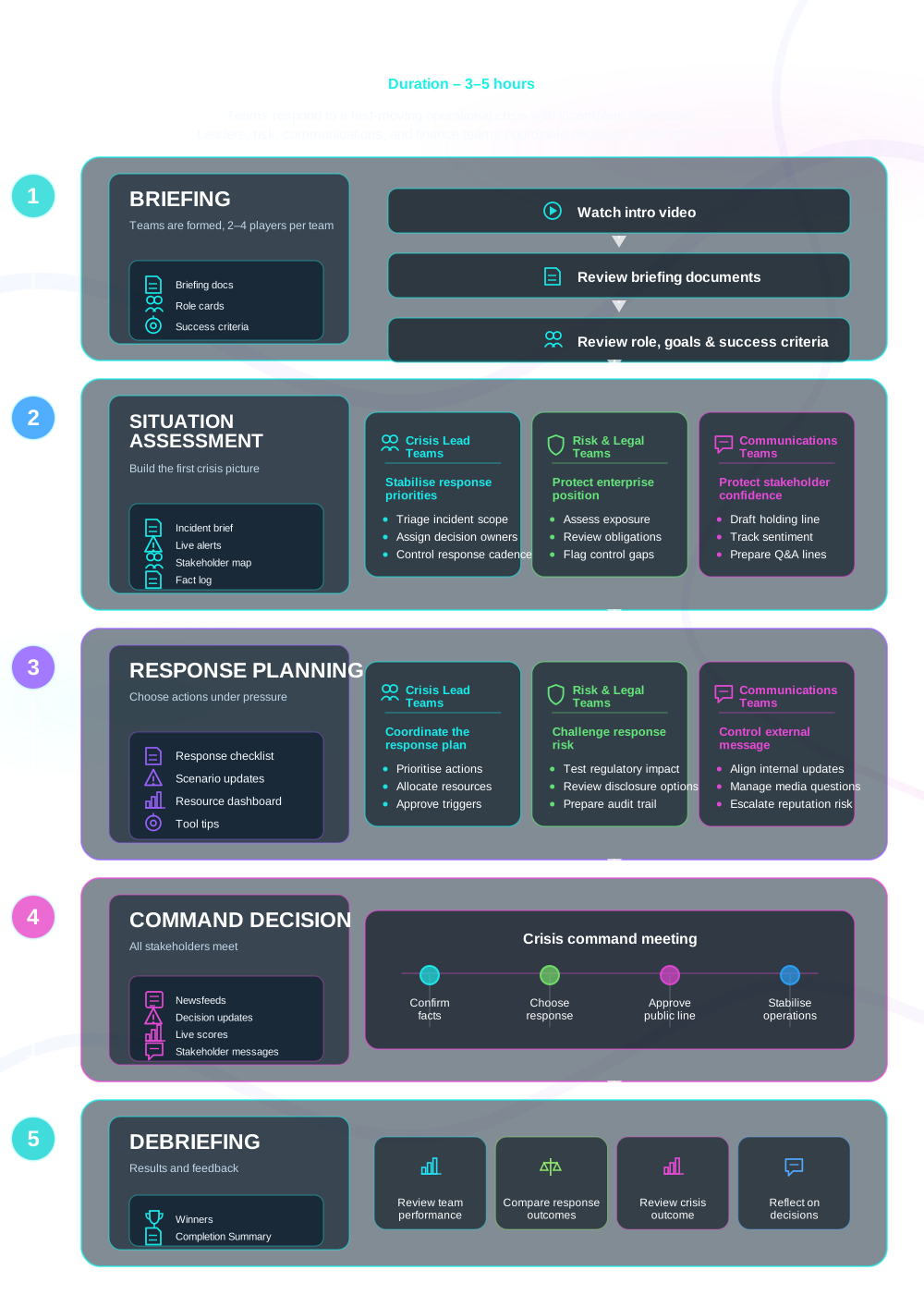
Designed for teams or individuals, the simulation includes multiple rounds of real-time crisis escalation.
1. Receive a Crisis Scenario Participants receive a realistic crisis trigger (e.g. data breach, fraud report, viral complaint), plus key facts and context.
2. Assess and Prioritise They identify the critical stakeholders, immediate risks, legal considerations, and communication needs.
3. Make Time-Sensitive Decisions Participants must respond across communication, operations, finance, HR, and legal - often with incomplete information.
4. Monitor Response Impact Outcomes evolve based on decisions made - affecting public reaction, financial health, team morale, and compliance exposure.
5. Debrief and Reflect After each round, participants analyze outcomes, review blind spots, and adapt their response plans for the next round.
6. Iterate with New Challenges Multiple simulations can be run - ranging from internal failures to external shocks - to test agility, leadership, and resilience thinking.

Why This Crisis Management Simulation Works
Crisis management can’t be taught by lecture- it must be lived. This simulation delivers a visceral, hands-on experience that mimics the stress, urgency, and ambiguity of real-life crises.
It develops composure, cross-functional thinking, and stakeholder empathy. Participants learn not just how to respond to crises, but how to lead through them. A perfect fit for leadership programs, MBA courses, or corporate resilience workshops.
Frequently Asked Questions
Assessment
Participants can be assessed on:
- Decision speed and strategic judgment
- Communication under stress
- Stakeholder sensitivity and alignment
- Ethical reasoning and regulatory awareness
- Post-crisis reflection and learning
- Team collaboration and leadership presence
- Overall business resilience strategy
You can also include memo writing and debrief presentations as part of the assessment structure. Additionally, you can also add a built-in peer and self-assessment tool to see how participants rate themselves. This flexibility allows the simulation to be easily integrated into by professors as graded courses at universities and by HR at assessment centres at companies.