It's ideal for undergraduate finance majors, MBA students, early-career bankers in commercial or corporate banking divisions, and anyone seeking to build or solidify foundational credit analysis skills.

Credit Underwriting Simulation
In this Credit Underwriting Simulation, participants are tasked with evaluating corporate borrowers, making crucial lending decisions, and managing a portfolio of credit exposures in a dynamic, risk-prone market.

Credit Underwriting Simulation Overview
The Credit Underwriting simulation is a dynamic, comprehensive financial simulation developed by experienced credit risk professionals. It replicates the rigor, pressure, and multi-faceted analysis of real-world commercial and corporate lending.
Participants engage in the complete credit cycle: from initial client outreach and financial statement analysis, to structuring the deal, setting covenants, and making a final approve/decline recommendation. They must balance the dual mandate of pursuing profitable lending opportunities while rigorously defending the bank's capital against potential losses. Each round introduces new client cases with varying complexity, industry sectors, and evolving macroeconomic conditions that test their judgment.
This multiplayer simulation emphasizes critical analytical thinking, structured decision-making, and effective communication of risk. Participants are assessed not just on the volume of deals they approve, but on the quality and risk-adjusted profitability of their credit portfolio.

Credit Underwriting Simulation Concepts
Participants work through realistic scenarios, which can be customized to emphasize or exclude specific topics depending on the learning goals. This modular structure allows the simulation to be tailored to any type of session. Key concepts include:
- The Five Cs of Credit
- Financial Statement Analysis
- Cash Flow Analysis
- Credit Scoring and Risk Rating
- Loan Structuring
- Covenants and Documentation
- Portfolio Management
- Macro-Economic Impact

Gameflow
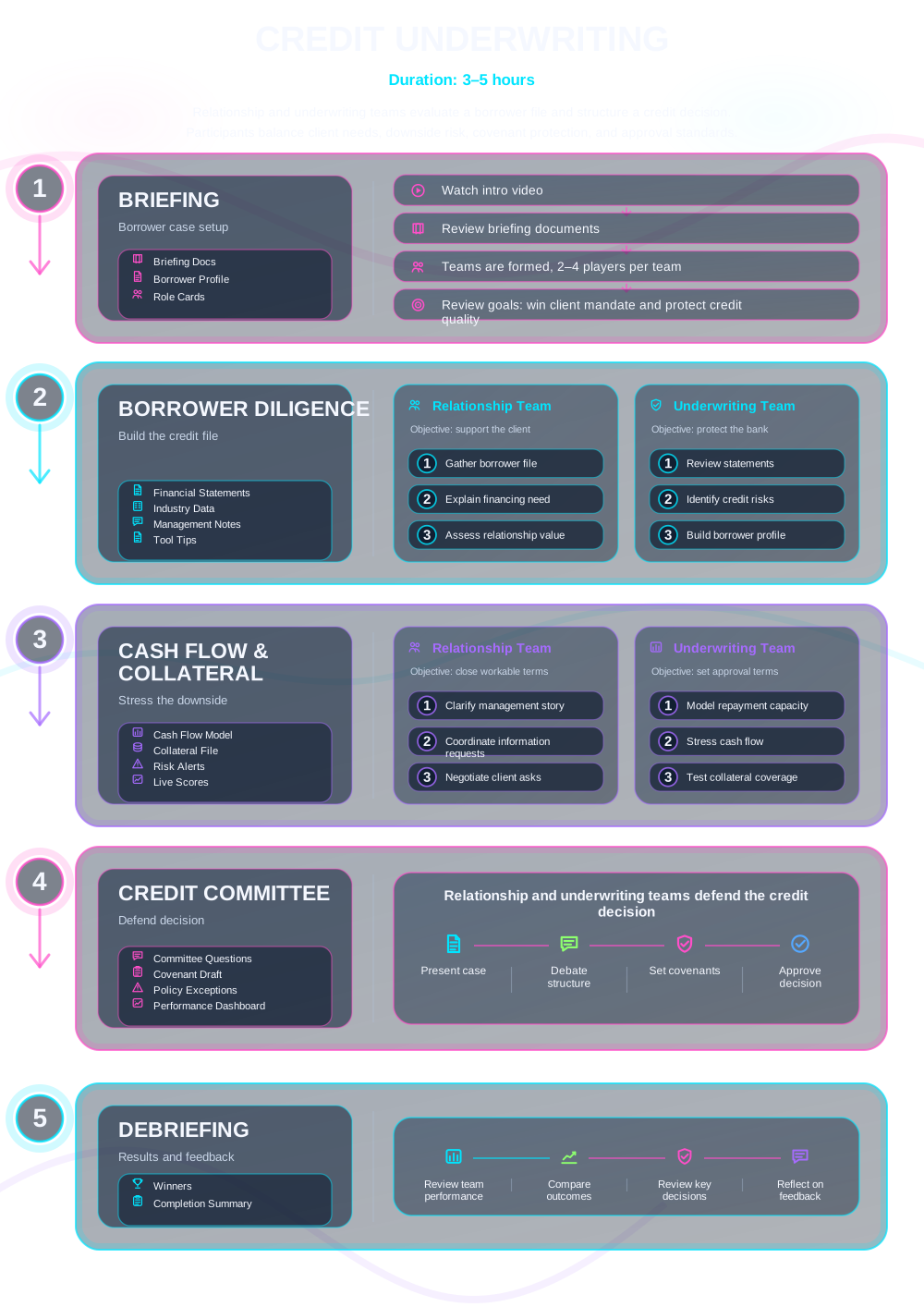

What Participants Do
In the simulation, participants will:
- Analyze detailed company financials, business plans, and industry reports.
- Build integrated financial models to forecast performance and debt capacity.
- Conduct sensitivity and scenario analysis (base, stress, upside cases).
- Structure loan terms, including pricing (spread), covenants, and collateral requirements.
- Write concise credit approval memos to recommend or decline the facility.
- Defend their underwriting decisions in simulated credit committee meetings.
- Monitor existing credits and respond to covenant breaches or borrower requests for amendments.
- Rebalance their credit portfolio in response to changing risk environments.

Learning Objectives
By the end of the simulation, participants will be able to:
- Systematically apply a structured credit analysis framework to real borrower cases.
- Interpret financial statements to identify strengths, weaknesses, and red flags.
- Build cash flow forecasts to determine a borrower's ability to service debt.
- Structure credit facilities that appropriately balance risk and reward.
- Communicate credit decisions clearly and persuasively in written memos and oral presentations.
- Understand how regulatory capital requirements influence lending decisions.
- Develop professional judgment to make decisions under uncertainty and incomplete information.
How the Credit Underwriting Simulation Works
This simulation can be run individually or in teams in academic or corporate contexts. Each cycle represents a stage of getting through a pressing financial situation.
1. Receive a Client Case Teams are introduced to a potential borrowing company with a specific financing need.
** 2. Conduct Due Diligence** They analyze provided data, including audited financials, management accounts, industry research, and management biographies.
3. Perform Analysis and Modeling Participants calculate key ratios, build financial forecasts, and run stress tests.
4. Make a Credit Decision Teams decide to approve or decline, and if approving, they must fully structure the proposed loan (amount, term, price, covenants).
5. Prepare and Present Participants compile their analysis into a standardized credit approval memo and present their recommendation to a simulated credit committee (which may be an instructor or another team).
6. Review and Reflect Instant, automated feedback from the simulation platform scores the quality of their analysis and decision. Facilitator-led debriefs connect outcomes to core learning points.
Frequently Asked Questions
Assessment
Assessment of participant performance can be tailored according to the host institution’s objectives (business school, corporate training, assessment centre). Typical assessment criteria include:
- Accuracy and depth of financial analysis and forecasting.
- Ability to correctly identify and weigh key risks.
- Appropriateness of the credit decision (approve/decline) and loan structure relative to the risk profile.
- Clarity, conciseness, and persuasiveness of the written credit memo and any oral presentations.
- The risk-adjusted performance of their overall book of credits at the simulation's conclusion.