A simulation allows you to test multiple scenarios (cost increases, price changes, or sales variability) in a risk-free, dynamic environment. It offers more realistic decision-making practice, where you can instantly see the effects of different strategies before implementing them in real life.

Cost-Volume-Profit Analysis Simulation
The Cost-Volume-Profit (CVP) Analysis Simulation is an immersive, interactive learning experience designed to help participants understand how costs, volume (sales), and pricing decisions influence a company’s profitability in the short term.

Cost-Volume-Profit Analysis Simulation Overview
In this simulation, participants assume the role of financial analysts (or managers) in a company launching a new product or evaluating an existing one. Leveraging CVP analysis, they will explore how different cost structures, sales volumes, and pricing strategies affect profit, break-even levels, and margin of safety.
The simulation helps bridge the gap between textbook formulae and real-world decision-making by giving participants the freedom to adjust inputs and see the consequences instantly.
Unlike long-term financial modeling or discounted cash flow analysis, this simulation focuses on short-run operational decisions — where costs and revenues are assumed to behave linearly and the mix of products remains constant. By the end of the simulation, participants will have gained a deeper, intuitive understanding of how volume, cost structure, and pricing interplay to drive business outcomes.

Cost-Volume-Profit Analysis Simulation Concepts
Participants work through realistic scenarios, which can be customized to emphasize or exclude specific topics depending on the learning goals. This modular structure allows the simulation to be tailored to any type of session. Key concepts include:
- Fixed Costs
- Variable Costs
- Contribution Margin
- Contribution Margin Ratio
- Break-Even Point
- Target Profit Volume
- Margin of Safety
- ”What-If” / Sensitivity Analysis

Gameflow
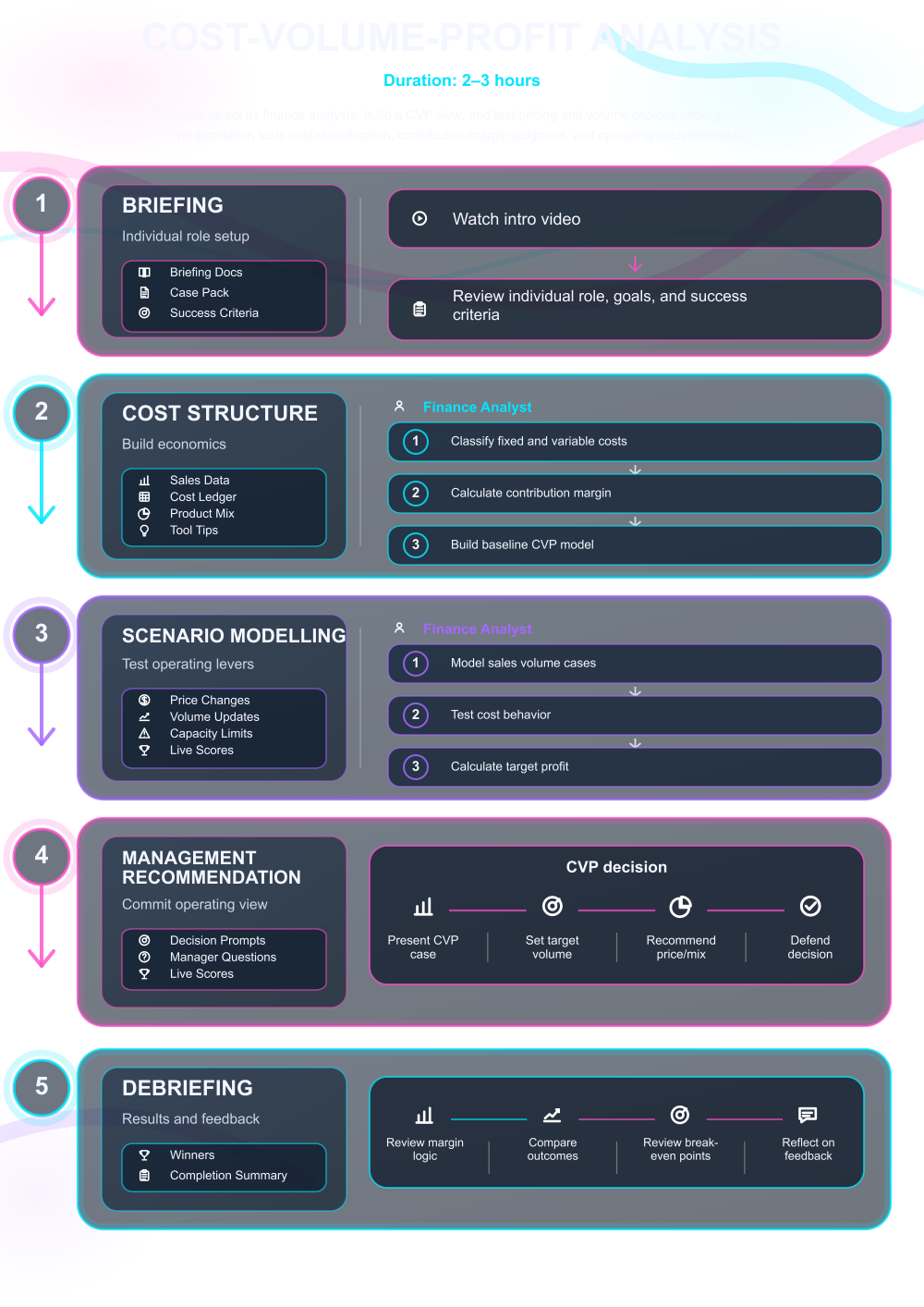

What Participants Do
In the simulation, participants will:
- Classify costs into fixed and variable components.
- Determine selling price per unit for a product.
- Estimate potential units to be sold under different market scenarios.
- Compute contribution margin
- Calculate the break-even point
- Model target profit scenarios
- Perform sensitivity testing
- Analyze margin of safety and assess the risk and buffer before incurring losses.
- Make managerial recommendations

Learning Objectives
By the end of the simulation, participants will be able to:
- Understand and articulate the basic components and assumptions of CVP analysis.
- Compute break-even points and target profit volumes under various cost, price, and volume settings.
- Use contribution margin and margin-of-safety metrics to assess business risk and profitability.
- Conduct sensitivity (“what-if”) analysis to understand how changes in pricing, costs, or sales volume impact profit.
- Make informed business decisions about pricing, cost management, product launch, production volume, and profitability planning.
- Present financial insights and recommendations clearly — as would be required in managerial or board-level discussions.
How the Cost-Volume-Profit Analysis Simulation Works
This simulation can be run individually or in teams in academic or corporate contexts. Each cycle represents a stage of getting through a pressing financial situation.
1. Scenario Setup Participants are presented with a business case. The case includes baseline data: fixed costs, variable cost per unit, expected demand, and suggested selling price.
2. Interactive Input Using a simulation dashboard, participants enter or modify inputs — such as unit price, variable cost, fixed costs, and expected volume.
3. Visual Outputs Charts and graphs visualize how costs, revenue, and profit change with volume.
4. What-If Analysis Rounds Participants run several rounds, adjusting assumptions and immediately see the impact on profitability.
5. Decision and Recommendation Finally, participants evaluate results and formulate strategic recommendations: whether to proceed with production, adjust pricing, reduce costs, or alter sales targets.
Frequently Asked Questions
Assessment
Assessment of participant performance can be tailored according to the host institution’s objectives (business school, corporate training, assessment centre). Typical assessment criteria include:
- Quality of the CVP analysis and supporting data used to justify each round’s key decisions (pricing, production, investment).
- Effectiveness in responding to market volatility and recalculating break-even points.
- A concise executive summary or presentation explaining the team’s strategy, how CVP guided decisions, key lessons learned, and what they would do differently.
- Collaboration, division of work, integration of roles, and final coherence
- Rating by peers and self-reflection on approach and decisions