Yes, it includes structured guidance and builds foundational knowledge step-by-step.

Cost Accounting Simulation
Participants take on cost accounting roles, allocating costs, analyzing variances, and supporting decision-making in a dynamic business environment where cost control and strategic insight directly affect performance.

Cost Accounting Simulation Overview
The Cost Accounting Simulation places participants in a manufacturing or service-based business where they manage cost systems, pricing decisions, and performance analysis across multiple cycles.
Acting as cost analysts or operations controllers, participants allocate direct and indirect costs, select costing methods, assess cost behavior, and identify inefficiencies across departments or product lines. They deal with pricing pressures, capacity decisions, inventory issues, and managerial expectations, all while tracking the financial impact of their decisions.
This simulation offers a rich, hands-on understanding of cost structures and their role in internal decision-making. It’s ideal for finance, operations, and accounting learners seeking practical insights into how numbers drive business actions.

Cost Accounting Simulation Concepts
Participants work through realistic scenarios, which can be customized to emphasize or exclude specific topics depending on the learning goals. This modular structure allows the simulation to be tailored to any type of session. Key concepts include:
- Cost Classification: Direct vs. indirect, fixed vs. variable
- Cost Allocation Methods: Job costing, process costing, activity-based costing
- Overhead Allocation and Absorption
- Standard Costing and Variance Analysis
- Contribution Margin and Break-even Analysis
- Inventory Valuation (FIFO, LIFO, Weighted Average)
- Cost-Volume-Profit (CVP) Relationships
- Budgeting and Forecasting
- Responsibility Accounting and Cost Centers
- Relevant Costing for Decision-Making

Gameflow
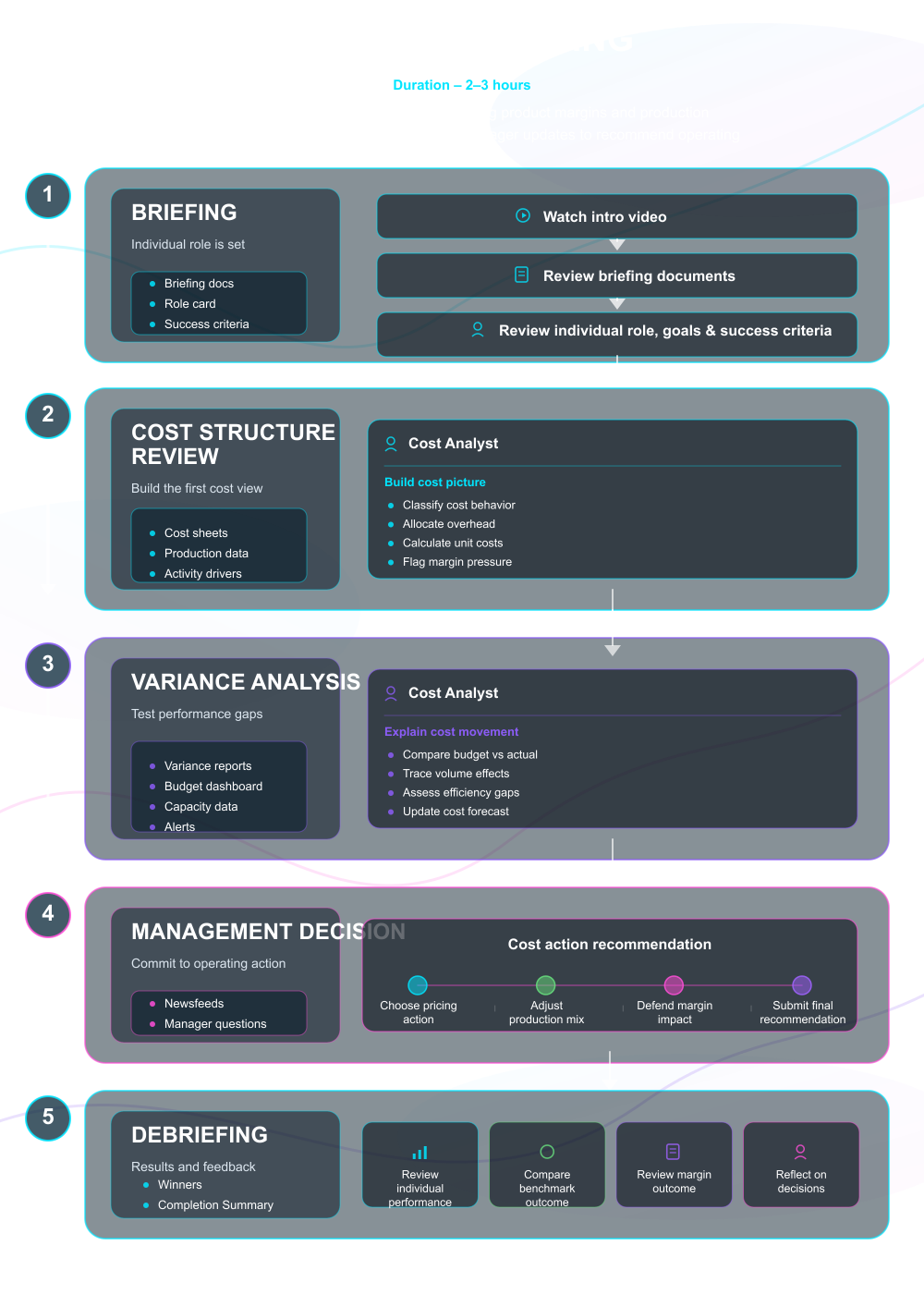

What Participants Do
During the simulation, participants:
- Collect cost data from departments and projects
- Select and apply appropriate costing methods for various scenarios
- Allocate overheads and track direct materials and labor
- Analyze actual vs. budgeted results and explain variances
- Decide on pricing strategies based on cost behavior
- Recommend make-or-buy, outsourcing, or product discontinuation options
- Identify bottlenecks or inefficiencies in operations
- Respond to changes in volume, pricing, or raw material costs
- Present cost insights to managers for business decisions
- Revise cost systems in response to evolving conditions

Learning Objectives
- Understand the classification and behavior of different types of costs.
- Apply appropriate cost allocation techniques in diverse business settings.
- Use job, process, and activity-based costing systems to assign costs accurately.
- Analyze variances between actual and standard costs to explain performance gaps.
- Apply contribution margin and break-even analysis for decision support.
- Evaluate pricing and product-line decisions using relevant cost data.
- Interpret cost-volume-profit relationships to forecast profit outcomes.
- Understand the impact of inventory costing methods on reported income.
- Support budgeting processes by estimating and allocating future costs.
- Communicate cost insights effectively to influence operational and strategic decisions.
The simulation’s flexible structure ensures that these objectives can be calibrated to match the depth, duration, and focus areas of each program, whether in higher education or corporate learning.
How the Cost Accounting Simulation Works
1. Scenario Setup Participants receive a business scenario that includes product lines, cost structures, and performance targets. They review internal reports, production data, and financial goals to frame their approach.
2. Cost Data Collection and Classification They identify fixed, variable, direct, and indirect costs from operations. Participants must determine how best to organize and interpret the data.
3. Cost Allocation and Method Selection Using guided tools, participants apply costing systems (e.g., ABC or job costing) to assign costs to products, services, or departments.
4. Decision-Making Based on Cost Analysis With full cost data available, participants make decisions about pricing, outsourcing, product mix, or operational improvements.
5. Variance and Performance Analysis After implementing decisions, participants receive results showing performance, cost control, and efficiency metrics - including variance reports.
6. New Round Challenges Each new round introduces fresh cost pressures or strategic decisions (e.g., a supplier cost spike or a drop in demand), prompting recalibration and revised analysis.

Why This Cost Accounting Simulation Works
Cost accounting is often seen as technical - but in practice, it drives decisions across pricing, operations, and strategy. This simulation puts cost concepts into motion, helping participants link financial data with managerial impact.
Learners walk away with not just accounting knowledge, but also with critical thinking and business judgment that mirrors real-world roles in finance and operations.
Frequently Asked Questions
Assessment
Participants are assessed on:
- Accuracy of cost allocation and classification
- Effectiveness of costing method selection
- Depth of variance analysis and response
- Soundness of pricing or operational decisions
- Communication of cost findings and strategic recommendations
- Improvement across simulation rounds
- Strategic use of relevant costing
- Team collaboration (where applicable)
- Engagement with financial and non-financial drivers
- Final performance summary and optional reflection memo
Additionally, you can also add a built-in peer and self-assessment tool to see how participants rate themselves. This flexibility allows the simulation to be easily integrated by professors as graded courses at universities and by HR at assessment centres at companies.