This simulation focuses on the application of financial analysis and strategic thinking to solve real-world business problems, replicating the experience of working at a top-tier management consulting firm.

Consulting Simulation
Master the Art of Financial Strategy and Client Advisory. Navigate complex business challenges, analyze financial data, and deliver actionable recommendations to top-tier clients in the Consulting simulation.

Consulting Simulation Overview
The Consulting in Finance Simulation plunges participants into the high-stakes world of a premier financial advisory firm. Acting as a team of consultants, you are tasked with solving critical, real-world business problems for a diverse portfolio of clients. These challenges range from optimizing capital structure and improving profitability to evaluating potential mergers and navigating corporate turnarounds.
This simulation goes beyond theoretical case studies. Participants will analyze live financial models, assess market conditions, benchmark against competitors, and wrestle with trade-offs under pressure. The goal is not just to find an answer, but to build a compelling, data-driven narrative and present your strategic recommendations to a discerning "client board”.
Although ideal for undergraduate and graduate finance courses, executive training, and corporate finance skill workshops, the simulation is modular and scalable, allowing instructors to vary complexity.

Consulting Simulation Concepts
Participants work through realistic scenarios, which can be customized to emphasize or exclude specific topics depending on the learning goals. This modular structure allows the simulation to be tailored to any type of session. Key concepts include:
- Profit and Loss Analysis
- Balance Sheet Restructuring
- Discounted Cash Flow Valuation
- M&A Screening and Synergy Analysis
- Capital Structure Optimization
- Credit Rating Analysis
- Strategic Benchmarking
- Client Management and Q&A
- Data-Driven Storytelling
- Executive Presentation Skills

Gameflow
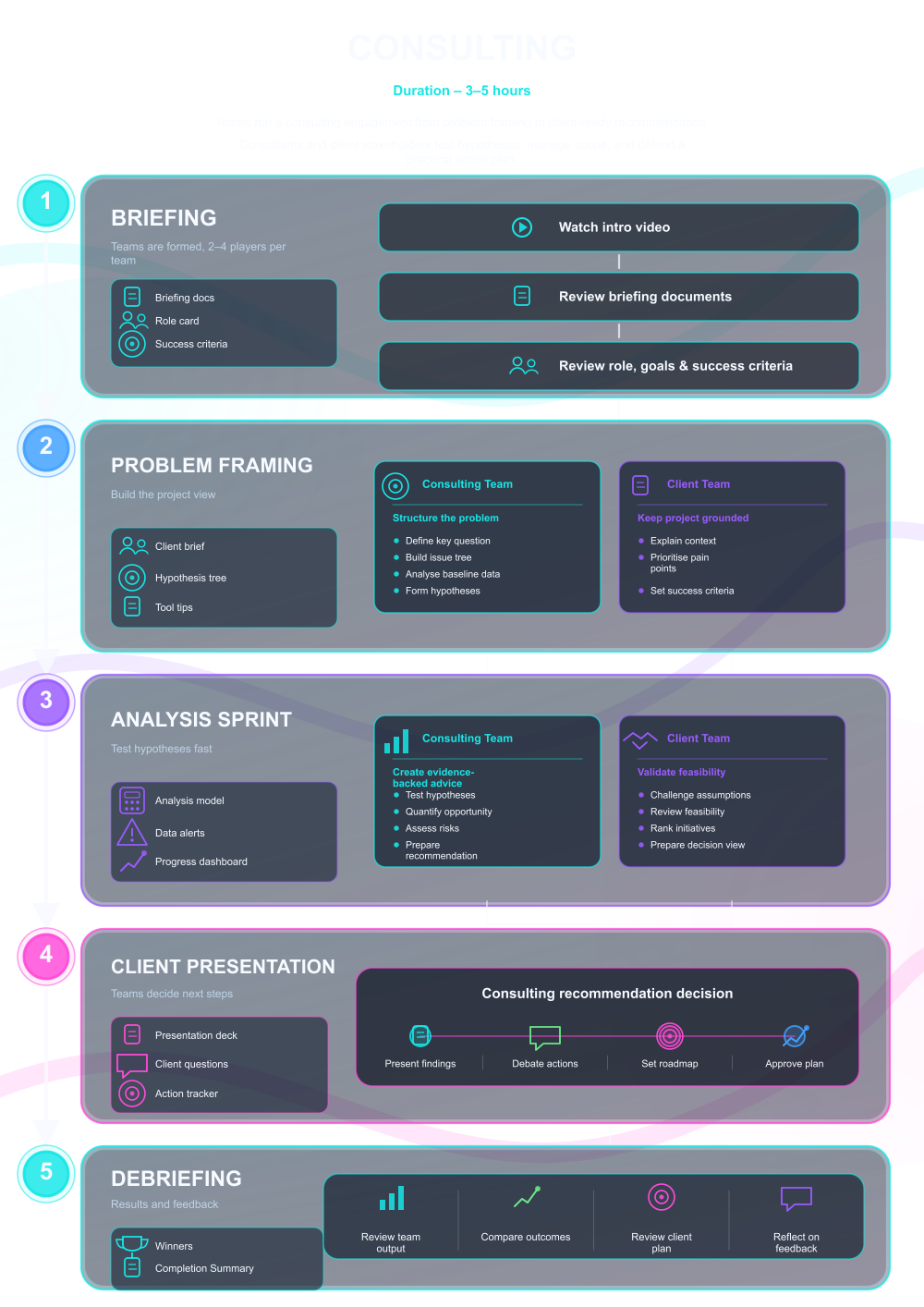

What Participants Do
In the simulation, participants will:
- Dive deep into the financial statements and strategic positioning of multiple client companies.
- Create and use models for valuation, M&A, and capital structure scenarios.
- Formulate and test hypotheses to address client-specific pain points.
- Choose between different strategic paths, each with quantifiable financial outcomes and risks.
- Synthesize complex data into a clear, persuasive storyline.
- Defend your recommendations and handle tough questions in a high-pressure boardroom setting.

Learning Objectives
By the end of the simulation, participants will be able to:
- Structure ambiguous business problems into a clear, analytical framework.
- Analyze a company's financial health and competitive position to identify key value drivers and risks.
- Apply advanced financial modeling and valuation techniques to justify strategic recommendations.
- Evaluate strategic alternatives, including M&A, restructuring, and financing options, using quantitative and qualitative measures.
- Synthesize complex data into executive-level insights and a persuasive presentation.
- Defend strategic recommendations under cross-examination, honing executive presence and communication skills.
How the Consulting Simulation Works
This simulation can be run individually or in teams in academic or corporate contexts. Each cycle represents a stage of getting through a pressing financial situation.
1. Team Formation and Briefing Participants are divided into consulting teams and receive a detailed briefing on their client's specific challenges.
2. Financial and Market Analysis Teams access the simulation platform to analyze the client's financials, run valuation models, and research the competitive landscape.
3. Strategic Decision-Making Teams make a series of interconnected decisions based on their analysis, inputting their chosen strategies into the platform.
4. Real-Time Results and Feedback The simulation processes the decisions, generating financial and market feedback, forcing teams to adapt their strategy.
5. Final Proposal Development Teams consolidate their findings into a final client proposal and presentation deck.
6. The Boardroom Presentation Teams present their strategic recommendations to a panel of "client executives" (instructors or judges), who challenge their assumptions and decide on the winning proposal.
Frequently Asked Questions
Assessment
Assessment of participant performance can be tailored according to the host institution’s objectives (business school, corporate training, assessment centre). Typical assessment criteria include:
- Accuracy of your financial models
- Depth of your quantitative analysis
- Logical soundness of your strategic assumptions.
- The effectiveness of your in-simulation decisions, as measured by key performance indicators (KPIs) like client profitability, valuation, and market share.
- Clarity, structure, and persuasiveness of your final presentation deck and your team's ability to defend its recommendations under pressure during the boardroom Q&A session.