It is ideal for students and professionals interested in trading, risk management, energy finance, supply chain management, and corporate finance roles where commodity price exposure is a factor.

Commodities Trading Simulation
Navigate global markets, master physical and financial trades, and manage real-world risks in this commodities trading simulation. Make critical decisions on everything from crude oil futures to agricultural supply chains.

Commodities Trading Simulation Overview
In the Commodities Trading Simulation, participants assume the roles of traders, analysts, and risk managers at a global commodities trading house. They navigate a dynamic environment shaped by geopolitical events, supply-demand shocks, weather patterns, and macroeconomic data. Each decision round presents new market intelligence requiring swift analysis and strategic execution.
fundamentals, execute trades in futures and spot markets, structure physical delivery contracts, and actively manage a complex book of exposures. The simulation emphasizes the unique interplay between physical assets and financial derivatives, challenging participants to balance speculative opportunities with crucial hedging operations to protect the firm from catastrophic losses.
This simulation is ideal for university finance programs, MBA courses, and corporate training for energy, agriculture, and trading firms, bringing the fast-paced reality of the trading floor directly to learners.

Commodities Trading Simulation Concepts
Participants work through realistic scenarios, which can be customized to emphasize or exclude specific topics depending on the learning goals. This modular structure allows the simulation to be tailored to any type of session. Key concepts include:
- Physical vs. Financial Trading
- Futures and Options Strategies
- Supply, Demand, and Price Formation
- The Forward Curve and Term Structure
- Basis Risk and Cross-Hedging
- Credit and Counterparty Risk
- Operational and Logistics Risk
- Commodity Trading Value Chain
- Impact of Geopolitical and ESG Factors

Gameflow
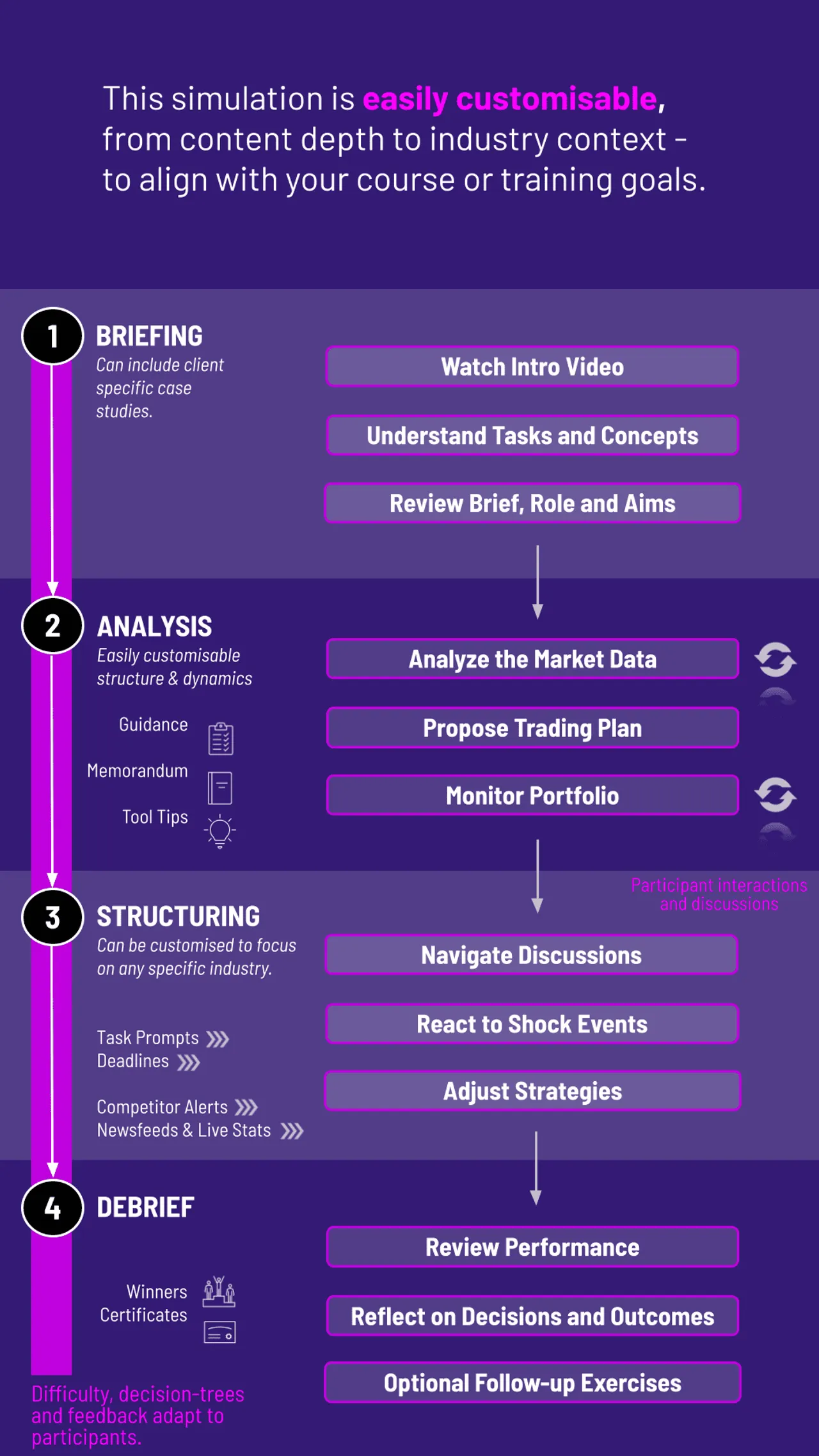

What Participants Do
In the simulation, participants will:
- Analyze real-time market feeds, research reports, and news alerts to identify trading opportunities.
- Execute trades across multiple commodity classes in futures markets.
- Negotiate and structure physical supply contracts with producers and end-users.
- Actively hedge the firm's exposure to adverse price movements using derivatives.
- Manage the firm's capital, margin requirements, and overall risk limits.
- Present a trading strategy and performance review to the firm's risk committee.

Learning Objectives
By the end of the simulation, participants will be able to:
- Explain the role of collateral management in mitigating systemic and counterparty risk.
- Execute the step-by-step workflow for processing and settling margin calls.
- Apply haircuts and make optimal collateral allocation decisions under constraints.
- Articulate the impact of key regulations (UMR, Basel III) on collateral practices.
- Analyze how market events directly affect collateral demand and liquidity needs.
- Develop strategies for efficient collateral and liquidity management.
- Communicate collateral positions and disputes effectively with counterparties and internal stakeholders.
- Build confidence in making critical operational decisions under time pressure.
How the Commodities Trading Simulation Works
This simulation can be run individually or in teams in academic or corporate contexts. Each cycle represents a stage of getting through a pressing financial situation.
1. Market Briefing Teams receive a package of market data, news, and client requests.
** 2. Strategy Session** Teams analyze information, debate opportunities, and formulate a trading plan.
3. Execution Teams place orders in the simulated trading platform, deciding on instruments, quantities, and timing.
4. Risk Management Review Teams monitor their resulting exposures and may adjust hedges.
5. Market Resolution The simulation engine processes all trades and reveals new market prices and events, impacting P&L.
6. Reporting and Reflection Teams compile their results, explain their decisions, and refine their strategy for the next round. The cycle repeats, with escalating complexity.
Frequently Asked Questions
Assessment
Assessment of participant performance can be tailored according to the host institution’s objectives (business school, corporate training, assessment centre). Typical assessment criteria include:
- Final P&L, risk-adjusted returns, and capital efficiency.
- Adherence to prescribed risk limits and the effectiveness of hedging strategies.
- The logic, consistency, and adaptability of their trading approach across market phases.
- The clarity and persuasiveness of their trading logs and strategy presentations to the risk committee.
- How effectively the team analyzed information, debated options, and executed a unified plan.