The primary goal is to provide a realistic, hands-on understanding of how a commercial bank operates, focusing on the critical balance between generating profits through lending and managing associated risks (credit, liquidity, interest rate).

Commercial Banking Simulation
Master the art of wealth management and become the trusted advisor to your ultra-high-net-worth clients. Navigate volatile markets, build bespoke portfolios, and learn the delicate balance of risk, return, and client relationships.

Commercial Banking Simulation Overview
In the Commercial Banking Simulation participants manage a commercial bank in a competitive market against other teams. The challenge is to build a profitable and sustainable banking institution by making integrated decisions across all key departments.
Participants will assess the creditworthiness of businesses seeking loans, set interest rates for deposits and loans, manage the bank's liquidity, adhere to strict capital requirements, and navigate unpredictable economic cycles.
A single bad loan can wipe out the profits from dozens of successful ones. Teams must learn to read economic indicators, set a strategic direction, and make data-driven decisions to ensure their bank not only survives but thrives.

Commercial Banking Simulation Concepts
Participants work through realistic scenarios, which can be customized to emphasize or exclude specific topics depending on the learning goals. This modular structure allows the simulation to be tailored to any type of session. Key concepts include:
- Credit Analysis and Underwriting
- Asset-Liability Management
- Capital Adequacy
- Liquidity Risk Management
- Net Interest Margin
- Interest Rate Risk
- Loan Loss Provisioning
- Deposit Pricing Strategy
- Macroeconomic Analysis
- Bank Valuation

Gameflow
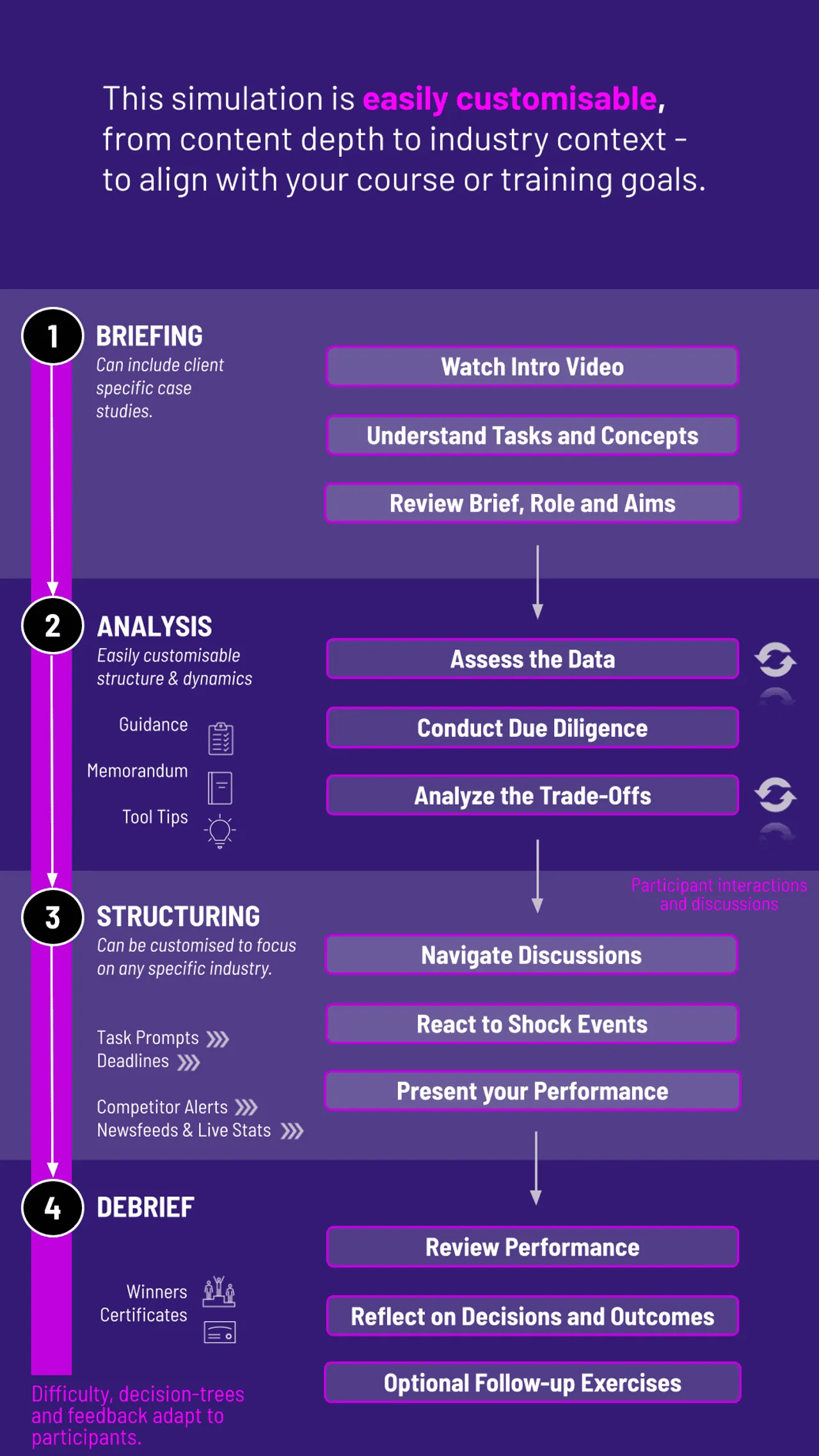

What Participants Do
In the simulation, participants will:
- Analyze loan applications from various businesses and decide on approval, amount, and interest rate.
- Set competitive interest rates for consumer deposits and corporate loans.
- Manage the bank's investment portfolio, including government and corporate bonds.
- Issue subordinated debt or equity to raise capital and meet regulatory requirements.
- Monitor key performance indicators (KPIs) like NIM, ROE, CAR, and Loan-to-Deposit Ratio.
- React to central bank policy changes, economic shocks, and competitor actions.
- Develop a coherent strategy to position the bank as a low-cost, high-risk, or balanced player in the market.
- Present a strategic review to the "board" (instructors and peers) justifying their decisions and performance.

Learning Objectives
By the end of the simulation, participants will be able to:
- Interpret the core financial statements of a commercial bank and its key performance metrics.
- Apply fundamental credit analysis techniques to make informed lending decisions.
- Formulate effective Asset-Liability Management (ALM) strategies to manage interest rate and liquidity risk.
- Evaluate the impact of macroeconomic events and regulatory changes on a bank's operations and strategy.
- Analyze the trade-offs between risk, return, liquidity, and capital adequacy.
- Create a coherent business strategy that aligns with the bank's risk appetite and market conditions.
- Collaborate effectively within a team to manage a complex financial institution under pressure.
How the Commercial Banking Simulation Works
This simulation can be run individually or in teams in academic or corporate contexts. Each cycle represents a stage of getting through a pressing financial situation.
1. Form Teams and Take Over a Bank Each team is assigned a bank with a starting balance sheet in a multi-period, online environment.
2. Review the Economy and Make Decisions Each round (representing a fiscal quarter or year), teams analyze the economic climate, their current financial position, and a queue of new loan applications and funding opportunities.
3. Input Decisions Teams input their decisions on loan approvals, interest rates, funding sources, and capital management into the simulation platform.
4. Get Results and Compete The simulation engine processes all team decisions simultaneously, generating results that show each bank's financial performance, stock price, and market share relative to competitors.
5. Review and Adapt Teams receive detailed reports, including an income statement, balance sheet, and key ratio analysis. They use this feedback to refine their strategy for the next round, navigating a changing economy.
Frequently Asked Questions
Assessment
Assessment of participant performance can be tailored according to the host institution’s objectives (business school, corporate training, assessment centre). Typical assessment criteria include:
- Portfolio Perfomance Score
- Net Worth Growth
- Simulation Performance
- Strategic Review Report
- Peer Evaluation
Assessment may incorporate peer and self-review components, facilitator scoring, and debrief discussion. Results may feed into grades, executive feedback, certification or development plans.