This simulation is ideal for students and professionals pursuing careers in risk management, operations, treasury, middle office functions, and anyone needing to understand the post-trade ecosystem in derivatives markets.

Collateral Management Simulation
Step into the back-office and risk functions of modern finance. Manage the complex exchange of collateral to mitigate counterparty risk in derivative trades, navigating market shocks, regulatory demands, and liquidity constraints.

Collateral Management Simulation Overview
This Collateral Management Simulation immerses participants in the operational heart of the over-the-counter derivatives market. Acting as collateral management professionals within a major bank or buy-side firm, teams are tasked with securing their firm's exposure throughout a dynamic trading day.
Participants must process incoming margin calls, optimize the allocation of scarce high-quality assets, manage cash flows, and respond to credit rating downgrades or sudden increases in volatility, all while maintaining compliance with Credit Support Annex terms and regulatory frameworks like Uncleared Margin Rules. The simulation captures the pressure and strategic decision-making required to protect the firm from default risk without crippling its trading capabilities or liquidity.
Tailored for university finance programs, risk management courses, and corporate training for operations and treasury staff, this gamified experience transforms abstract concepts into tangible skills through hands-on, consequential decision-making.

Collateral Management Simulation Concepts
Participants work through realistic scenarios, which can be customized to emphasize or exclude specific topics depending on the learning goals. This modular structure allows the simulation to be tailored to any type of session. Key concepts include:
- Counterparty Credit Risk
- Credit Valuation Adjustment
- Credit Support Annex
- Margin Call Processing
- Collateral Optimization and Haircut Application
- Liquidity Management and Collateral Transformation
- Regulatory Frameworks
- Operational Workflows and Dispute Resolution
- Impact of Market Shocks on collateral requirements
- High-Quality Liquid Asset

Gameflow
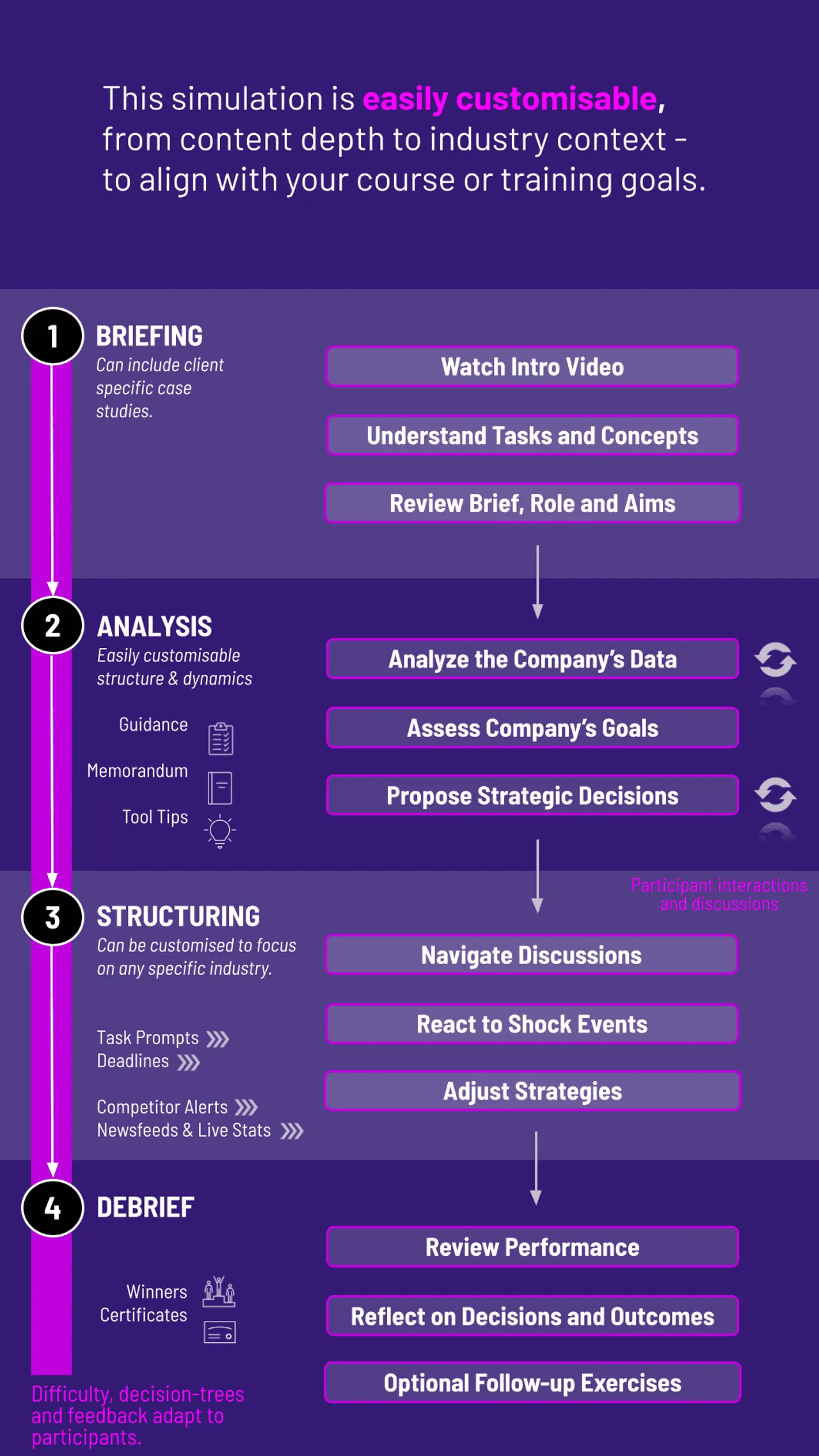

What Participants Do
In the simulation, participants will:
- Analyze trade portfolios and calculate daily exposure using industry methods.
- Process and respond to margin calls from multiple counterparties.
- Strategically select and allocate collateral assets from a limited pool to meet calls.
- Navigate and apply the specific terms of different CSAs.
- Manage liquidity by deciding when to transform assets or access funding.
- Respond to real-time economic events that trigger rating changes or volatility spikes.
- Negotiate with "counterparty" teams to resolve collateral disputes.
- Report on collateral positions, usage, and potential risks to the "management."

Learning Objectives
By the end of the simulation, participants will be able to:
- Explain the role of collateral management in mitigating systemic and counterparty risk.
- Execute the step-by-step workflow for processing and settling margin calls.
- Apply haircuts and make optimal collateral allocation decisions under constraints.
- Articulate the impact of key regulations (UMR, Basel III) on collateral practices.
- Analyze how market events directly affect collateral demand and liquidity needs.
- Develop strategies for efficient collateral and liquidity management.
- Communicate collateral positions and disputes effectively with counterparties and internal stakeholders.
- Build confidence in making critical operational decisions under time pressure.
How the Collateral Management Simulation Works
This simulation can be run individually or in teams in academic or corporate contexts. Each cycle represents a stage of getting through a pressing financial situation.
1. Receive the Brief Teams receive their firm's trading book, CSA terms with key counterparties, and available collateral inventory.
** 2. Analyze Exposure and Calls** Each round, teams calculate net exposure, receive margin calls, and assess their available HQLA.
3. Make Strategic Decisions Participants decide which assets to pledge to which counterparty, manage cash, and potentially negotiate calls.
4. Collaborate and Negotiate Teams may need to internally prioritize calls or engage with other teams acting as counterparties to resolve disputes.
5. Navigate Shocks Mid-simulation injections, like a broad market sell-off or a counterparty downgrade, force strategic pivots.
6. Review and Reflect End-of-round dashboards show performance metrics (cost of collateral, dispute rate, liquidity buffer), leading to strategy refinement for the next round.
Frequently Asked Questions
Assessment
Assessment of participant performance can be tailored according to the host institution’s objectives (business school, corporate training, assessment centre). Typical assessment criteria include:
- Speed and accuracy in processing margin calls.
- Minimizing the cost of collateral and preserving liquidity.
- Adherence to CSA terms and effective mitigation of exposure.
- Quality of collateral optimization and response to market shocks.
- Clarity in internal reporting and effectiveness in resolving disputes with counterparties.