No. The simulation provides all necessary context, making it accessible for all levels.

Climate Risk Simulation
In this hands-on Climate Risk Simulation, participants act as corporate or financial leaders navigating environmental, regulatory, and market risks. They balance sustainability, profitability, and reputation while making high-stakes strategic decisions.

Climate Risk Simulation Overview
Participants step into decision-making roles where climate-related risks have immediate financial and strategic consequences. Each round introduces new developments - regulatory shifts, activist pressure, climate shocks, or investor expectations - that force participants to adapt their approach.
They must weigh trade-offs between short-term returns and long-term resilience, managing factors like carbon exposure, supply chain vulnerability, and customer perception. Performance depends not only on financial results but also on credibility and sustainability.
The simulation is designed for use in business schools, executive education, and corporate leadership programs, providing a practical lens to explore climate risk management, ESG, and strategic adaptation.

Climate Risk Simulation Concepts
Participants work through realistic scenarios, which can be customized to emphasize or exclude specific topics depending on the learning goals. This modular structure allows the simulation to be tailored to any type of session. Key concepts include:
- Climate-related financial disclosures and reporting
- Transition risk: carbon pricing, regulation, and investor pressure
- Physical risk: climate shocks, supply chain disruption, and resilience
- ESG integration and stakeholder alignment
- Green finance, carbon markets, and sustainable investment
- Trade-offs between profit and environmental responsibility
- Communication and reputation management
- Scenario planning and stress testing
- Innovation and sustainable product strategy
- Ethics, governance, and accountability in climate-related decisions

Gameflow
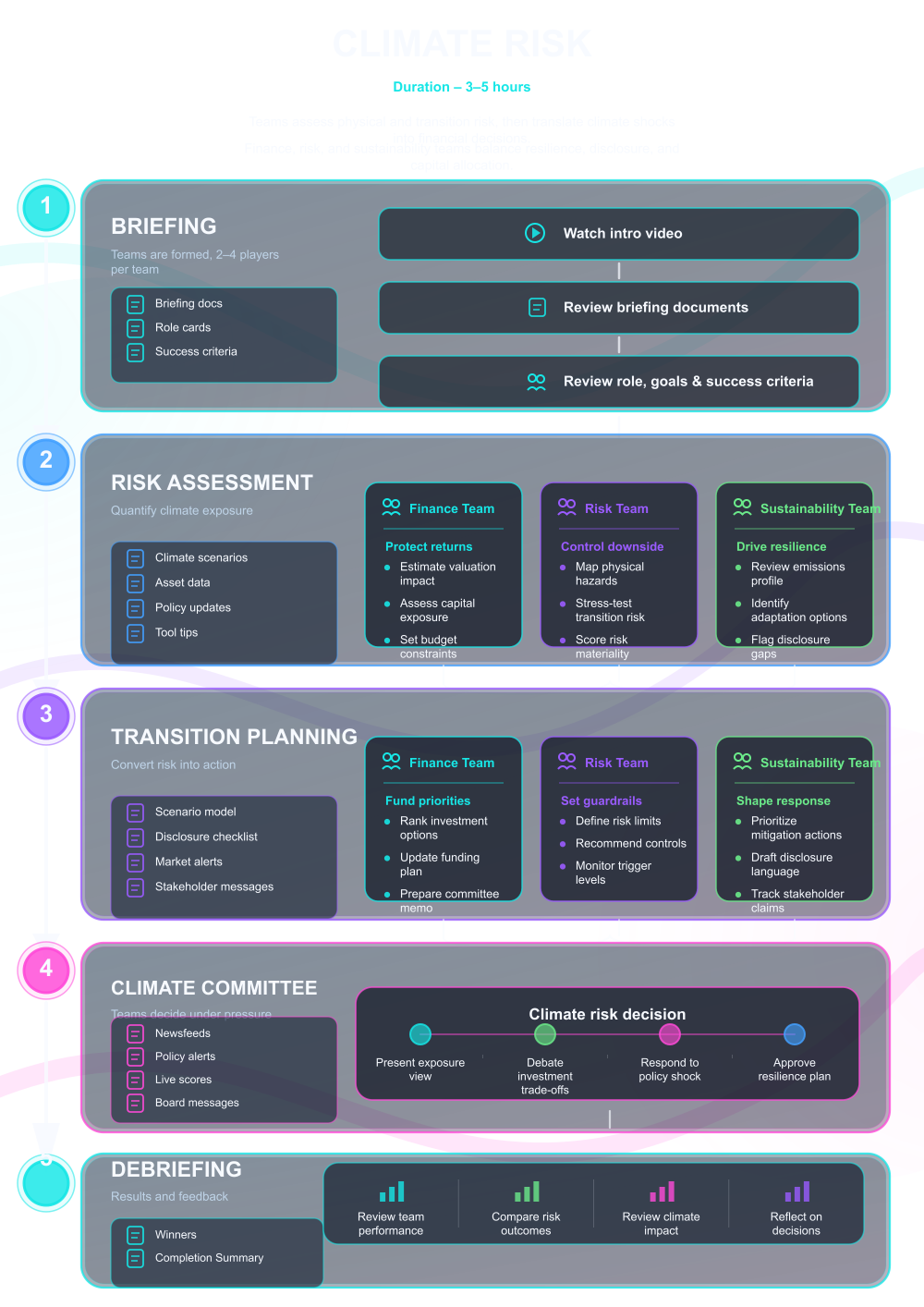

What Participants Do
In this simulation, participants act as corporate executives, bankers, or policymakers. They:
- Assess financial and operational exposure to climate risks
- Decide on mitigation strategies like divestment, carbon offsets, or green innovation
- Balance stakeholder pressure from regulators, investors, NGOs, and communities
- Manage crises such as natural disasters or public protests
- Communicate strategy in board presentations, press releases, or investor calls
- Adapt decisions across multiple rounds as climate risks evolve

Learning Objectives
By the end of the simulation, participants will be able to:
- Identify and assess physical and transition climate risks
- Integrate ESG considerations into strategic decision-making
- Balance short-term profitability with long-term sustainability
- Evaluate financial trade-offs in mitigation and adaptation strategies
- Communicate effectively with diverse stakeholders under pressure
- Understand climate-related reporting frameworks and investor expectations
- Strengthen resilience planning across business models and industries
- Make ethical decisions in the face of competing pressures
- Apply scenario planning to uncertain and complex environments
- Collaborate across functions to build sustainable strategies
The simulation’s flexible structure ensures that these objectives can be calibrated to match the depth, duration, and focus areas of each program, whether in higher education or corporate learning.
How the Climate Risk Simulation Works
This simulation can be delivered in classrooms, workshops, or corporate programs, and run individually or in teams. Each cycle builds complexity and mirrors real-world climate risk dynamics.
1. Receive a Scenario or Brief: Each round begins with a scenario - such as new regulation, climate-related losses, or shifting investor sentiment. Participants are given objectives and context.
2. Analyse the Situation: They review financial data, stakeholder expectations, and environmental metrics, identifying key risks and opportunities.
3. Make Strategic Decisions: Participants choose between mitigation and adaptation strategies, resource allocations, and communication tactics - all with financial and reputational consequences.
4. Collaborate and Role-Play: In team formats, participants role-play as executives, regulators, or investors, negotiating and aligning strategies.
5. Review Results and Reflect: Feedback highlights financial performance, ESG credibility, and stakeholder reactions. Participants reflect on successes and missteps.
6. Repeat and Iterate: Each new round introduces additional complexity, requiring participants to adapt and refine strategies.
Frequently Asked Questions
Assessment
Assessment can be tailored to focus on strategic thinking, ethical decision-making, or sustainability outcomes. Participants may be evaluated on:
- Climate risk identification and management
- Strategic alignment of adaptation and mitigation choices
- Communication quality in stakeholder contexts
- Responsiveness to changing external conditions
- Collaboration and negotiation effectiveness
You can also include memo writing and debrief presentations as part of the assessment structure. Additionally, you can also add a built-in peer and self-assessment tool to see how participants rate themselves. This flexibility allows the simulation to be easily integrated by professors as graded courses at universities and by HR at assessment centres at companies.