This simulation is ideal for finance students (BSc, MSc, MBA), corporate trainees, early-career treasury professionals, and anyone seeking hands-on experience in liquidity management and corporate finance.

Cash Management Simulation
In the Cash Management Simulation, participants step into the role of corporate treasury managers, navigating the complexities of liquidity, cash flow forecasting, working capital optimization, and risk mitigation.

Cash Management Simulation Overview
The Cash Management Simulation is an interactive training tool designed by corporate treasury and finance professionals. Replicate the end-to-end cash management process within a corporate treasury department, where participants must optimize liquidity, manage working capital, forecast cash flows, and respond to unexpected financial shocks.
Participants will face evolving scenarios, such as fluctuating interest rates, supplier payment delays, sudden market downturns, or urgent investment opportunities, that test their ability to maintain solvency while maximizing returns on idle cash. The simulation emphasizes strategic decision-making, analytical thinking, and adaptability in a high-pressure environment with time constraints.
Ideal for university finance programs, MBA courses, corporate training, and treasury certification programs, this simulation bridges theory and practice, giving learners a visceral understanding of how cash management impacts overall corporate health and strategic flexibility.

Cash Management Simulation Concepts
Participants work through realistic scenarios, which can be customized to emphasize or exclude specific topics depending on the learning goals. This modular structure allows the simulation to be tailored to any type of session. Key concepts include:
- Cash flow forecasting and liquidity planning
- Working capital management
- Short-term investment and financing strategies
- Cash pooling and netting techniques
- Bank relationship management and fee negotiation
- FX and interest rate risk exposure management
- Compliance and internal controls in treasury operations
- Technology and automation in cash management
- Stress testing and contingency funding planning
- ESG considerations in treasury and liquidity decisions

Gameflow
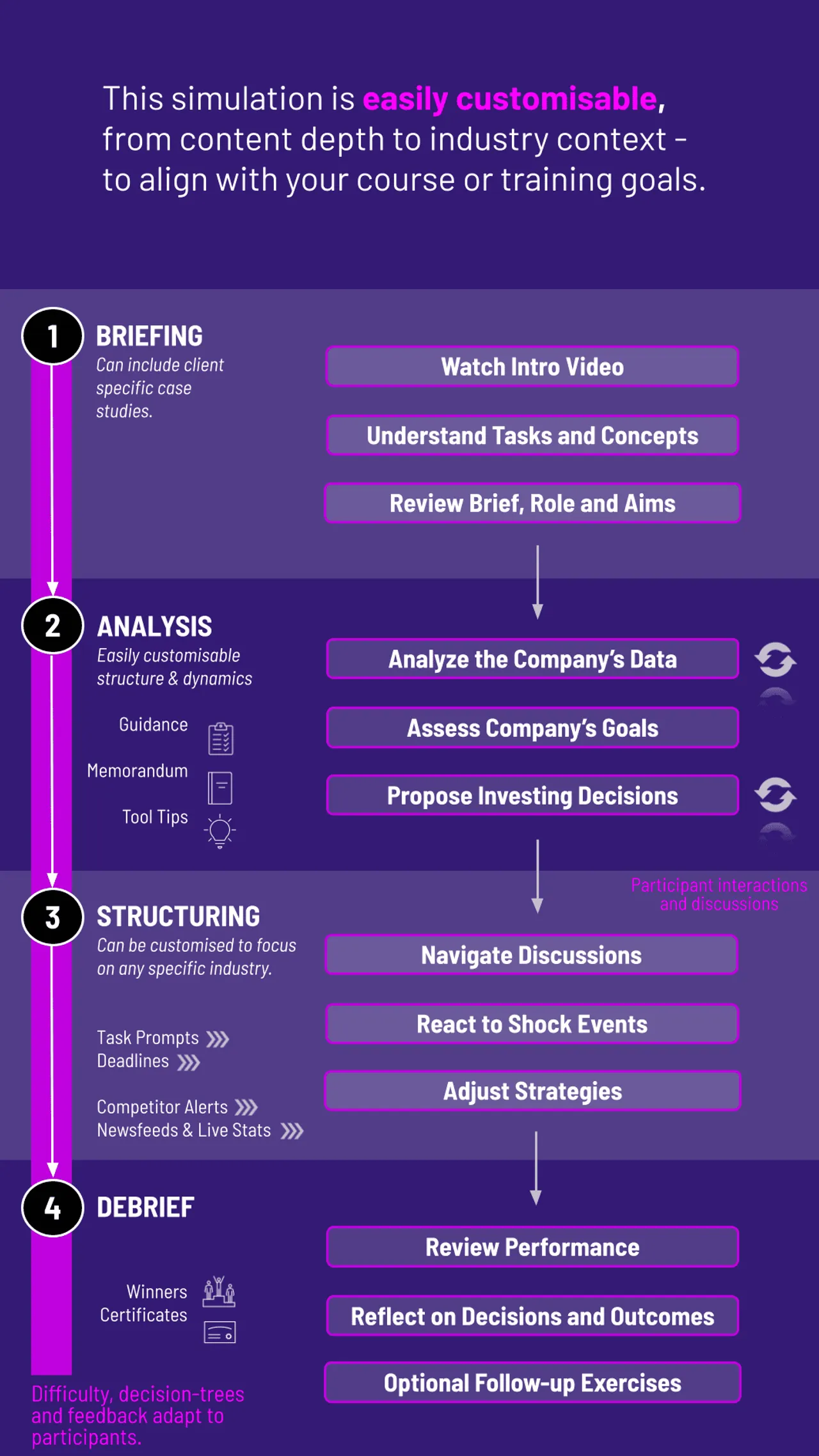

What Participants Do
In the simulation, participants will:
- Analyze company financials, cash flow statements, and market data
- Forecast short- and medium-term cash positions
- Optimize working capital by managing payables, receivables, and inventory
- Execute short-term investments or borrowings to balance liquidity
- Respond to unexpected events like economic shocks or operational disruptions
- Negotiate with banks for better terms and lower fees
- Present cash management strategies and performance updates to senior management
- Reflect on decision outcomes and adjust strategies across simulation rounds

Learning Objectives
By the end of the simulation, participants will be able to:
- Understand the role and functions of a corporate treasury department
- Apply cash flow forecasting techniques to predict liquidity needs
- Optimize working capital to free up cash and reduce financing costs
- Evaluate short-term investment and borrowing instruments
- Mitigate financial risks related to currency, interest rates, and counterparties
- Leverage technology and banking solutions for efficient cash management
- Communicate treasury performance and strategies effectively to stakeholders
- Develop judgment and adaptability under financial uncertainty
- Recognize the impact of cash management on corporate strategy and valuation
- Build confidence in making data-driven treasury decisions
How the Cash Management Simulation Works
This simulation can be run individually or in teams in academic or corporate contexts. Each cycle represents a stage of getting through a pressing financial situation.
1. Receive a Scenario Brief Participants review the company’s financial position, market conditions, and treasury objectives.
** 2. Analyze Data** Examine cash flow statements, bank balances, market rates, and upcoming obligations.
3. Make Decisions Allocate cash, adjust working capital policies, invest or borrow, and hedge exposures.
4. Collaborate and Negotiate Teams may role-play as treasury, AP/AR, or banking partners to align priorities.
5. Submit Plans Participants lock in their decisions within time limits.
6. Review Outcomes The simulator generates results showing liquidity position, costs/returns, and risk metrics.
7. Adapt Strategies In subsequent rounds, participants refine approaches based on feedback and new challenges.
8. Present and Debrief Teams explain their strategies and lessons learned in a final review session.
Frequently Asked Questions
Assessment
Assessment of participant performance can be tailored according to the host institution’s objectives (business school, corporate training, assessment centre). Typical assessment criteria include:
- Liquidity efficiency, minimizing financing costs while maintaining adequate cash buffers
- Working capital optimization, improving DSO, DPO, and inventory turnover
- Risk management, effectively hedging FX and interest rate exposures
- Strategic adaptability, responding to market shocks and unforeseen events
- Communication, clarity and persuasiveness in presenting treasury strategies to stakeholders
- Collaboration, teamwork and negotiation in multi-role settings