Yes. It’s adaptable for MBA, undergrad, or corporate training contexts.

Capital Structure Optimization Simulation
In this simulation, participants act as CFOs tasked with optimizing the capital structure. They balance debt and equity under changing market, credit, and strategic conditions to maximize firm value.

Capital Structure Optimization Simulation Overview
The Capital Structure Optimization Simulation places participants in the role of senior finance executives navigating real-world decisions around funding, leverage, and financial stability. Faced with dynamic market conditions, they must manage the company’s debt-to-equity mix to improve valuation, minimize risk, and align with long-term strategy.
Throughout the simulation, learners explore how interest rate changes, credit ratings, industry shifts, and investor sentiment influence capital structure decisions. Participants are expected to adjust financing plans in response to new opportunities (such as acquisitions or expansion) and risks (such as market volatility or profit decline).
Co-developed with CFOs and investment bankers, this simulation blends technical calculations with strategic trade-offs and board-level communication.

Capital Structure Optimization Simulation Concepts
Participants work through realistic scenarios, which can be customized to emphasize or exclude specific topics depending on the learning goals. This modular structure allows the simulation to be tailored to any type of session. Key concepts include:
- Debt vs. Equity Trade-offs
- Optimal Capital Structure Theory (Modigliani-Miller, trade-off theory, pecking order)
- Cost of Capital (WACC adjustments based on capital mix)
- Credit Ratings and Interest Rates
- Market Signaling and Investor Perception
- Covenants and Financial Flexibility
- Impact of Capital Structure on Valuation
- Scenario-Based Stress Testing

Gameflow
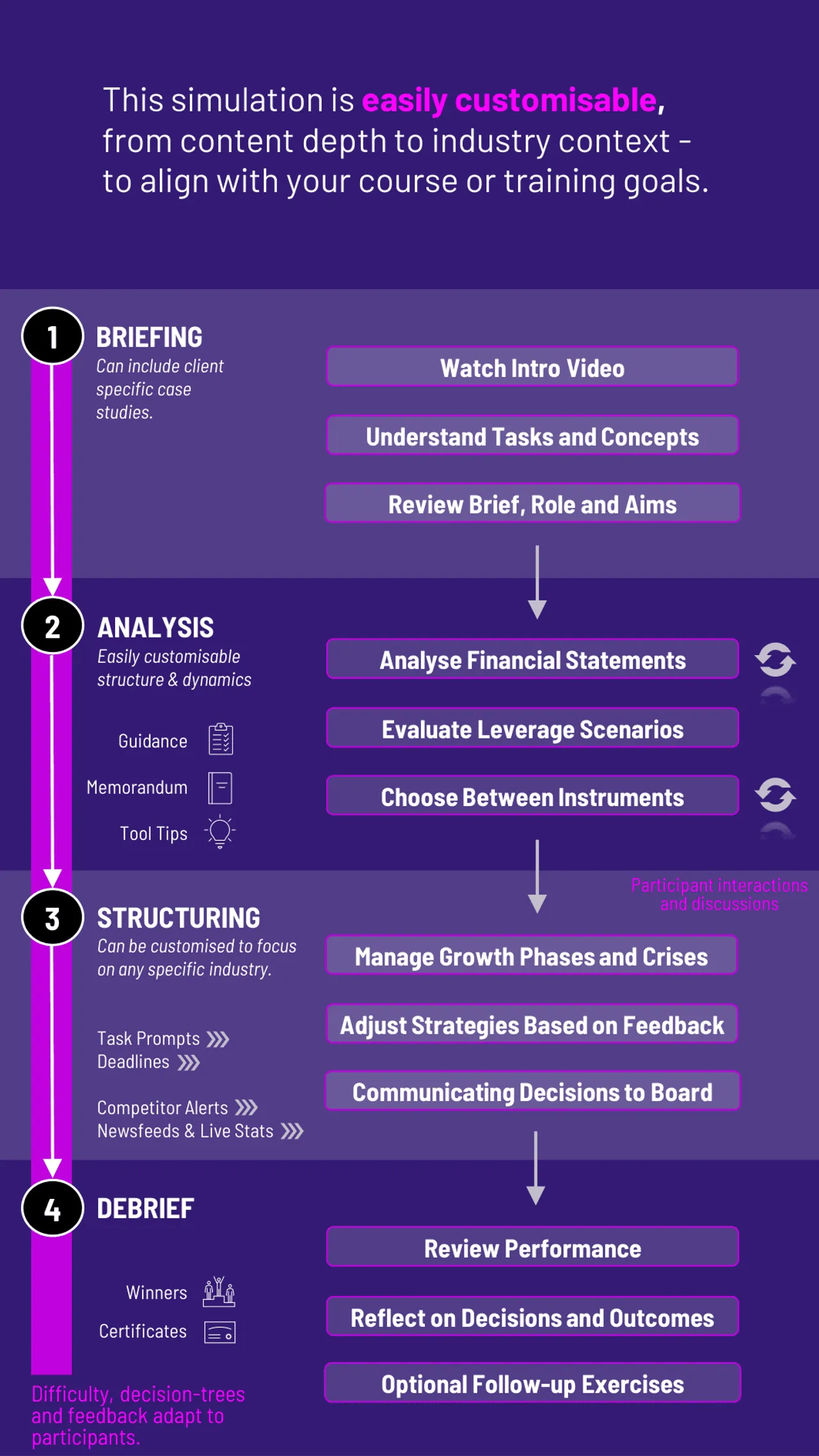

What Participants Do
Participants make critical capital structure decisions over several decision cycles, including:
- Analyzing financial statements and capital costs
- Evaluating leverage scenarios under varying business forecasts
- Choosing between issuing debt, equity, or hybrid instruments
- Assessing the impact of capital changes on WACC, credit rating, and shareholder value
- Communicating funding decisions to boards, analysts, and investors
- Managing capital structure during growth phases, crises, or M&A events
- Adjusting strategy based on simulated stakeholder feedback and market dynamics

Learning Objectives
By the end of the simulation, participants will:
- Understand the core principles of capital structure theory
- Apply capital mix decisions to real-world financial challenges
- Evaluate how financing choices affect risk, cost of capital, and valuation
- Respond to shifts in macroeconomic conditions, credit markets, and investor sentiment
- Build persuasive narratives to justify financing strategies
- Work cross-functionally to balance capital access with operational needs
- Apply stress-testing and scenario planning to financial strategy
The simulation’s flexible structure ensures that these objectives can be calibrated to match the depth, duration, and focus areas of each program, whether in higher education or corporate learning.
How the Capital Structure Optimization Simulation Works
The simulation runs over several rounds, each simulating a fiscal period or strategic inflection point.
1. Scenario Introduction Participants receive a business case with financials, goals, and constraints.
2. Capital Assessment They evaluate existing capital structure, debt maturities, and liquidity.
3. Decision Making Participants make funding choices (e.g., refinance debt, issue new equity, or adjust mix).
4. Market and Stakeholder Feedback Their decisions affect stock price, credit score, investor sentiment, and financial ratios.
5. Board-Level Communication Participants justify their capital strategy through memos or presentations.
6. Next-Round Adaptation Each new cycle introduces a new economic context, requiring recalibration.

Why This Capital Structure Optimization Simulation Works
Capital structure optimization isn’t just about formulas - it’s a strategic balancing act. This simulation brings technical finance concepts to life through realistic, high-stakes decisions.
Participants must think like CFOs: forecasting risk, understanding capital markets, and defending their plans to multiple stakeholders. It connects valuation theory to the pressures of real business dynamics.
Frequently Asked Questions
Assessment
Participants are evaluated on:
- Financial soundness and realism of capital decisions
- Strategic consistency over multiple simulation rounds
- Responsiveness to market signals and economic shifts
- Clarity and persuasiveness in written or verbal communication
- Collaboration, if run in team format
- Understanding of how capital mix impacts valuation and risk
Deliverables can include investment memos, capital structure reports, or final board presentations. Additionally, you can also add a built-in peer and self-assessment tool to see how participants rate themselves. This flexibility allows the simulation to be easily integrated by professors as graded courses at universities and by HR at assessment centres at companies.