Duration
About 3-4 hours
You set every stage timing from the professor panel, so it fits one block or splits across two sessions.

Capital Markets Simulation
The Finsimco Capital Markets Simulation gives each student a company that needs $400 million. They decide whether to sell shares or borrow it, find a price investors will pay, then watch what the market does to that price afterwards.
Duration
You set every stage timing from the professor panel, so it fits one block or splits across two sessions.
Format
Each student works alone and asynchronously, taking the issuer, investor and market roles in turn.
Level
Adjustable to the level you teach. The same activity suits a first-year class or an MBA group.
Professor tools
Manage students, adjust stage timings, control progression and monitor individual inputs.
Prerequisites
Only what a share and a bond are. Pricing, demand, allocation and the spread are explained inside.
Delivery
The web-based simulation supports in-person, remote, blended and homework-supported delivery.
Assessment
Every submission is individual, so each student's decisions and reasons export for grading, or run it ungraded.
Course fit
Designed for Capital Markets, Investments, Corporate Finance and Financial Markets courses.
The topics a capital markets module has to cover: equity against debt and what each one promises, primary markets and how a new issue is sold, how a price is discovered from investor demand, risk and the return investors require for it, secondary markets and what happens after the money is raised, and liquidity and the bid-ask spread.
Written to drop into your module descriptor without rewriting. On completing the simulation, your students will be able to:
Each student runs the fundraising alone, holding the issuer, investor and market roles in turn. All three want something different from the same $400 million, and only one deal gets submitted.
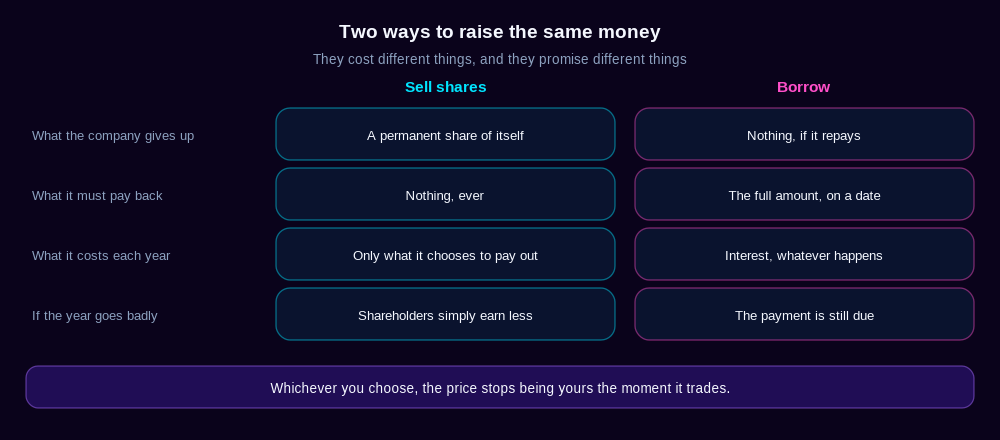
Students decide how much money the company needs and whether to raise it by selling shares or by borrowing, which are not the same promise to make.
Students decide what the company is worth to them and what they will actually pay for it, which is lower than the issuer would like.
Students watch what happens to the price once anybody can buy and sell it, and find out how easily it can be traded at all.
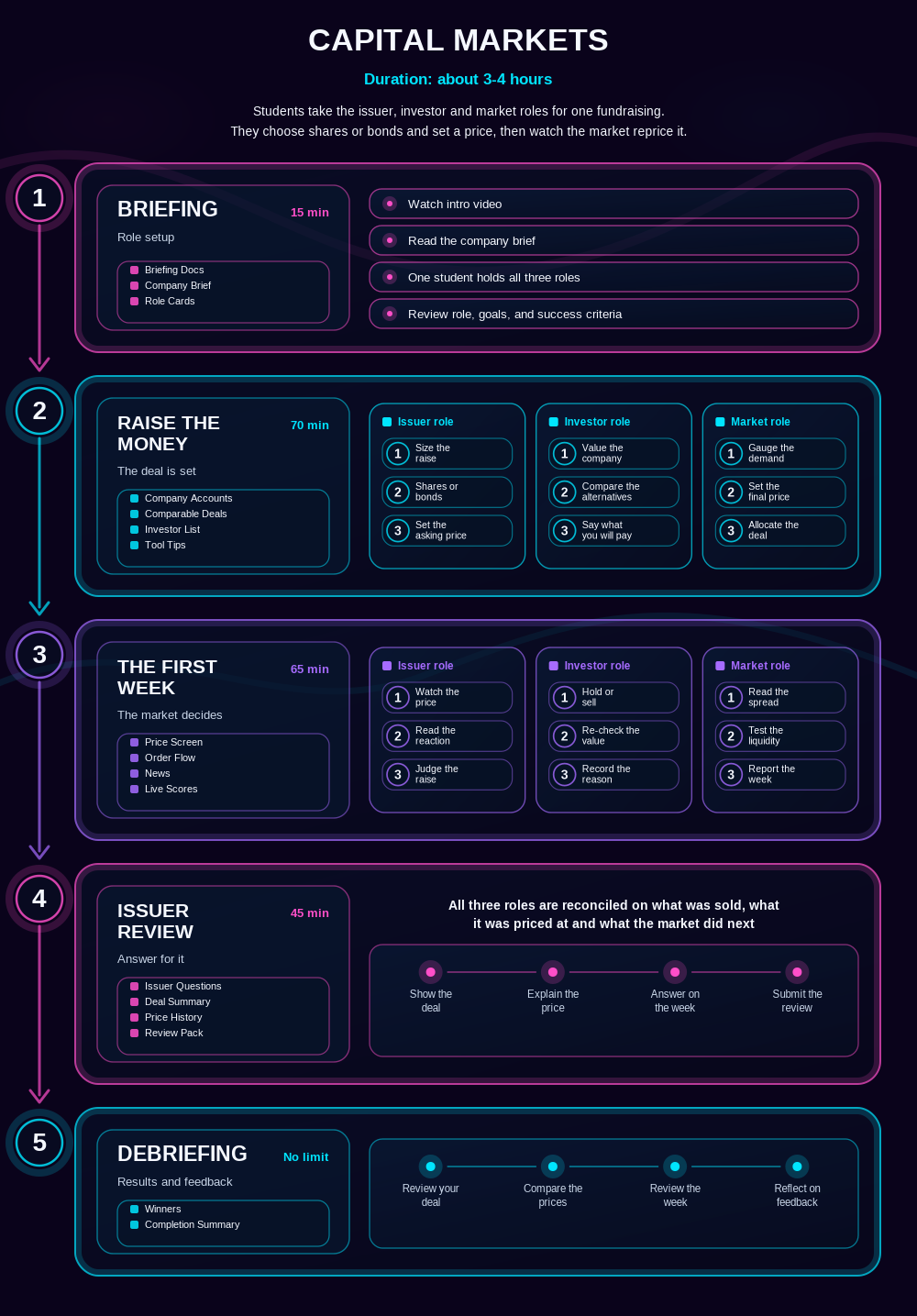
Five stages. Students choose how to raise the money, agree a price with investors, then watch the market change it.
Stage 1 · 15 min
briefing docs · company brief · role cards
Students watch the intro video, read a brief for a company that needs $400 million and cannot fund it from its own cash, and take on all three roles, checking what each one is judged on before anything is chosen.
Stage 2 · 70 min
company accounts · comparable deals · investor list · tool tips
The deal gets built. Working as issuer, the student decides how much to raise and whether to sell shares or borrow; as investor, works out what the company is worth and what they will pay; as market, reads the demand and strikes a price. The deal is submitted with a reason for the instrument and the price.
Stage 3 · 65 min
price screen · order flow · news · live scores
Trading opens. The price moves away from where it was set, a piece of news arrives that nobody priced in, and some investors try to sell more than the market can absorb without moving the price against them.
Stage 4 · 45 min
issuer questions · deal summary · price history · review pack
Students are asked why they chose shares over bonds or the other way round, how much more the company could have raised, whether the first week's price says the deal was mispriced or the news was simply unlucky, and who they gave the securities to.
Stage 5 · No limit
winners · completion summary
Students review their own deal, compare instruments and prices across the cohort, revisit the decisions that produced them and reflect on the feedback. Winners and the completion summary give you a structure for the discussion.
The student interface carries the company, the demand and the reasoning. The professor panel carries the timeline, the controls and every individual deal.
Students work option by option, with what each way of raising the money costs, what it commits the company to and how much demand there is sitting next to the box they choose, and a written reason required for the instrument picked and each one rejected.
Once trading opens the price is no longer anyone's decision. The spread column shows how much it costs to get out, which is usually the first time students see that selling has a price of its own.
Your view. Adjust any stage timing, start or stop the session, and compare what each student chose to issue with what the market did to it in the first week.
Explore the student and professor experience, and discuss timing, setup and syllabus fit.
It works best early, as the session that shows what a market is for before the instruments are taught one by one.
What a share and a bond are, in one sentence each. No market experience is needed: pricing, demand, allocation and the spread are all explained inside the activity.
Early to mid module, typically weeks three to seven, as the session that connects the primary and secondary markets in one sitting.
Bond pricing and the yield curve, equity valuation, market microstructure, derivatives, and any assessment asking students to defend a financing decision.
The capital markets course guide sets out where it sits in a full module.
The three mistakes students make on this topic almost every time. Recognising them is usually the moment the subject lands, and it is the core of the learning science behind it.
1
Students price the deal as high as investors will tolerate, raise the most money, and then watch the price fall all week while the investors who bought it decide not to come back next time. A fundraising is not a one-off sale; the price has to leave something for the buyer or there is no buyer the second time. This is the cleanest route into why issuers deliberately price below what they could get.
2
Both bring money in, so students choose on price alone. Selling shares gives away part of the company forever and promises nothing; borrowing keeps the company but promises to pay it back whatever happens. Students who have only compared the cost are caught by the first question about what the company is now committed to.
3
The price was agreed between an issuer and some investors. The moment it trades, anyone can buy or sell and the price is whatever the last trade says. Students who set a price carefully and then see it move within a day learn what a secondary market is in a way no definition achieves, and it is the natural way into liquidity and the spread.
The debrief runs itself. Every student sees their results, the cohort comparison and the decisions that produced them, with nothing for you to prepare. If you would rather lead the discussion, these five questions work straight from a slide, and they use what your cohort actually did.
Assessment is optional. Run the simulation ungraded as an applied activity, or use platform data as supporting evidence. Every student generates an instrument choice, a price, an allocation, a first-week result and written reasons. Because the simulation is single-player, every input belongs to one named student, so there is no group-work marking to untangle. All of it exports as CSV or PDF, per student, so you can assess reasoning rather than a result.
On generative AI: written rationales are exactly what marking teams now worry about. Because every rationale here is tied to a price the student set inside the platform, with the demand it came from and the first week of trading sitting next to it, the reasoning can be checked against the evidence rather than taken on trust.
93% of students rate Finsimco simulations Excellent, across more than 30,000 responses.
Teaching notes, a setup and facilitation guide and a gameflow diagram come with it, and we support your first delivery directly.
Run it ungraded the first time. Assessment is optional and can be added once you have seen how your cohort responds.
Pause or stop at any point and resume later without losing submitted data, so an overrun costs you a timetable slot, not the activity.
Read what lecturers say.
Ron Tuninga, Managing Director for EMEA at AACSB, and Victor Hedenberg, Membership Director at AMBA, on why simulation-based learning belongs in business education. Watch both interviews.
If this one is not quite right for your module, these are the closest alternatives.

Taking a company public and pricing it.
Learn More
Raising debt and living with the terms.
Learn More
Getting a deal priced, placed and done.
Learn More
What a share is worth and why the number moves.
Learn More
The order book, the spread and the cost of size.
Learn More
What a bond pays, and what can go wrong.
Learn MoreA one-page summary of this simulation, covering stages and timings, roles, concepts, learning outcomes and the debrief questions, plus a full sample teaching pack from one of our live simulations, so you can see exactly what you would be running.
During the call, we can: