It is ideal for high-potential employees, new managers, cross-functional teams, and business students who need to develop a comprehensive, big-picture understanding of how a company works.

Business Acumen Simulation
A dynamic simulation where participants step into the shoes of business leaders to make critical, integrated decisions that drive company performance in a competitive market.

Business Acumen Simulation Overview
In this immersive Business Acumen Simulation, participants take on the role of executive managers responsible for steering a company through multiple business cycles. They face the core challenge of any leader: making holistic decisions that balance immediate financial performance with long-term strategic health. Each simulation round presents a new market scenario with evolving competitive dynamics, economic shifts, and internal resource constraints.
Teams must analyze financial statements, interpret market data, and allocate limited capital across competing priorities like R&D, marketing, operations, and talent development. The experience bridges the gap between functional expertise and general management, requiring participants to understand how decisions in one area ripple through the entire P&L and balance sheet.
The simulation is ideal for emerging leaders, management trainees, and cross-functional teams in corporate training programs, as well as MBA and advanced business students, providing a safe yet intense environment to develop the judgment required for executive roles.

Business Acumen Simulation Concepts
Participants work through realistic scenarios, which can be customized to emphasize or exclude specific topics depending on the learning goals. This modular structure allows the simulation to be tailored to any type of session. Key concepts include:
- Financial Statement Fluency
- Strategic Investment and Resource Allocation
- Operational Efficiency
- Market Positioning and Pricing Strategy
- Drivers of Profitability and Valuation
- Cross-Functional Decision-Making
- Managing Trade-offs
- Scenario Planning and Risk Management

Gameflow
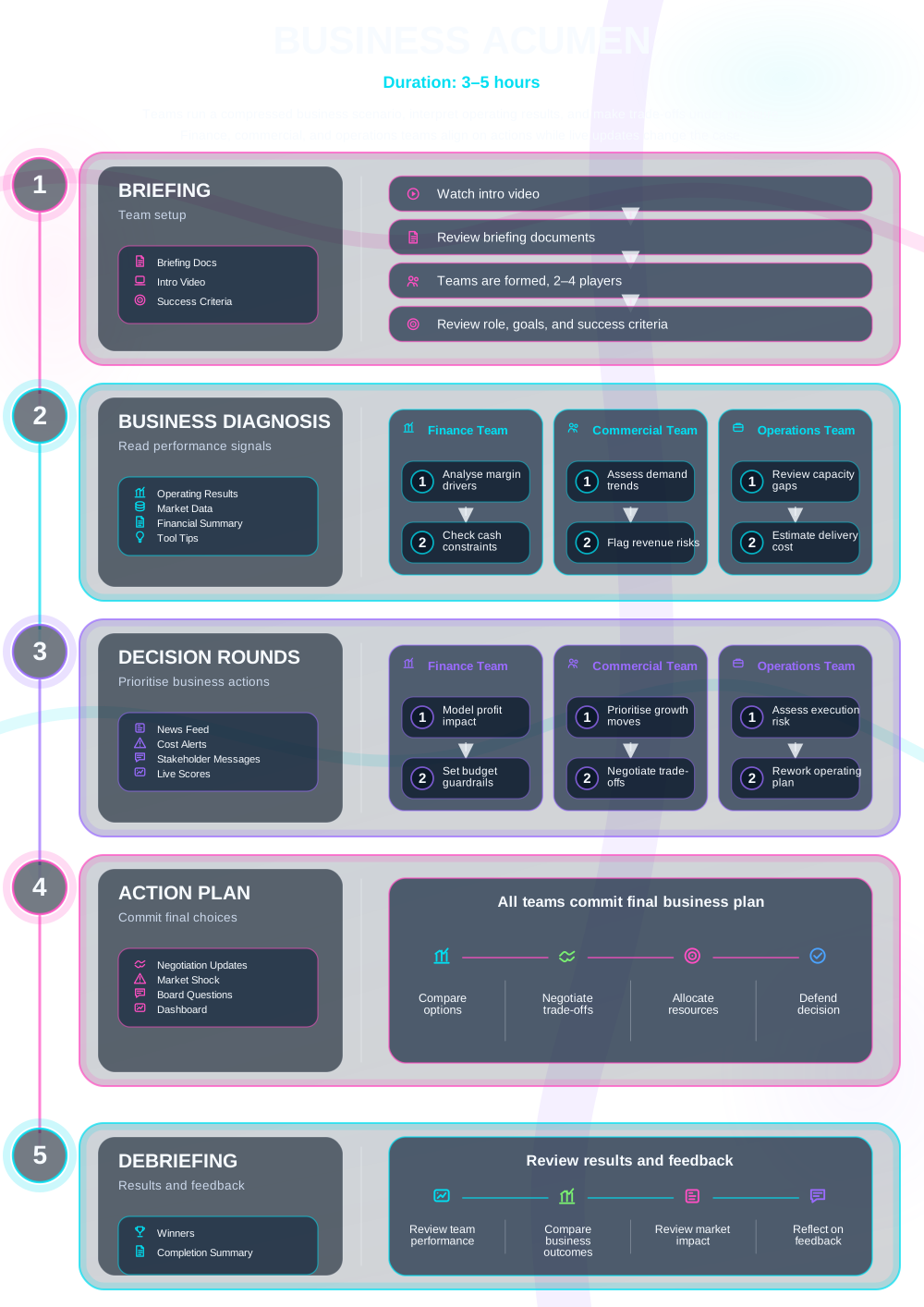

What Participants Do
In the simulation, participants will:
- Analyze company financials, market reports, and competitor data.
- Set overarching strategy and make quarterly decisions on pricing, production, marketing spend, and R&D investment.
- Manage operational constraints like capacity and inventory levels.
- Secure financing and manage cash flow to fund operations and growth.
- Negotiate priorities and resource allocation within their team.
- Present their strategic plan and business results to a board of directors or investors.
- Adapt their strategy based on performance feedback and changing market conditions.

Learning Objectives
By the end of the simulation, participants will be able to:
- Read and use key financial statements to make informed business decisions.
- Allocate finite resources strategically to maximize firm value and competitive advantage.
- Articulate the cause-and-effect relationships between operational levers and financial outcomes.
- Develop a holistic view of the business that integrates marketing, operations, and finance.
- Make disciplined trade-offs between short-term profitability and long-term strategic goals.
- Communicate business performance and strategy clearly to stakeholders.
- Build confidence in executive-level decision-making under pressure and uncertainty.
How the Business Acumen Simulation Works
This simulation can be run individually or in teams in academic or corporate contexts. Each cycle represents a stage of getting through a pressing financial situation.
1. Briefing and Analysis Teams receive a company brief, historical financials, and current market data. They analyze their starting position and competitive landscape.
** 2. Strategic Planning** Teams establish their multi-period goals and strategic priorities.
3. Decision Input Each round (representing a business quarter), teams input a comprehensive set of decisions covering pricing, sales forecasts, production, marketing, and capital investment.
4. Execution and Results The simulator processes decisions against a dynamic market model, generating financial results, market share updates, and competitor reactions.
5. Review and Reflection Teams review their income statement, balance sheet, and key performance dashboards. Facilitators lead debriefs on the outcomes.
6. Iteration Teams use insights from the results to adjust their strategy for the next round, facing new market developments. This cycle repeats, building complexity and reinforcing learning.
Frequently Asked Questions
Assessment
Assessment of participant performance can be tailored according to the host institution’s objectives (business school, corporate training, assessment centre). Typical assessment criteria include:
- Achievement of key metrics like profitability, market share, and return on invested capital across simulation rounds.
- The rationale and strategic coherence behind their choices, especially in managing trade-offs.
- How effectively the team adjusted its strategy based on market feedback and results.
- The clarity and persuasiveness of their final strategic review or board presentation.
- How well the team leveraged diverse perspectives to analyze data and reach decisions.