Textbooks teach the formula; our simulation teaches the feel. You experience the direct, cause-and-effect relationship of your decisions on profitability, making the learning stick through experiential engagement.

Break-Even Analysis Simulation
Our Break-Even Analysis Simulation transforms a core financial concept into a dynamic, hands-on learning experience and moves beyond static formulas and spreadsheets to manage a virtual company.

Break-Even Analysis Simulation Overview
The Break-Even Point is more than just a number, it's the critical milestone where a business begins to generate profit. Understanding the dynamics that influence the BEP is essential for managers, entrepreneurs, and investors alike. This simulation places participants in the role of a product manager for a new startup. They are tasked with launching a product and steering the company toward profitability as quickly as possible.
Participants will control key levers of the business, including setting the sales price, managing fixed operational costs, and negotiating variable costs. They will run the company over several simulated months, observing in real-time how their decisions affect unit sales, total revenue, total costs, and ultimately, the break-even point. The goal is to achieve and sustain profitability while navigating market fluctuations and competitive pressures.
This simulation provides an intuitive and practical understanding of how fixed costs, variable costs, and pricing directly impact a company's path to profitability and long-term financial health.

Break-Even Analysis Simulation Concepts
Participants work through realistic scenarios, which can be customized to emphasize or exclude specific topics depending on the learning goals. This modular structure allows the simulation to be tailored to any type of session. Key concepts include:
- Break-Even Point
- Fixed Costs
- Variable Costs
- Contribution Margin
- Cost-Volume-Profit Analysis
- Operating Leverage
- Pricing Strategies
- Sensitivity Analysis

Gameflow

What Participants Do
In the simulation, participants will:
- Assume the role of a Product Manager or Startup Founder.
- Set the initial sales price for a new product.
- Analyze and make decisions on fixed cost investments.
- Manage variable costs through supplier negotiations and process efficiency.
- Run the simulation over multiple decision rounds.
- Analyze dynamic financial dashboards showing revenue, costs, profit, and the break-even point.
- Adjust their strategy based on performance reports and changing market conditions.
- Compete with other teams to achieve the highest cumulative profit.

Learning Objectives
By the end of the simulation, participants will be able to:
- Calculate the break-even point using both formula-based and graphical methods.
- Differentiate clearly between fixed and variable costs in a real-world business context.
- Analyze the impact of pricing decisions on the contribution margin and the break-even volume.
- Evaluate the trade-offs between high fixed-cost and high variable-cost business models.
- Develop a strategic plan to lower the break-even point and accelerate the path to profitability.
- Interpret financial dashboards to make data-driven operational and strategic decisions.
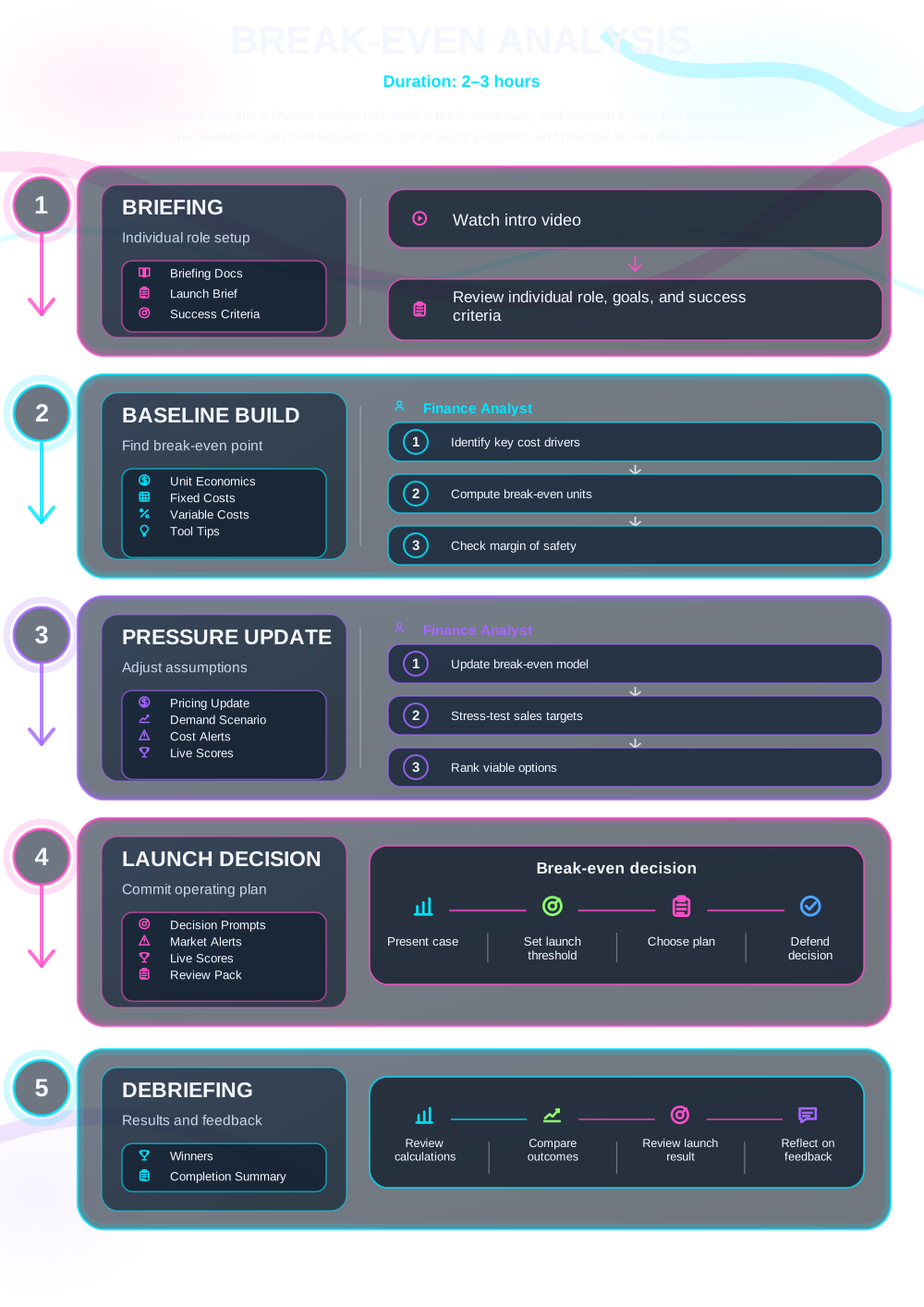
How the Break-Even Analysis Simulation Works
This simulation can be run individually or in teams in academic or corporate contexts. Each cycle represents a stage of getting through a pressing financial situation.
1. Setup Participants are introduced to their virtual company, its product, and the initial market data.
2. Decision Rounds Each round represents a business period. Participants input their key decisions on price, fixed costs, and variable costs.
3. Simulation Engine The algorithm processes these decisions against a realistic market model, calculating sales volume, revenue, and costs.
4. Results and Feedback Participants receive a detailed financial dashboard and report showing their P&L, cash flow, current break-even point, and market share.
5. Analysis Strategy Adjustment Based on the results, participants analyze their performance, identify what drove their success or shortfall, and adjust their strategy for the next round.
6. Debrief The experience concludes with an instructor-led debrief that consolidates the key learnings and connects the simulation outcomes to theoretical concepts.
Frequently Asked Questions
Assessment
Assessment of participant performance can be tailored according to the host institution’s objectives (business school, corporate training, assessment centre). Typical assessment criteria include:
- Simulation Financial Performance
- Strategic Decision Memo
- Collaboration, division of work, integration of roles, and final coherence
- Collaboration, division of work, integration of roles, and final coherence
- Rating by peers and self-reflection on approach and decisions