This simulation is ideal for business students, finance and accounting professionals, early-career professionals in corporate treasury, and anyone seeking to understand the strategic importance of working capital management.

Accounts Payable Simulation
The Accounts Payable Simulation plunges you into the high-stakes world of corporate cash flow management. Experience the real-time pressure of optimizing payables to strengthen vendor relationships and maintain financial stability.

Accounts Payable Simulation Overview
In today's competitive environment, Accounts Payable (AP) is no longer a back-office clerical function but a critical strategic component of corporate treasury and working capital management. This simulation provides a dynamic, hands-on environment where participants manage the complete AP cycle for a simulated company.
Participants will be faced with a constant stream of incoming invoices, each with varying amounts, terms, and vendors. Their decisions on when to pay each invoice will directly impact the company's cash position, its relationships with key suppliers, and its overall profitability. The simulation replicates the real-world trade-offs between holding onto cash longer and the benefits of paying early to capture discounts or avoid penalties.
Although ideal for undergraduate and graduate finance courses, executive training, and corporate finance skill workshops, the simulation is modular and scalable, allowing instructors to vary complexity.

Accounts Payable Simulation Concepts
Participants work through realistic scenarios, which can be customized to emphasize or exclude specific topics depending on the learning goals. This modular structure allows the simulation to be tailored to any type of session. Key concepts include:
- Working Capital Management
- Cash Flow Forecasting and Analysis
- Invoice Processing Cycle
- Payment Terms
- Early Payment Discounts
- Vendor Relationship Management
- Days Payable Outstanding
- AP Aging Schedule
- Liquidity vs. Solvency
- Strategic Payment Scheduling

Gameflow

What Participants Do
In the simulation, participants will:
- Process a high volume of incoming invoices from multiple vendors.
- Analyze payment terms and early payment discount opportunities.
- Strategically schedule payments to optimize company cash flow.
- Manage a limited cash reserve and forecast short-term cash needs.
- Navigate scenarios involving key vendor relationships and potential supply chain disruptions.
- Analyze performance through a detailed AP Aging Report and Cash Flow Statement.
- Compete with peers to achieve the highest financial health score for your simulated company.

Learning Objectives
By the end of the simulation, participants will be able to:
- Analyze the impact of accounts payable on a company's working capital and liquidity.
- Evaluate invoice payment terms to strategically capture early payment discounts.
- Manage the critical trade-off between maintaining cash reserves and meeting financial obligations.
- Forecast short-term cash flow requirements based on the AP aging schedule.
- Calculate and interpret key metrics like Days Payable Outstanding.
- Develop a strategic payment schedule that optimizes for both financial efficiency and vendor satisfaction.
How the Accounts Payable Simulation Works
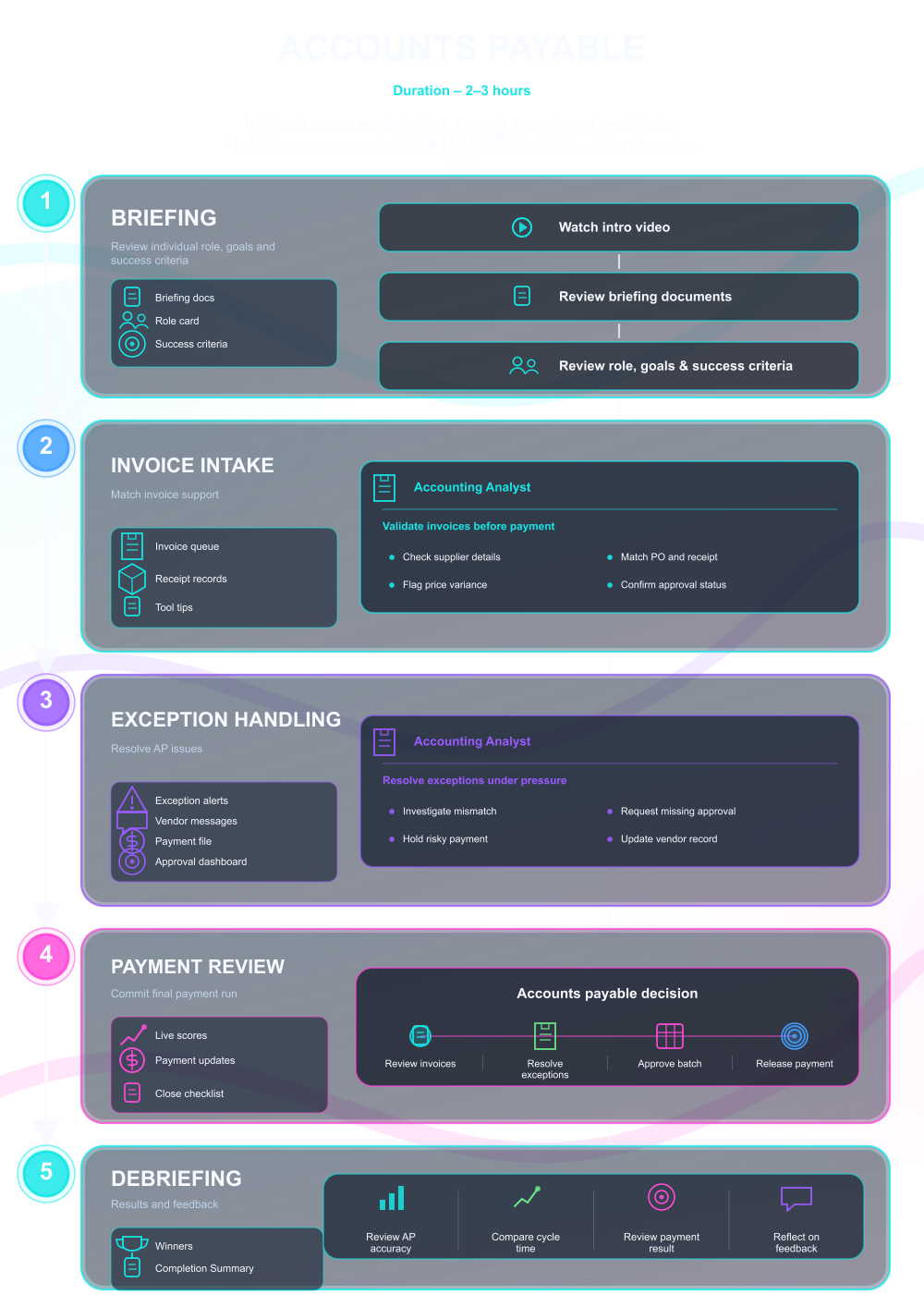
This simulation can be run individually or in teams in academic or corporate contexts. Each cycle represents a stage of getting through a pressing financial situation.
1. Introduction Participants are assigned the role of AP Manager at a growing mid-sized company.
2. Invoicing Phase Each round, a new set of invoices arrives in their digital queue. Each invoice has a vendor, amount, due date, and potential discount terms.
3. Decision-Making Participants must decide which invoices to pay immediately and which to schedule for later, based on your available cash, discount opportunities, and strategic priorities.
4. Simulation Engine The platform processes decisions. Paying early may capture discounts (improving profitability) but depletes cash. Paying late preserves cash but may harm vendor relationships or incur late fees.
5. Results and Feedback After each round, participants receive a comprehensive dashboard including a Cash Flow Statement, AP Aging Report, and a Vendor Health Scorecard. Your overall company financial health score is updated.
Frequently Asked Questions
Assessment
Assessment of participant performance can be tailored according to the host institution’s objectives (business school, corporate training, assessment centre). Typical assessment criteria include:
- A composite score based on profitability, cash reserves, and vendor relationships.
- The percentage of available early payment discounts participants successfully captured.
- Effectively at which participants are managing the company's payment cycle compared to industry benchmarks.
- The health of participants’ supplier relationships based on your payment history.
- Assessment of individual contribution within the team to ensure collaborative engagement.