Many finance employers have already started moving away from CV screening on degree, grade and university alone. Skills-based hiring takes that shift further: instead of reading three lines on a CV, you set out the skills a role needs, test for them directly, and let the results decide who moves forward.
The idea has spread fast. It now appears in annual reports, careers pages and conference talks. Look at who firms hire, though, and the change is smaller than the announcements suggest.
Finance has a particular stake in this. Banks and advisory firms have leaned on target schools and a 2:1 cut-off for decades. Those filters cost little to run, and no one asks awkward questions of a recruiter who hires from the same five universities as last year. We cover what skills-based hiring means, how it compares with traditional hiring, where the evidence stands and what it looks like for graduate, analyst and associate roles. We build job simulations for graduate and analyst recruitment teams, so we have views on where this approach works and where it stalls.
What is skills-based hiring?
Skills-based hiring is a way of selecting people on demonstrated ability instead of credentials. You define the hard skills and soft skills a job needs, write the job description around them, and assess candidates against them with work samples, job simulations, structured interviews or tests. Degrees, grades and previous employers can appear in the process. They stop acting as the gate.
You will also see it called skill-based hiring or skills-first hiring. The labels describe the same practice. The difference from a traditional process sits in the evidence you accept: one asks where someone studied and infers what they can do, and the other asks them to show it.
In finance, the hard skills are familiar. A candidate builds a three-statement model, reads a set of accounts or runs a discounted cash flow valuation. The soft skills matter as much, and firms test them less. You also need to know whether a candidate can explain a recommendation to a sceptical managing director, hold their own in a deal team at 11pm and decide which of three urgent requests to finish first. You can measure both kinds. The soft skills take more design work.
Plenty of firms that adopt skills-based hiring go on hiring graduates for most roles. The shift is in the order of events. A candidate with a 2:2 from a non-target university gets a chance to show what they can do before anyone rejects them on paper.
Skills-based hiring vs traditional hiring
The two approaches differ at almost every stage of the process. This table sets them side by side.
Stage | Traditional hiring | Skills-based hiring
|
|---|---|---|
Job description | Degree, grade and years of experience | Tasks and skills the role needs |
First screen | CV sift on university, degree class and employers | Short assessment or work sample for all eligible applicants |
Main evidence | Credentials and interview impression | Performance on job-like tasks |
Interviews | Unstructured, many first-round slots | Structured, for candidates who have shown the skills |
Talent pool | Target schools and familiar backgrounds | Non-target universities, career changers, internal staff |
Hiring manager role | Judges fit and polish | Agrees skills and scoring rubric up front |
Success measures | Offer acceptance, cost per hire | Quality of hire, retention, score versus performance |
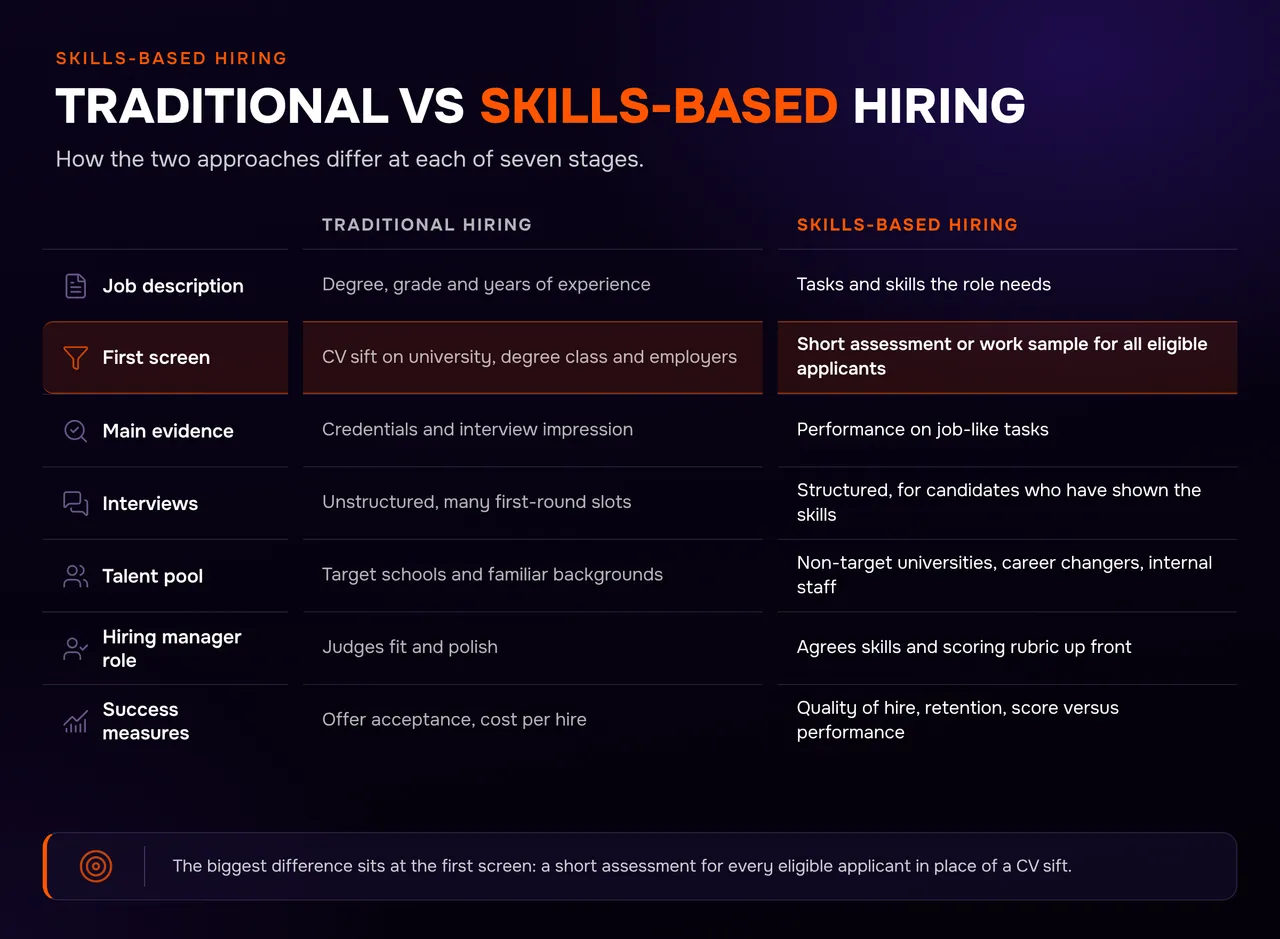
The biggest practical difference shows up at the first screen. In a traditional graduate process, a recruiter or an algorithm reads thousands of CVs and keeps the ones that match a pattern. That pattern rewards candidates who attended certain schools and had the contacts to land a summer internship at 19. Skills-based hiring moves assessment to the front, so the pattern counts for less and performance counts for more.
Neither approach removes judgement. You choose which skills count and how to score them. With skills-based hiring you make those choices in the open, before you meet any candidates, instead of leaving them to whoever reads CVs that week.
Why skills-based hiring is growing
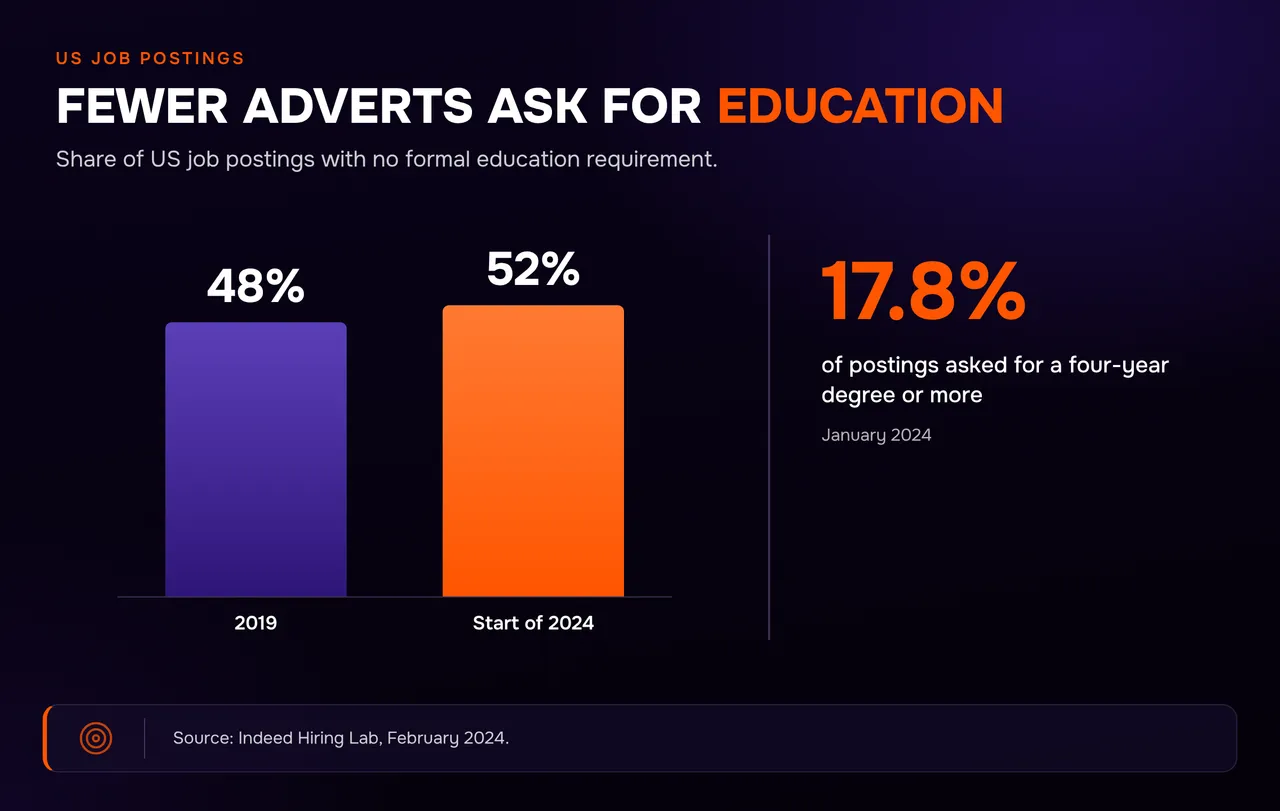
Employers have been cutting formal education requirements from job adverts for several years. Indeed's Hiring Lab found that the share of US job postings with no formal education requirement rose from 48% in 2019 to 52% at the start of 2024, and that fewer than one in five postings (17.8%) asked for a four-year degree or more in January 2024.
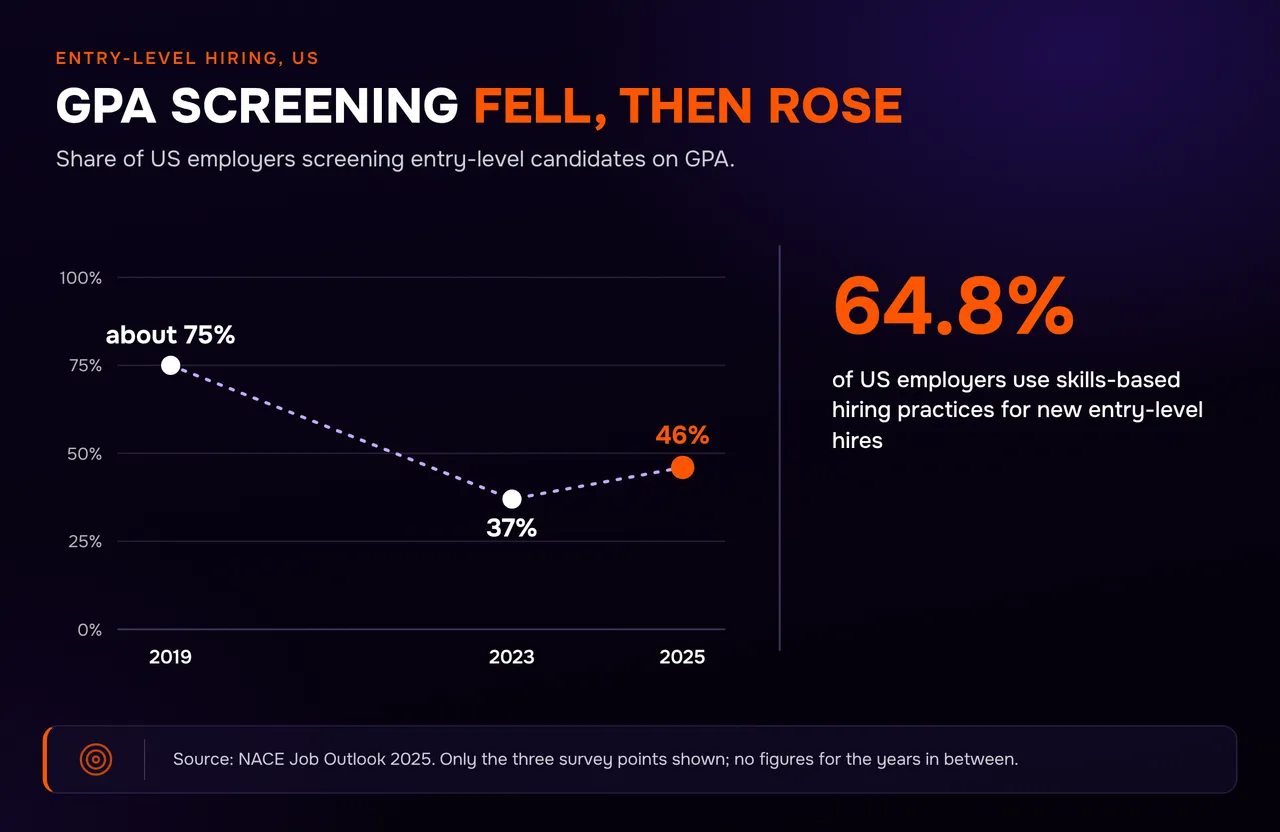
Graduate recruiters have moved too. In NACE's Job Outlook 2025 survey, 64.8% of US employers said they use skills-based hiring practices for new entry-level hires. The same NACE report tracks GPA screening, and the trend there is less tidy. About three-quarters of employers filtered on GPA in 2019. That fell to 37% in 2023 and climbed back to 46% in the 2025 survey. Graduate recruiters will recognise the likely reason: when application volumes rise, teams look for a fast way to cut the pile.
TestGorilla, an assessment vendor, surveyed 1,019 employers across eight countries in March 2024. It reported that 81% of employers used skills-based hiring in 2024, up from 73% in 2023 and 56% in 2022. Its finance cut of the same survey put the figure at 87% of finance companies, based on 138 finance employers. Treat these as self-reported numbers from a company that sells assessments, and set them against the hiring data further down.
UK finance has its own history here. EY dropped its 2:1 degree and A-level thresholds for graduate programmes in 2015 and switched to numerical tests and online strengths assessments, saying it had found no evidence that university results predicted success in professional qualifications. PwC removed the 2:1 requirement for its undergraduate and graduate roles in 2022, relying on its own aptitude and behavioural testing instead.
The reasons behind the growth are practical. Many graduate recruiters receive far more applications than they can read with care. Firms want wider access and better social mobility in their intakes. And many finance teams have learned the hard way that a first from a top university says little about whether someone will cope with a live deal.
Benefits of skills-based hiring for employers
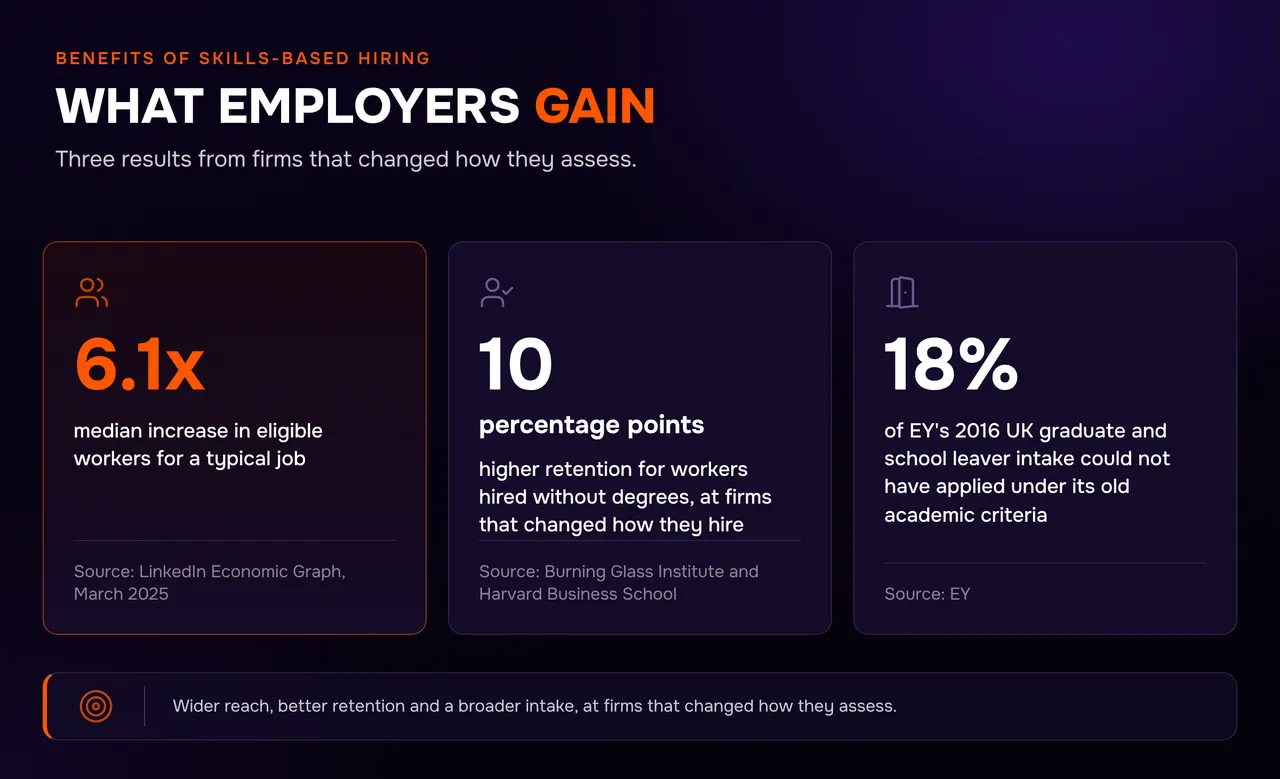
The first benefit is reach. LinkedIn's Economic Graph team found that a skills-based approach produces a median 6.1x increase in eligible workers for a typical job. For a bank fishing in the same pool of target-school candidates as its competitors, that gap matters. You compete for strong people your rivals have screened out.
The second is better evidence at the point of decision. From a CV you learn what someone has studied. A work sample or simulation shows you how they handle the tasks they will face in the job, under conditions close to the real ones. We explain the evidence behind work-sample assessment, and how we score it, on our assessment science page.
Retention is the third. The Burning Glass Institute and Harvard Business School report Skills-Based Hiring: The Long Road from Pronouncements to Practice found that at the firms which changed their hiring in practice, workers hired without degrees had a retention rate 10 percentage points higher than their degree-holding colleagues. The report measured this at firms that changed how they hire, so the finding reflects genuine adopters and not firms that edited their adverts.
Diversity and social mobility follow from the wider pool. EY reported that 18% of its 2016 UK graduate and school leaver intake could not have applied under its old academic criteria.
There is a benefit inside the firm too. Once you describe roles in terms of skills, you can match existing staff to open roles on the same basis. That makes internal mobility easier to run, because you compare a risk analyst's skills with an FP&A vacancy instead of comparing job titles.
Recruiters also report fewer bad hires. In the TestGorilla survey, 90% of employers using skills-based hiring said it reduced mis-hires. That figure is self-reported, so the honest way to claim this benefit for your own firm is to measure quality of hire before and after you switch.
How to adopt skills-based hiring
You do not need to rebuild your whole recruitment process at once. Most firms that make skills-based hiring stick start small, prove it works on a few roles, and expand from there. The steps below give an overview.
Start with a few pilot roles
Pick roles where you hire in volume and where you have doubts about your current filters. Graduate analyst intakes are a good candidate in most finance firms, because you see thousands of applications and the CVs look alike. Choose one or two roles, agree a time frame, and keep the rest of the process steady so you can compare results.
Define the skills each role needs
Sit down with the people who manage the role today. List the tasks a new joiner does in the first year, then the skills those tasks need. Separate the skills a candidate must bring on day one from the skills you will teach. For a graduate analyst, accounting logic and comfort with numbers are must-haves. Knowledge of your in-house model templates is something you train.
Rewrite job descriptions around skills
Skills-based job descriptions lead with the work. Describe what the person will do, the skills they need to do it, and how you will assess those skills. Remove degree class and university requirements that you will not enforce, and be honest about any you keep, such as a professional qualification required by a regulator.
Assess skills with work samples and simulations
Assessment is where skills-based hiring succeeds or fails. Work samples and job simulations give you the closest view of real performance, because candidates do a version of the job instead of describing it. Keep the first assessment short enough that strong candidates with other offers will finish it. Our custom recruitment assessments cover this stage for finance roles, and our [link: How to Assess It guide] covers assessment design in detail.
Train hiring managers and measure results
Hiring managers need to trust the scores, or they will fall back on the CV. Involve them in setting the rubric and in calibrating pass marks against current strong performers. Then track the numbers that tell you whether the change worked: quality of hire at six and twelve months, retention, offer acceptance and the mix of universities and backgrounds in each intake.
What skills-based hiring looks like in finance
Most writing on skills-based hiring ignores finance, which is odd given how hard banks and advisory firms lean on credentials. Finance roles suit skills-based hiring well. The core work is concrete, the skills are testable, and you can build tasks that look like the job.
The skills you test should change with seniority. A graduate needs potential and sound reasoning. An associate needs judgement you can put in front of a client. This table gives a starting point.
Skill | Intern | Analyst | Associate
|
|---|---|---|---|
Accounting logic | Knows how the three statements link | Spots errors and adjusts for one-offs | Reviews others' work and challenges assumptions |
Financial modelling | Extends a simple model from a template | Builds a three-statement model from scratch | Structures deal models and checks junior builds |
Valuation | Grasps DCF and multiples in principle | Runs a DCF and comps with sensible inputs | Defends a valuation range to a client or committee |
Commercial judgement | Asks how a business makes money | Links the numbers to strategy and risk | Forms a view and recommends a course of action |
Decisions under time pressure | Prioritises a short task list | Delivers accurate work to deal deadlines | Makes trade-offs with incomplete information |
Communication | Explains a calculation in plain terms | Writes a tight summary for seniors | Leads client and team conversations |
Teamwork | Contributes to a group task | Coordinates across workstreams | Manages analysts and gives feedback |
The hard part for most finance firms is letting go of the degree, grade and target-school filters without lowering the bar. Keep the bar where it is and move it from the CV to the assessment, so your test becomes the standard. Set the pass mark by running the same simulation with your strongest current analysts, and hold applicants to that level whatever their university.
Open the first screen to everyone who meets the basic eligibility rules, such as right to work and graduation year. Read CVs after candidates pass the assessment, when the CV can add context instead of acting as a filter. This order also reduces the time your team spends on CV sifts that reject good people for the wrong reasons.
Design graduate assessments around potential. A history graduate has not studied accounting, and a test of accounting knowledge will screen them out before you learn whether they can think. Give candidates the information they need inside the task, then watch how fast they learn it and how well they apply it. Save the technical knowledge tests for analyst and associate hires, where you expect people to arrive with those skills.
Keep target schools as a sourcing channel if they produce strong candidates. Campus events and university partnerships bring in good applicants, and a skills-based process lets you add new universities to your campus recruitment without guessing which ones will work. Track assessment scores and first-year performance by source, and let those numbers decide where you spend next year's budget.
Challenges of skills-based hiring
Skills-based hiring costs more to set up than a CV sift. Someone has to define the skills, design or buy an assessment, set a fair rubric and calibrate pass marks. Good simulations take time to build, and an assessment that does not reflect the real job will mislead you as much as a degree filter does.
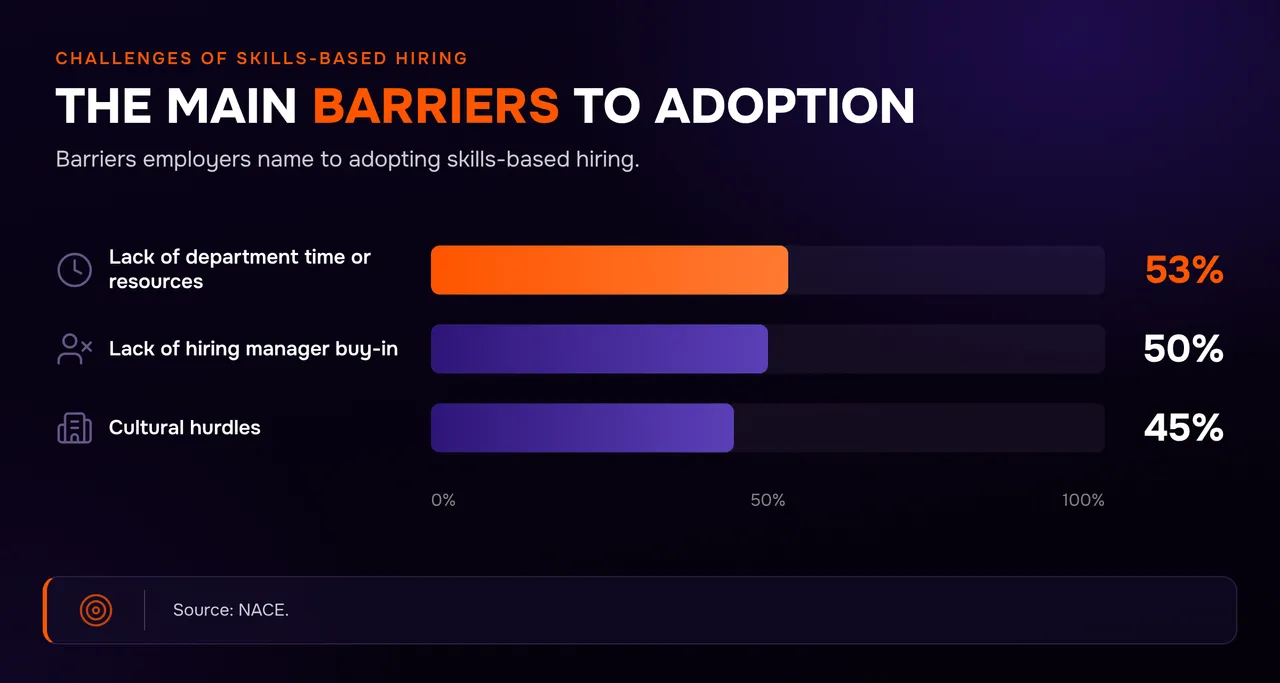
Hiring manager habits are the next obstacle. Many managers who joined through a target-school route trust that route, and some will glance at the university before the score. In NACE's survey, employers named a lack of department time or resources (53%), a lack of hiring manager buy-in (50%) and cultural hurdles (45%) as the main barriers to adoption. Training and early involvement help. So does showing managers the performance data once the first intake has been in post for a year.
Fair measurement takes more design work than most teams expect. A flawed test can disadvantage the groups you meant to help, for example by assuming knowledge that some candidates never had the chance to learn, or by timing tasks in ways that penalise candidates who need adjustments. Take-home tests also face a newer problem, because candidates can now use AI tools to complete them. Live or proctored simulations, and tasks that track how a candidate works as well as the final answer, reduce that risk.
The biggest challenge is the gap between announcing skills-based hiring and doing it. The Burning Glass Institute and Harvard Business School studied a sample of 11,300 roles at large firms. They found that the promised increase in opportunity showed up in fewer than 1 in 700 hires. About 45% of firms that dropped degree requirements changed "in name only", in the report's words, and about a fifth were "backsliders" whose early progress faded. The bulk of the real change came from 37% of the firms studied. Those firms changed how they assessed and selected candidates, along with the wording of their adverts.
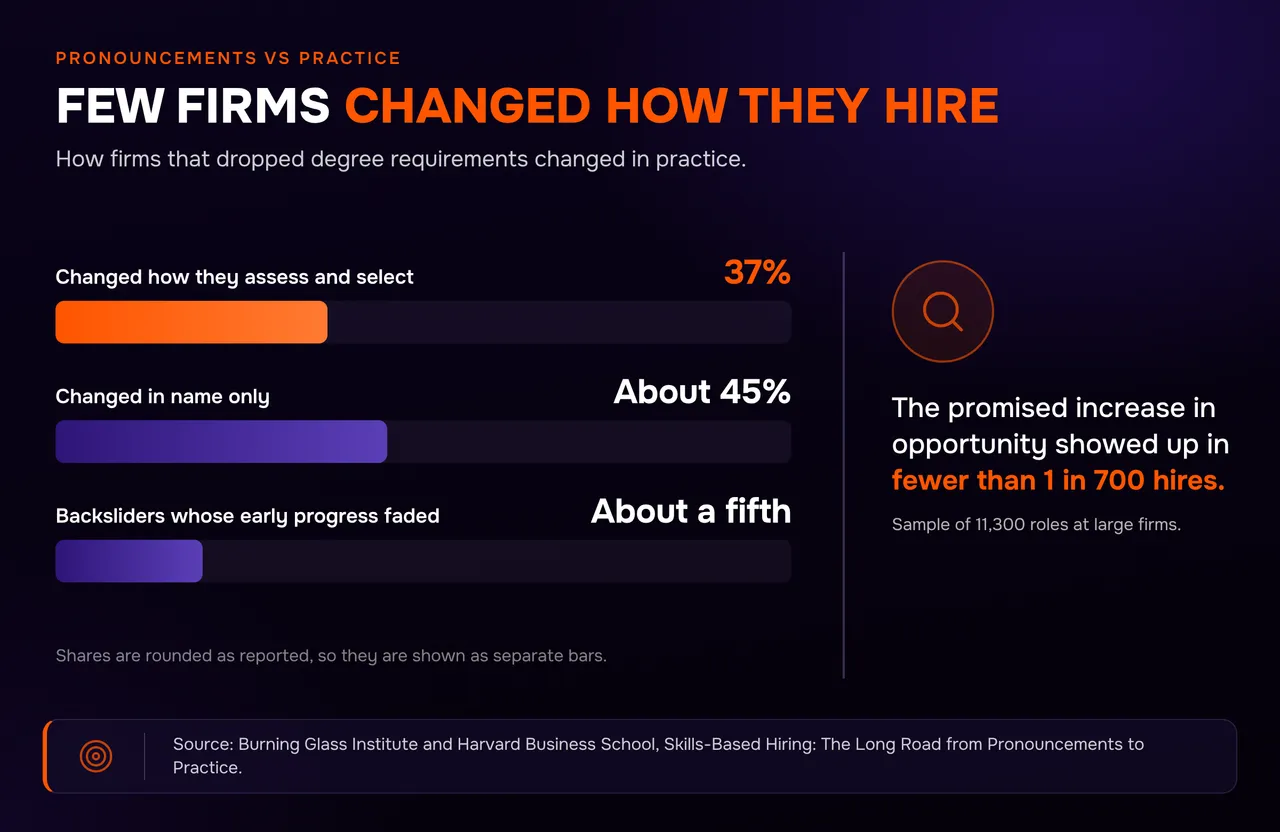
That finding should shape how you plan. Removing a line from a job advert costs nothing and changes little. You need new assessments and trained interviewers, and you need to track outcomes, or your hiring will drift back to the old proxies.
What companies use skills-based hiring?
In UK finance, EY dropped its 2:1 and A-level thresholds for graduate programmes in 2015, and PwC removed its 2:1 requirement in 2022. Both firms rely on their own tests instead. The Burning Glass Institute and Harvard Business School report names Koch Industries, Walmart, Apple, General Motors and Target among the firms whose hiring changed after they removed degree requirements.
What is an example of skills-based hiring?
A bank recruiting graduate analysts drops its 2:1 cut-off and invites every eligible applicant to a two-hour online simulation. Candidates read a company's accounts, build a short valuation and present a recommendation to a mock investment committee. The bank interviews the top scorers, whatever their university, and checks their first-year performance against their scores. Our guide to campus recruitment strategy shows how this fits a wider graduate plan.
Where FINSIMCO fits
We build business simulations that let finance employers see candidates do the work before they interview them. Candidates analyse, decide, negotiate and present in a setting close to a real deal team, and you get a ranked view of each cohort with the skills behind the scores.
Our recruitment clients have used the simulation to remove up to 90% of first-round interviews. Employers make about one hire for every four candidates we submit, because the people who reach your interview room have already shown the skills the role needs.
If you are planning a graduate or analyst intake and want to move past CV and grade filters, get in touch. We will talk through your roles, your current process and what a skills-based assessment would look like for your team.