- The strongest graduates choose employers on growth, people and mission. Pay has to be competitive, but in our data only 17% of top-decile performers called it the deciding factor.
- 46% of the top-decile performers we track came from universities outside the employer's original target list, and 38% would not have passed a standard CV screen.
- Employers that let candidates do real work with their team before the offer see acceptance rates 10 to 15 points above their own campus average, and roughly half as many offers declined after acceptance.
A campus recruitment strategy is the plan an employer uses to identify, attract and hire strong graduates directly from universities. It is usually built around targeted events, assessments and a structured path from first contact to accepted offer. Done well, it reaches the graduates who never enter a standard application funnel.
What you will get from this guide
Most campus recruitment guides tell you to attend more fairs and post more jobs. This one starts from a different premise: the students you most want to hire are not in your funnel, and the way to reach them is to become the employer they choose. It draws on how Cursor, one of the fastest-growing software companies of the decade, built its team, and on what we see across 500+ universities, 100,000+ students a year and the 2,300 hires we have followed through their first-year reviews.
Here is what is coming, in eight sections:
- Why the funnel loses the students you want most – and what Cursor does instead
- What high-potential graduates want – seven things, ranked by our data, with pay in seventh place
- Who the high performers are – four traits that predict first-year performance, and why target lists miss half of them
- The campus journey in five stages – awareness, the two-hour simulation, nurturing, referrals, closing
- A worked campaign in numbers – from 8 universities to 18 graduates started, with every assumption stated
- Where the evidence pushes back – the shrinking junior market and what it means
- A 30-day starting plan – one pilot, alongside what you already do
- Where we fit in – three ways to run it, and the one that suits a first campaign
Every figure below is ours unless stated otherwise. We have tried to state each one in a way you can check against your own numbers.
1. Why the funnel loses the students you want most
Cursor's Head of Talent, Adam Ward, calls the standard approach the funnel of doom. You reach out to 100 people. Twenty reply. Those twenty are not the top 20%. They are the twenty you caught on a bad day, when they happened to be looking. You then weed people out stage by stage and hire whoever remains. Over time, however good your interviews are, you regress to the mean.
Cursor's alternative is the method normally reserved for executive searches: define precisely what great looks like, work out who the fifty people are that fit, and pursue those fifty. The company applied that logic to every hire. The founders hired their first eighty people themselves. In 2025 it bought the recruiting firm it had been working with outright and made its founder Head of Talent. When SpaceX announced its acquisition of Cursor in 2026, its own statement stressed models and compute; analysts read the density of Cursor's team as one of the assets being paid for. We would not say Cursor was bought for its hiring. We would say its hiring was widely seen as part of what made it worth buying.
Campus recruitment is where this way of working pays off most, for three reasons.
Reason | Why it matters on campus |
Students have the fewest data points of any candidate group | A CV at 21 shows where someone studied and which societies they joined. It cannot show how they think under pressure, so credential filters miss exactly the people you want |
The best students are in demand and know it | Banks, consulting firms, tech companies and AI labs compete for the same few hundred people per cohort. Those students are not moving through your funnel. You are moving through theirs |
The experience before the offer is the offer | In our data the acceptance decision is made long before the number arrives. That is good news, because the experience is the part you control |

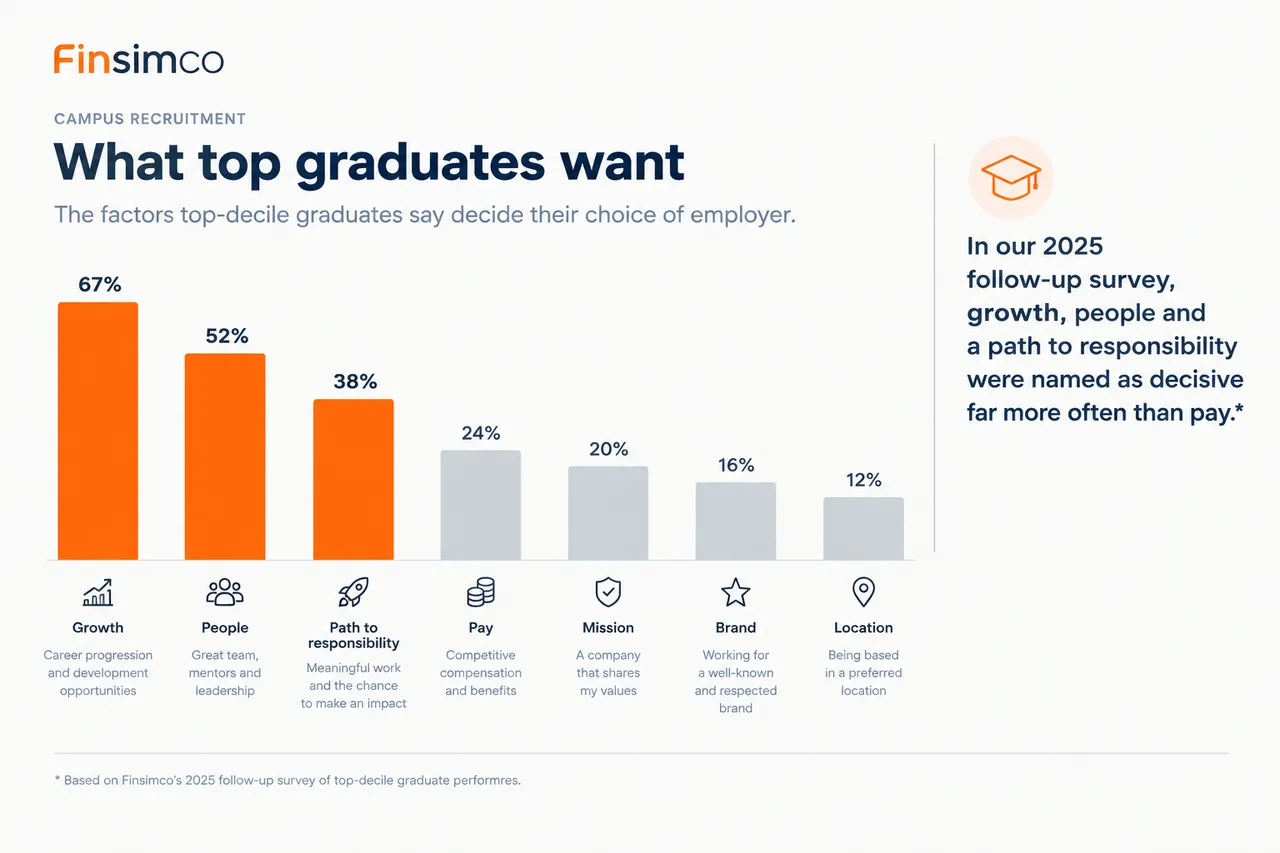
2. What high-potential graduates want
We ask every participant for feedback after a simulation. In 2025, 6,380 students chose to respond. We also run a follow-up survey with participants who scored in the top decile of their cohort, and compare their answers with where they accepted offers and how they later performed. This is the clearest picture we have seen of what the strongest graduates actually choose on, as opposed to what they say in an interview.
If you want to know how to attract top graduates, start here: the order of priorities is not what most employer branding assumes.
Rank | What top-decile graduates want | Called it decisive | What it means for you |
1 | Growth: learning fast through real work | 81% | Show what someone will be able to do in twelve months that they cannot do today |
2 | Working with people they respect | 74% | Put your best people in front of candidates, not your most available |
3 | A clear path to responsibility | 69% | Explain how, and how quickly, results turn into scope |
4 | A mission they believe in | 63% | Say what the company is trying to change, and let some people opt out |
5 | Meaningful work from the start | 58% | Describe the first real problem they will own |
6 | Honesty about what they are joining | 44% | Tell them the hard parts before they sign |
7 | Compensation | 17% | Be competitive. Do not expect it to win on its own |
91% of the same group said an offer had to be competitive with their alternatives before they would consider it. Money is the entry ticket. It is almost never the tie-breaker.
That matches what Cursor reports: candidates regularly accept offers that are not the highest, and the aim is to win heads and hearts rather than to buy them. Here is how to translate each finding into what you should be telling a candidate, in the second person, because that is how they hear it.
How you will grow them: The growth these graduates want is not a training catalogue. It is the speed at which they get to do real work and see what happens. Fast-growing companies compound learning because something ships every week rather than every year, and AppLovin famously has no formal learning and development function at all, on the argument that curious people develop themselves when given access to everything. In our data the strongest predictor of who is still a high performer in five years is learning rate: how much a candidate improves from their first task to their last inside a two-hour simulation. Tell them, concretely, what they will be trusted with in month one, month six and month twelve.
Whether they will be a meaningful part of the work: The strongest recruiting move we have seen is to show a candidate that their specific strength lines up with the company's single biggest blocker. Then they are not joining a good company. They are betting on themselves. Shopify insists its interns are hired because they are useful, not as a public service; Linear looks for people who can take on more than their title implies. Describe the first real problem your graduate will own. If you cannot, that is information for you, not for them.
A vision they can believe in: A mission statement is mandatory. A mission that puts some people off is better. Palantir and the AI labs attract people who believe in the mission almost to a fault, and the filtering is deliberate. In our follow-up surveys, top-decile graduates who said they strongly believed in their employer's direction were 1.9 times more likely to still be there at 24 months than those who said they liked the role.
Surrounded by A-players: Netflix calls talent density the prerequisite for everything else in its culture, and treats a single tolerated weak performer as toxic for the team. Notion keeps an internal page tracking it. Students feel this instantly. The most common free-text comment from top performers about a company session is some version of "the people running it were sharp". The most common negative comment is that the person running it could not answer a technical question. Before Cursor's product was widely known, the team was the only thing it had to sell, and its long on-site existed partly so candidates could meet that team. You have the same asset. Use your best people on campus, even though they are the busiest.
Progression by results, not by years served: High-potential graduates want to know that if they deliver, they move. This is not a comment on who you hire or how diverse your intake is; it is the opposite. The most inclusive thing you can do for a strong graduate from a university nobody targets is to judge them on what they deliver rather than on where they started. Ramp gives people from adjacent roles six months to try product management and lets the engineers they work with decide whether they stay. Revolut reviews performance quarterly on results and skills. In our tracked cohort, employers that could point to one named example of a graduate promoted within 18 months on results had a 22-point higher acceptance rate among top-decile candidates than employers that could not.
Impact they can point to: Graduates want to be able to say "I did that". Companies that ship fast attract talent because candidates can see the output. If your work takes longer to show results, explain what a graduate will have visibly delivered by the end of year one.
Honesty about what they are joining: One practice we admire, from a hiring leader at Square, is a short note at offer stage listing the hard truths about the role, drawn from concerns the candidate raised during the process. It lost around 30% of candidates at offer, which infuriated recruiters, and the people who still said yes became the best hires. His suggestion was to judge recruiters on retention at six and twelve months rather than on acceptance rates. We would suggest the same.
3. Who the high performers are, and why your target list misses them
Being embedded in 500+ university programmes and running 100,000+ students a year through the same simulations means we can see the patterns that separate top performers from the rest, and follow them into employment. Four traits predict performance in the first 12 to 24 months of an early-career role more consistently than anything else we measure.
Trait | What it looks like in the simulation | What we found |
Critical thinking and evidence-based decision-making | Disciplined document use, conclusions backed by evidence, decisions that hold up under scrutiny | Top-quartile analytical scorers are 67% more likely to exceed expectations at their 12-month review |
Cognitive agility and adaptive learning | Response to breaking news and urgent requests; improvement from first task to last | Top-quartile learning rate makes a candidate 2.4 times more likely to be flagged high-potential at 12 months |
Collaborative effectiveness and communication | Participation, influence, listening, clarity in writing and speech | Top-quartile communicators are 52% more likely to exceed expectations at 12 months |
Drive, resilience and professional conduct | Holding a position calmly and factually under pressure from an opposing team | The strongest predictor of early manager ratings on client handling and stakeholder management |
The measurement behind these, and the validity figures, are on our assessment science page.
What matters for your campus strategy is where these people come from, and the answer is uncomfortable for anyone running a target-school list.
46% of top-decile performers in our tracked cohort came from universities outside the employer's original target list. 38% would not have passed a standard CV screen based on university ranking and grade.
Two more patterns from the same data:
- Engineers and STEM graduates hired into non-engineering roles are over-represented in the top decile for analytical scores. Business-school pedigree is a weaker predictor than it was.
- Of the top-decile performers we tracked into employment, roughly 41% went to investment banks and bulge bracket firms, 18% to Big Four and consulting, 14% to technology companies and 9% to asset managers and hedge funds. The technology share has roughly doubled since 2022. If you are a bank or a professional services firm, you are receiving fewer of the strongest applicants than you were four years ago.
The big-company recruiting machinery filters on credentials. The signal is in behaviour, and behaviour is only visible when someone is doing the work.
4. The campus journey in five stages
This is the sequence we recommend. It starts where a student first hears of you and ends when they walk in on day one. Get the middle right and the ends take care of themselves. These five stages are the campus hiring best practices we see separate the employers who win top graduates from the ones who don't.
Stage | Goal | What the best employers do |
1. Awareness | Get the right students into the room | Offer an experience they want to join, introduced by their lecturer |
2. The two-hour simulation | See real work, and be seen doing it | Real tasks, your people present, a readout the same day |
3. Nurture the high performers | Stay useful for months, not weeks | Something of value every few weeks, hiring-manager contact within 7 days |
4. Referrals | Turn one top student into five | Ask the top quartile who else should have been there |
5. Close and convert | Confirm the decision, do not sell it | Evidence-backed offer, work the gap to the start date |
One thing sits before all five: define who you are looking for. Cursor writes down objectively what the top 20% looks like for a role, with the skills ranked, before it talks to anyone. "I'll know it when I see it" does not work. On campus this means ranking four or five behaviours that matter for the role ("can hold a position calmly when challenged", not "2:1 from a target university") and deciding what evidence would confirm each. When employers do this first, the target list usually grows, because the profile is far less correlated with university brand than people assume.
Stage 1. Awareness: an experience, not a stand
The strongest awareness comes from something students want to do, not something they walk past. Lovable's product hype became its recruiting brand, and it runs hackathons with free access to the product so students come to it. Everyone without a consumer product has to create the experience deliberately.
A student who completes a branded simulation event with an employer is 3.1 times more likely to apply to that employer within 60 days than a student who met the same employer at a careers fair the same term. Completion runs at 76% of registrations.
The reason is simple: the students get something. Career clarity, a realistic test of themselves and a story to tell. 68% of our 2025 respondents said they had already told a classmate about the session by the time they filled in the feedback form.
Channel | Why it works | How to use it |
Lecturers and course leads | A recommendation from a lecturer reaches the students who never attend fairs, and carries more weight than any campus ambassador | Because our simulations sit inside curricula, the lecturer usually introduces the employer's event |
Public, specific commitments | A named number of places, a fixed start cohort, a public list of the problems graduates will work on | Shopify's public commitment to hire 1,000 interns prompted other firms to outbid it; Cloudflare has since announced 1,111 for 2026 |
Small, real, specific events | Product demos and walk-throughs of real problems in small groups | A fifty-person engineering firm we know of skipped careers fairs, ran small events in five cities and filled almost all of its 16 graduate places |
Professors as scouts | Scale AI runs campus programmes that go directly to professors to find expert contributors | Ask course leads who they would send. It is the most underused question in campus recruitment |
Timing matters. A targeted campaign can be live within one to two weeks, and it pays to allow a two-week lead time before the first event so the university can announce it and build interest. Plan for the full campaign to run for at least a month.
Stage 2. The two-hour simulation: real work, seen both ways
Cursor invests most where most employers invest least: the day itself. Every touchpoint is curated. Who greets the candidate. Who sits beside them at lunch, and there is always a meal. Which interviewer shares the candidate's niche interest, chosen deliberately rather than by calendar availability. Airbnb ran the same idea with a hand-picked group of core-values interviewers who saw their role as protecting a culture they cared about.
Two principles from Cursor's on-site carry straight onto campus.
Work samples.A work sample is the highest predictor of success on the job, and has been for decades, yet most on-sites still consist of one-to-one assessments across a table. Cursor runs long on-sites where the candidate does a real project alongside the team. It tried dropping the trial once, because it is expensive for everyone, and found it could no longer make hiring decisions with confidence. The trial came back. Linear runs a paid trial with access to Slack, Notion and team meetings, and reports that candidates value judging the company by what they see inside.
Two-way.Most on-sites are buying: the company assesses and gives little back. Cursor gives the candidate data too, because good self-selection depends on good inputs.
For a campus event with fifty or five hundred students you cannot run a week-long trial. You can run two hours that feel like the job. This is what a simulation event is designed to do.
Location | What the student does | What you see |
Desk (individual) | Reads imperfect information, prioritises, makes time-boxed decisions | Analytical thinking, prioritisation, cognitive agility |
Team room (team of four) | Builds a position with people they have just met | Collaboration, written and verbal communication, listening |
Boardroom (against another team) | Defends the position under pressure | Influence, conflict handling, resilience, professional conduct |
Sessions run in stages of 5 to 20 minutes across the two hours, with groups of 4 to 12 allocated automatically, so the format scales from one campus to twenty. Everything a student does is recorded, so you get the work sample at scale. They get what they came for: a real test of themselves and a credible experience they are proud to talk about. Within hours you have an assessment report per candidate: ranking against the cohort, a breakdown of analytical and soft skills, risk flags for ethics and professionalism, and an interview guide with strengths and follow-up questions.
Three details we have learned matter more than they sound:
- Two hours is the sweet spot. Longer sessions gather more data and lose the students with the most options. Shorter sessions never build enough pressure to show anything real.
- Your people must be in the room, or on the call. An event run entirely by a vendor is a test. An event where your best analyst debriefs the boardroom round is an experience. The ten-minute company session after the simulation, where you tell your story and answer questions, is consistently the highest-rated part of the day in student feedback.
- Give something back the same day. A short personal readout of how a student performed, including for those you will not shortlist, is rare enough that students talk about it. Net promoters are worth having even when they never join, because the strongest students influence the rest of their year.
One question we are always asked: can students game it with AI? In practice no. The format is time-pressured and interactive, so pausing to consult a tool puts a student behind in every other phase, and any gap between a polished written answer and live decisions and communication is visible in the record.
Stage 3. Nurture the high performers: stay useful for months
Cursor starts the clock early and cultivates people for weeks, months and sometimes years. When a candidate says the timing is wrong, it lowers the ask: not an interview, just a next conversation. The touchpoints are specific: coffee or dinner, an office visit, an introduction to someone on the team who is fascinated by the candidate's work, an invitation to give a talk or take on a small side project. Then, when the candidate is ready, speed: the hiring manager speaks to them within the hour, not within the week. Revolut's early hires got replies within minutes, an interview the next day and an offer straight after.
On campus the equivalent is a relationship that starts the day after the simulation and runs through to the offer, with a reason to talk that is not "please apply". The high performers you have just identified now know you took the trouble to identify them. What you do in the following weeks tells them whether you meant it.
When an employer contacts top performers within seven days of a simulation event, response rates are roughly three times higher than at three weeks. Beyond three weeks the strongest candidates have usually engaged elsewhere.
A nurture calendar that works, in our experience:
When | What | Why it works |
Within 7 days | A hiring manager, not a recruiter, calls the top quartile with their personal readout | Shows the company looked, and that the person who would manage them cares |
Week 3 | A second simulation on a different topic, run for the shortlist only | Useful to them, more data for you, and a reason to talk |
Week 6 | A problem-solving session with a small team on a live question | Lets them see the work and the people |
Week 9 | A call with a graduate hired two years ago from the same campus | The path, from someone two steps ahead |
Ongoing | A named person per student, an office day when they are nearby, an honest answer to every question | The gut feeling Cursor calls a home game: this feels like home |
The principle is that every touch gives the student something they can use whether or not they join you. That is what distinguishes investment from pursuit, and strong students can tell the difference.
Stage 4. Referrals: turn one top student into five
Cursor's recruiters hold 30-minute sessions with employees every other week for six weeks to surface names from their networks, and hold them to the follow-ups. The tactic that matters most is the question. "Who is the best engineer you know?" is the worst question you can ask. "Of all the people you have worked with, who is the most collaborative with designers?" produces names, and when several people name the same person, that person goes on the list.
Two cautions from people who have run this at scale. Referrals alone can turn a company into fifty people who look the same. And cash incentives attract people who want the reward rather than the company. Both apply on campus.
Campus recruitment referrals have one advantage over corporate referrals: students know exactly who the strongest people in their year are, and are usually happy to say so. Almost nobody captures that. A simulation event is the natural place to do it, and these are the mechanics we recommend. None requires a bonus.
Mechanic | How it works | Why it works |
Team sign-ups | Students register as a self-formed team of four rather than individually | Strong students pick strong teammates. You get the network, not just the node |
Nominate a peer | At the end of the session, ask the top quartile: "Who else in your year should have been here?" | Top performers' nominations are the highest-quality names an employer will receive on campus |
Ambassadors by invitation | Invite last year's top performers to host this year's event, instead of an application-based ambassador scheme | A visible role for them, an honest peer for candidates to ask |
Alumni at the tables | Bring back graduates hired from that campus two years ago to sit in the team room | Strong students want to see the path from someone two steps ahead |
Ask the lecturer | Course leads know whose work stands out | The single most underused referral question in campus recruitment |
The shared principle: a strong student's endorsement is the only referral currency that matters on campus, and you earn it by giving them an experience worth endorsing.

Against a traditional campaign reaching the same 1,200 students through fairs and applications, the differences are not at the top of the funnel. They are in the middle and at the end.
Simulation campaign | Careers fairs and applications | |
Reach | 500+ university network, hundreds of students per campus | A few campuses your team can physically visit |
Screening | Ranked shortlist within hours; up to 90% fewer first-round interviews | Recruiters sort applications by hand; around 40% of their time goes to candidates who never advance |
Signal | Observed behaviour under pressure across desk, team room and boardroom | CV, aptitude test, interview impression |
Engagement after the event | Ongoing, because there is a readout and a reason to talk | Little beyond the fair; students drift to other offers |
Reporting | Participation, performance, diversity and outcome data per campus | Hires counted; little on which campus efforts worked |
Recruiter time moves from screening to nurturing, which is where it earns its keep.
6. Where the evidence pushes back
It would be dishonest to present campus recruitment as a market that only rewards effort. Two things are changing.
The junior market is shrinking.Investors and operators now talk openly about the "death of the junior employee": companies unwilling to spend three to six months training graduates when AI tools deliver senior-level output on many tasks. Cursor itself lists new graduates without enough experience to be multi-skilled as a softening part of the market.
The juniors in demand are different.They are multi-skilled, fluent with AI tools and able to take on more than their title implies. Elite talent now treats access to the best tools as part of the offer, and in our data the students who score highest on learning rate are almost always the ones who adopt whatever tool is put in front of them fastest.
Both points argue for the approach in this guide rather than against it. If the pool of graduates worth hiring is smaller and harder to identify from a CV, a generic funnel is a worse bet every year, and the employers who can find the fast-learning few and give them a reason to choose will keep taking a disproportionate share. That is what we already see: the employers running the strongest campus experiences are increasing their share of the top decile even as their overall graduate intake falls.
7. A 30-day starting plan
You do not need to overhaul your funnel to start. In our experience the employers who make the most progress run one focused pilot alongside their existing process and compare the numbers.
- Week 1: Write the profile. Four or five ranked behaviours for one role family. Decide what evidence would confirm each.
- Week 2: Pick eight campuses from the profile, not the league table. Identify the course leads on each and ask them who they would send. Announce the events with two weeks' lead time.
- Week 3: Run the events. Your best people in the room, a break together, a ten-minute company session, a same-day readout for every participant. Ask the top quartile who else should have been there.
- Week 4: Hiring managers, not recruiters, contact the top 10% within seven days. Start the nurture calendar. Track acceptance, declines after acceptance and, later, first-year reviews, not just hires.
Then compare that cohort with the one you hired the usual way, and decide.
8. Where we fit in
Everything above can be done without us, and some of it should be done by you regardless of who you work with: the profile, the honesty, the hiring manager's first call.
What we bring is the part that is hard to build alone. We are integrated into the curricula of 500+ universities, so your event is introduced by the lecturer rather than pinned to a noticeboard. Our simulations are the work sample at scale: two hours of realistic work, recorded in detail, with a ranked shortlist and an interview guide for every candidate within hours. Because more than 100,000 students go through the same simulations every year, every candidate is benchmarked against a population, not against the twelve people who happened to attend. Participation and data sharing are opt-in.
Option | What you do | What we do | Best for |
We run it for you | Tell us the roles, skills and locations | Outreach, promotion, delivery, shortlisting; you receive a ready-made pool | Teams without campus capacity |
We run it with you | Host the company session, meet the students | Promote across the network, deliver the simulation, report | A first campaign |
You run your own events | Lead your campus or virtual events | Simulations, materials, analytics and support behind the scenes | Teams with an established campus programme |
Most employers start with one pilot for one hiring cycle, keep their existing interview stages and expand only when the numbers justify it. How a campaign runs is set out on our campus recruitment page. If you would rather start from students who have already proven themselves, see pre-screened candidates; if your roles need an assessment built around your own work, see custom assessments.
If you want to see what a candidate sees before deciding anything, we run a free two-hour live simulation for your own team. You experience it exactly as students do and receive the same report recruiters receive afterwards.
Contact us or write to info@finsimco.com. The measurement behind everything in this guide is explained on our assessment science page.