CVs don't tell you much about whether a candidate can do the job. A degree and a summer internship show where someone has been, not whether they can build a model that balances, spot a weak assumption in a deal case, or defend a valuation to a sceptical managing director. A skills-based assessment tests that directly: you give candidates a version of the real work and score what they produce against criteria you set in advance.
Finance employers have good reasons for moving in this direction, and our companion [link: What Is Skills-Based Hiring? guide] covers the definition and the wider case for the shift. This guide is for HR leads, talent acquisition teams and graduate recruiters who have accepted the case and now need to put it into practice: which formats suit finance roles, how to run an assessment from scratch, what a usable scoring rubric looks like and what to change now that every candidate can open an AI tool in another tab.
More than 100,000 students and young professionals complete our simulations each year, and much of what follows comes from watching them work. If you want background on our approach first, read our overview of using simulations to assess skills during recruitment.
Why CV screening falls short in finance hiring
CV screening measures access more than ability. Graduate applications for analyst roles look alike: similar degrees, the same society memberships, the same online modelling certificates. Faced with a pile of near-identical documents, recruiters fall back on proxies such as university ranking, grades and a recognisable internship. Those proxies reward candidates who had the contacts to land a spring week, and they say nothing about how someone reasons through a valuation with incomplete data.
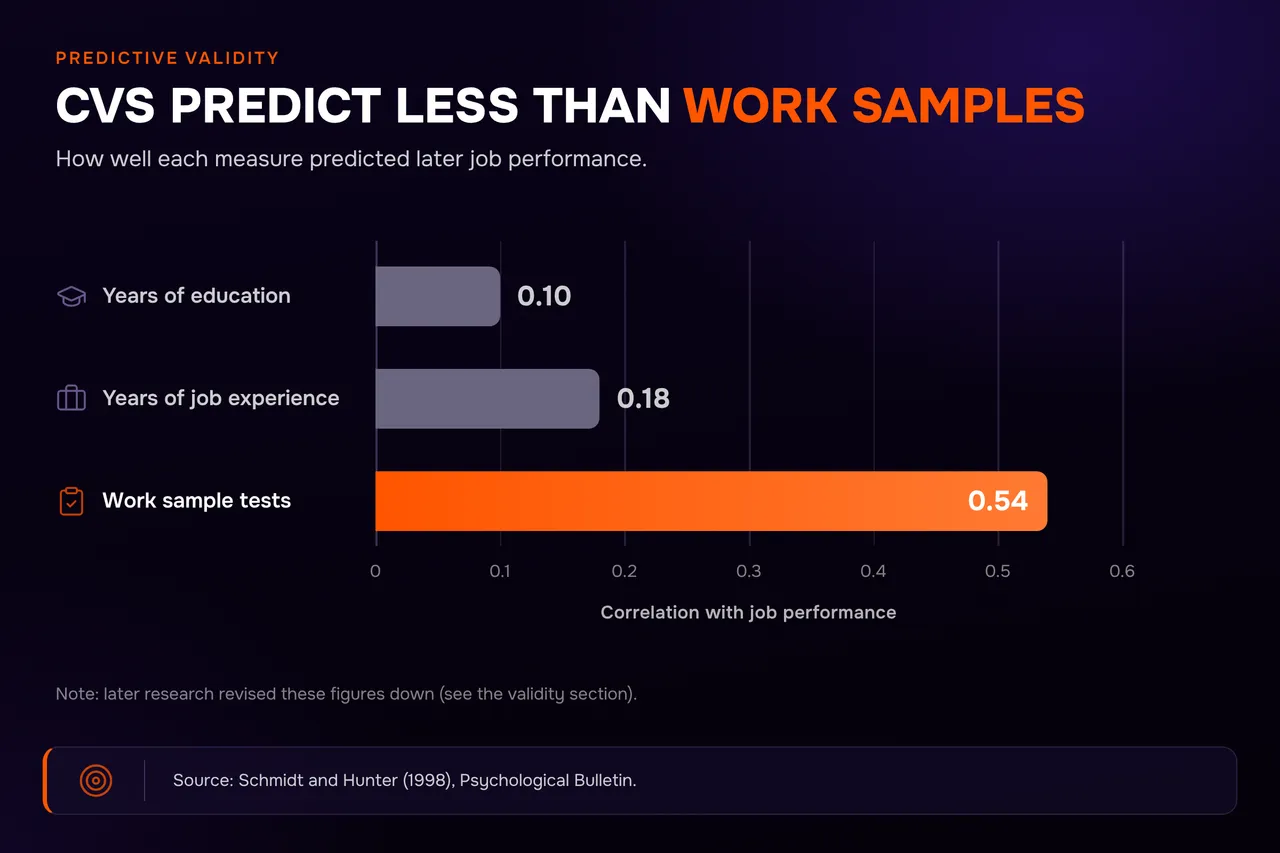
The research on selection methods has pointed this way for decades. In Schmidt and Hunter's 1998 review of 85 years of personnel selection research, years of education correlated with later job performance at 0.10 and years of job experience at 0.18. Work sample tests came out at 0.54, the highest of any single method in their table. Later work has revised those figures, as we cover below, but the gap between paper credentials and observed work has held up.
You also pay for a weak screen further down the funnel. If you cannot separate candidates at the CV stage, you push the sorting into first-round interviews, and your analysts and associates lose hours to conversations a short exercise could have settled. Interviewers then lean on rapport and polish, which favours confident talkers over careful thinkers. AI-polished CVs and cover letters make the problem worse, because the documents now read even more alike.
What is a skills-based assessment?
A skills-based assessment is a structured exercise in which candidates perform tasks that mirror the job, under the same conditions, and you score their output against a rubric written before you see any answers. In finance, the task might be a timed Excel exercise, a short investment memo or a round of a live acquisition simulation.
Three features separate it from a general aptitude test or a personality questionnaire. The task comes from the job itself. Every candidate gets the same brief, time and information. And the scoring criteria exist before the first candidate starts, so assessors judge the work instead of the person's background. You will see the same idea under other labels, such as a pre-employment skills assessment or a skills assessment test for employment. The labels matter less than those three features.
For graduate roles, keep one point in mind. You are assessing reasoning and learnable skills, since few graduates have done the job before. Good assessments brief candidates on the context they need and then test what they do with it.
Types of skills-based assessment for finance roles
Examples of skills-based assessment in finance range from a 30-minute Excel test to a half-day simulation with several decision rounds. Most employers end up combining two or three formats, because each one shows you something different.
Technical tests (Excel, accounting, modelling)
Technical tests check whether a candidate has the baseline knowledge the role assumes. A typical Excel test asks candidates to clean a data set, build a lookup and lay out a simple debt schedule. An accounting test might ask how a change in depreciation flows through the income statement, balance sheet and cash flow statement. A modelling test hands over a set of assumptions and asks for a basic discounted cash flow valuation within a fixed time.
These tests are cheap to run at volume and easy to mark, which makes them useful as an early filter with a pass mark. They are weak at ranking candidates. A candidate can memorise accounting rules and still make poor calls with them, and graduates from engineering or economics degrees may score lower on day one while learning faster than their peers. Online numerical tests and static technical questions are also the formats AI tools handle best, a problem we return to later.
Work sample tests
A work sample test gives the candidate a slice of real work and asks for the output a junior employee would produce. For an equity research role, that could be a two-page note on a mid-cap company built from a data pack. A credit analyst candidate might review a borrower's accounts and recommend loan terms. For a financial planning and analysis role, you could hand over a monthly management pack and ask the candidate to explain why operating costs came in over budget.
Work samples rank among the strongest single predictors in the selection research. They take longer to mark than a technical test, and Schmidt and Hunter noted that they work best with applicants who already know the job or have received training for it. For graduates, that means you supply the context in the brief and test reasoning, not prior deal experience. Take-home versions carry a second risk: you cannot see who, or what, produced the answer.
Job simulations
A job simulation puts candidates inside a scenario that develops over several rounds, with each decision shaping what happens next. In a finance simulation, a team might screen acquisition targets in round one, value a shortlisted company in round two, bid against rival teams in round three and then respond when the target's latest results come in below forecast. You watch technical skill, judgement, teamwork and communication in one sitting, under time pressure close to the real job.
Simulation-based assessment also gives candidates a realistic preview of the work, and some decide the role is not for them, which saves both sides time. You can run simulations live, with your own staff observing, or online at scale. We design custom recruitment assessments around the decisions your junior hires make in their first year, so the scenario matches your business instead of a generic case.
Situational judgement and structured interviews
Situational judgement tests present realistic dilemmas and ask candidates to choose or rank responses. A finance example: your managing director asks you to adjust a growth assumption so the valuation clears a client's target price. Questions like this test professional judgement and ethics, which technical tests miss.
A structured interview asks every candidate the same questions in the same order and scores each answer against an anchored scale. The format works best after a simulation or work sample, when you can ask candidates to defend their own decisions. "You bid nine times EBITDA when the comparables averaged eight. Talk me through that." A candidate who did the work can answer. A candidate who copied an answer struggles once you push past the first reply.
How to run a skills-based assessment, step by step
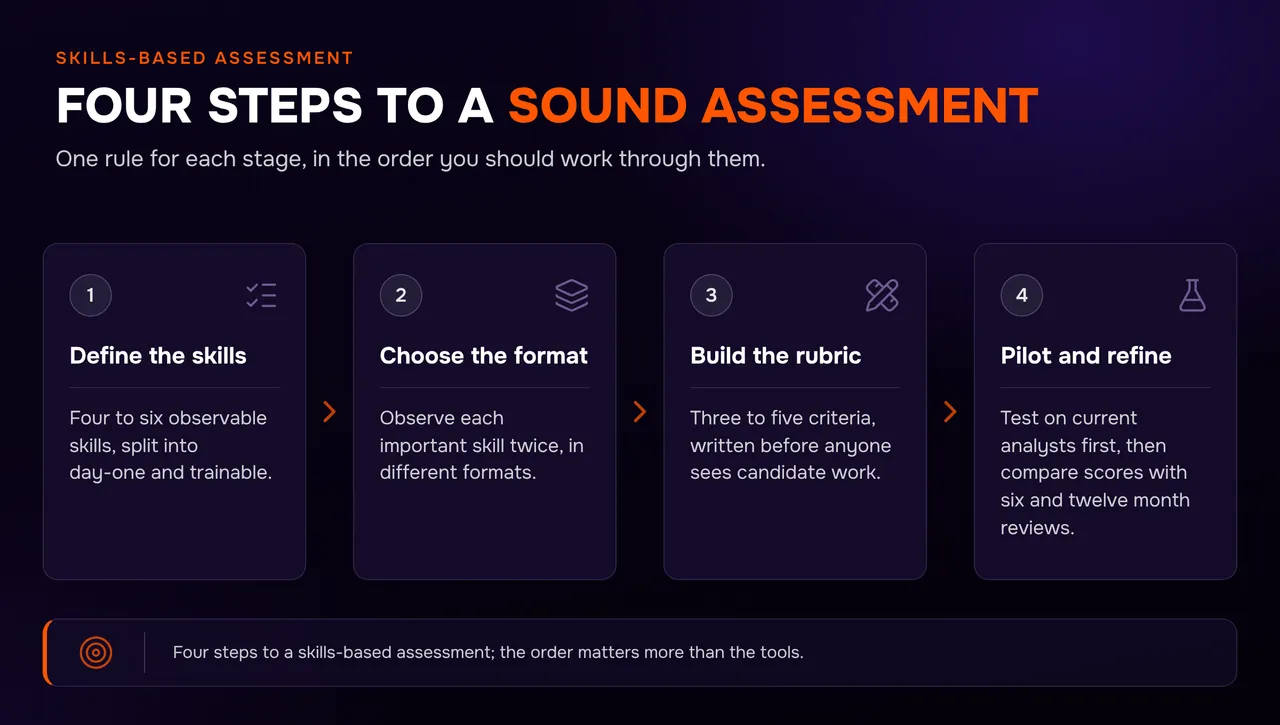
You can build a sound assessment in four stages, and none needs a large budget. The order matters more than the tools. Our three-step plan for building a bespoke assessment covers the same ground from the angle of working with us on a custom design.
Define the skills the role needs
Start with the job, not the test. Sit down with the people who manage your current graduates and ask what a first-year analyst spends their time on in the first six months. You will hear answers like updating models, checking numbers others have produced, drafting slides, summarising a company for a pitch and briefing seniors under deadline pressure.
Turn those activities into four to six skills you can observe. For a graduate financial analyst, a workable list might include accounting fluency, valuation logic, judgement with incomplete information, attention to detail and clear communication. Make each skill concrete enough to score. "Strong communicator" gives assessors nothing to work with. "Can state a valuation recommendation and its main risk in under two minutes" does.
Separate the skills a hire needs on day one from those your training programme will build. If your graduate scheme teaches modelling in the first month, test the reasoning behind a valuation and leave advanced Excel out.
Choose the right format for each skill
Match each skill to the format that shows it best, and try to observe the important skills twice, in different formats. A candidate who builds a sound valuation in a simulation round and then defends it well in a structured interview has given you two pieces of evidence that point the same way.
Skill | Suitable format | Practical note
|
|---|---|---|
Accounting and Excel basics | Timed technical test | Use as a pass mark screen, not to rank |
Valuation and modelling | Work sample or simulation round | Supply the data pack; vary the assumptions |
Judgement under uncertainty | Multi-round simulation | Change the information between rounds |
Communication | Live presentation or structured interview | Score against anchored levels |
Teamwork | Observed team simulation round | Brief assessors on the behaviours to note |
Professional ethics | Situational judgement test or interview | Use realistic finance dilemmas |
Keep the total time proportionate to the role. A graduate candidate applying to a dozen firms will not give each of them a full day before a first conversation, and the best candidates have the most alternatives.
Build a scoring rubric
A scoring rubric turns assessor opinion into consistent judgement. Write it before anyone sees a candidate's work. Choose three to five criteria tied to the skills you defined, describe what weak, good and strong performance looks like for each, and decide on weights. The descriptions need to be behavioural. "Good analysis" means nothing; "uses at least two valuation methods and explains why they differ" gives an assessor something to check.
Train assessors with two or three sample answers before the live round, and have each of them score alone before they compare notes. Ask them to write down the evidence behind each score. That record helps you defend decisions, spot assessors who mark harder than others and improve the rubric after each cycle. You will find a complete example for a graduate financial analyst task later in this guide.
Pilot it, then refine
Run the assessment with a group of current analysts or recent hires before any candidate sees it. You are checking practical things: whether the time limit works, whether the instructions confuse anyone and whether scores spread out or bunch at the top. If your strongest current analysts score low, the test is measuring something other than the job.
After your first hiring cycle, compare assessment scores with performance reviews at six and twelve months. The sample will be small, so treat the comparison as a sense check. Drop or rewrite tasks that fail to separate candidates, and adjust weights if one criterion predicts later performance better than the rest.
What makes a skills-based assessment valid and fair
Predictive validity describes how well assessment scores line up with later job performance. Researchers express it as a correlation between 0 and 1, and no selection method comes close to 1. The useful question is which methods predict better than the alternatives and how to combine them.
The headline numbers have moved. Schmidt and Hunter put work sample tests at 0.54 and structured interviews at 0.51. In 2022, Sackett, Zhang, Berry and Lievens argued that earlier meta-analyses had overcorrected for range restriction and so overstated the validity of many selection methods. Their revised estimates fell by about 0.10 to 0.20 for most procedures. As HumRRO researchers summarised in SIOP's TIP, structured interviews came out on top at 0.42, followed by job knowledge tests at 0.40 and work sample tests at 0.33, with cognitive ability at 0.31.
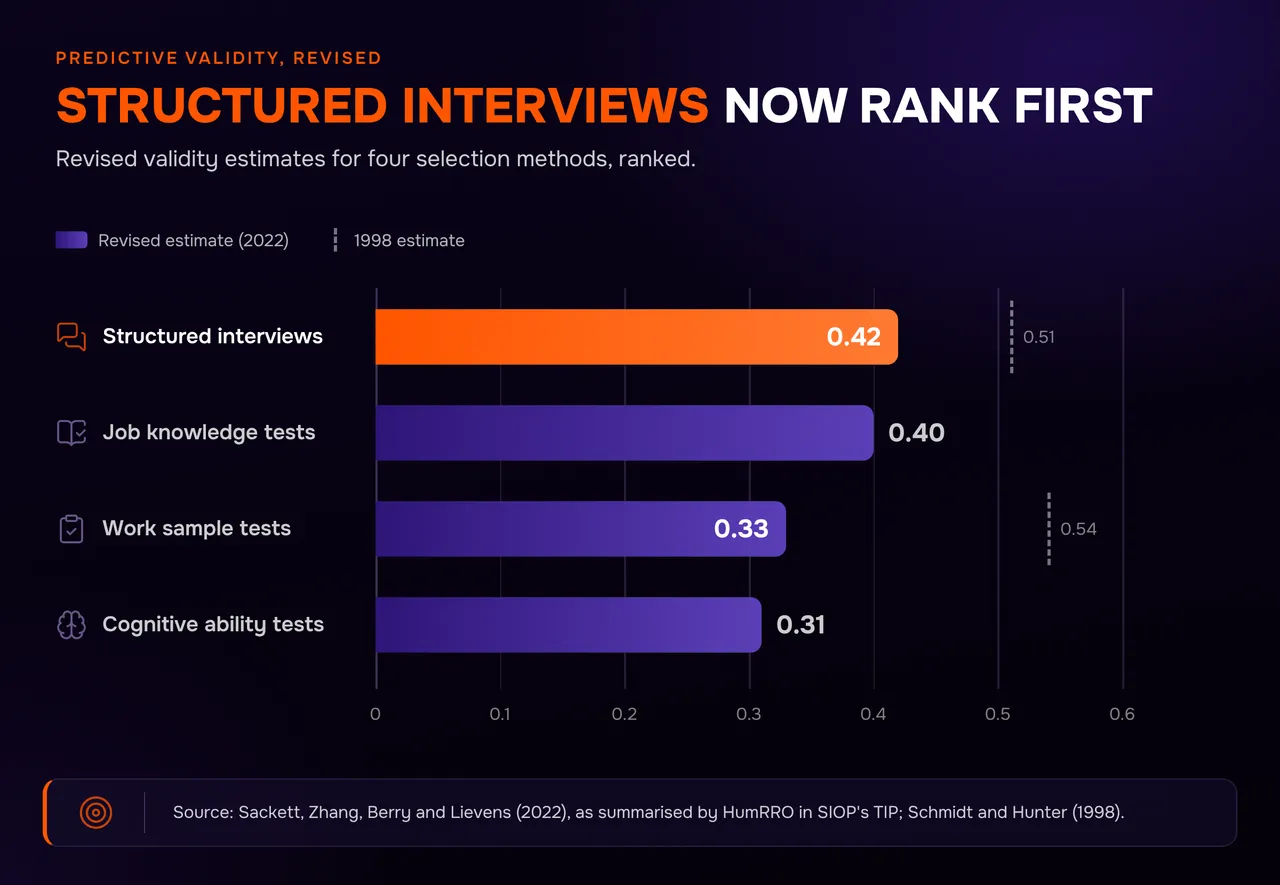
Two lessons follow for finance employers. Job-related methods such as structured interviews, job knowledge tests and work samples still rank near the top, so the case for assessing skills holds. And each method predicts less on its own than older figures implied, which argues for combining a work sample or simulation with a structured interview instead of relying on one score.
Your own design choices decide how much of that validity you keep. Tasks need to reflect the job you defined. Conditions need to be the same for every candidate, and assessors need a rubric and training. You can read more about the assessment science behind our simulations and how we apply these principles.
Fairness belongs in the same conversation. Sackett and colleagues set their validity estimates alongside group differences in scores, and found trade-offs between the two. In practice, avoid insider jargon that favours candidates who had expensive coaching, brief the context so graduates from any degree can engage, and offer adjustments such as extra time for candidates who need them. Track pass rates by group after each cycle, and look again at any task where one group falls behind for reasons unrelated to the job.
Keeping the candidate experience in mind
Candidates judge your firm by the assessment you set. A clumsy online test with no explanation tells a strong graduate how you treat junior staff, and they hold offers from your competitors.
Tell candidates what the assessment involves, how long it takes and what you will use it for. Keep unpaid take-home work short, or replace it with a live session. Design tasks that feel like the job, because candidates respond well to an exercise they can see the point of and poorly to abstract puzzles. A realistic simulation also helps your employer brand: candidates who do not get an offer still leave with a clearer picture of the work and a reason to speak well of you.
Give feedback where you can, even a short note on strengths and areas to develop. Stick to the timelines you promised. Candidates will forgive a hard assessment sooner than silence after it.
Sample rubric: a graduate financial analyst task
The rubric below covers one round of a simulated acquisition, the kind of task you might use as a financial analyst assessment test for graduates. Treat it as an illustrative starting point to adapt.
The task. In round three of the simulation, each candidate's team has already screened targets and chosen one. They receive an updated data pack: three years of revenue and EBITDA, a set of comparable company multiples, management's synergy estimate and a note that the target's largest customer contract comes up for renewal in six months. Candidates have 20 minutes to set a maximum acquisition price and submit a short written recommendation. They then have three minutes to justify the price to an assessor playing the investment committee, who asks follow-up questions. Our financial modelling and valuation simulation uses decisions of this kind.
Criterion (weight) | Weak | Good | Strong
|
|---|---|---|---|
Technical accuracy (30%) | Calculation errors or a multiple applied to the wrong metric; confuses enterprise and equity value; assessor cannot trace the price to the numbers | Correct calculation from one method; small slips that do not change the conclusion; bridges enterprise value to equity value | Uses two methods and explains the gap between them; correct equity bridge; checks the implied multiple against the comparables |
Judgement under uncertainty (30%) | Ignores the contract renewal risk, or fails to submit a price in time | Recognises the risk and lowers the price or adds a condition; sets a walk-away price | Sizes the downside if the contract is lost; sets a walk-away price; proposes protection such as an earn-out; decides on time |
Use of evidence (20%) | Relies on one data point or anchors on the seller's asking price; counts synergies in full | Uses the comparable set and adjusts for obvious differences; discounts synergies | Selects comparables with reasons and drops outliers; separates standalone value from synergy value and decides how much synergy to pay away |
Communication of the recommendation (20%) | Opens with process instead of the answer; cannot defend the number under challenge | States the price and main reasons; answers most follow-up questions | Gives the price in one sentence, then the reasons and the main risk; answers challenges with evidence and changes view only on new information |
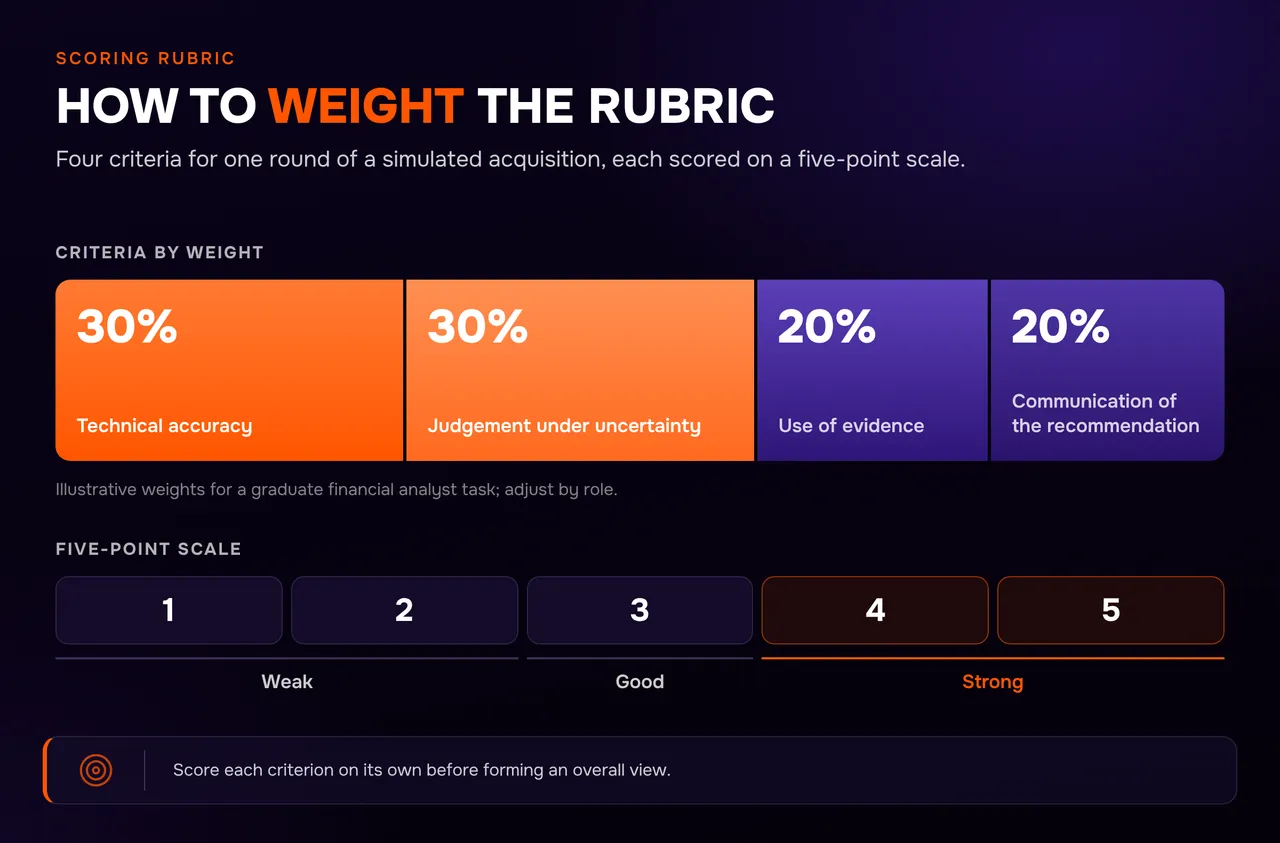
To use it, score each criterion on its own before you form an overall view, so a confident presenter cannot lift a weak calculation. A five-point scale works well, with 1 to 2 for weak, 3 for good and 4 to 5 for strong. Adjust the weights to the role. A credit team might give judgement under uncertainty more weight, since downside protection sits at the centre of the job, while a valuation-heavy advisory role might weight technical accuracy higher. If the round involves team decisions, add a fifth criterion for contribution to the team and brief assessors on what to watch for.
Calibrate before the live round. Write a weak, a good and a strong sample answer, have each assessor score all three, and talk through any disagreements. Most scoring drift between assessors comes from different readings of the middle band, so spend most of the calibration time there.
Assessing skills when candidates can use AI tools
Any test a candidate completes alone, unsupervised, with a fixed set of questions, an AI tool can now complete too. A static take-home case, an online numerical reasoning test or a multiple-choice accounting quiz takes a candidate seconds to paste into a chatbot. If your pre-employment skills assessment relies on these formats, you may be ranking candidates on their prompting.
Detection software and stricter proctoring offer limited protection and add friction for honest candidates. You get further by changing the design so that a generic AI answer stops being useful.
Start by deciding what AI use you allow, and tell candidates. Your analysts will use AI tools on the job, so a round that permits them can show you something real: whether a candidate checks the output, spots a wrong figure and takes responsibility for the final number. Other rounds can ban AI, as long as you run them in conditions where you can see the work.
Live, multi-round simulations are much harder to game. The information changes from round to round, rival teams' bids alter the situation and each decision depends on choices the candidate made earlier. Nobody can paste a scenario into a chatbot when the scenario keeps moving, and time pressure leaves little room to try. Observed team rounds add another layer, since assessors watch candidates reason out loud with colleagues.
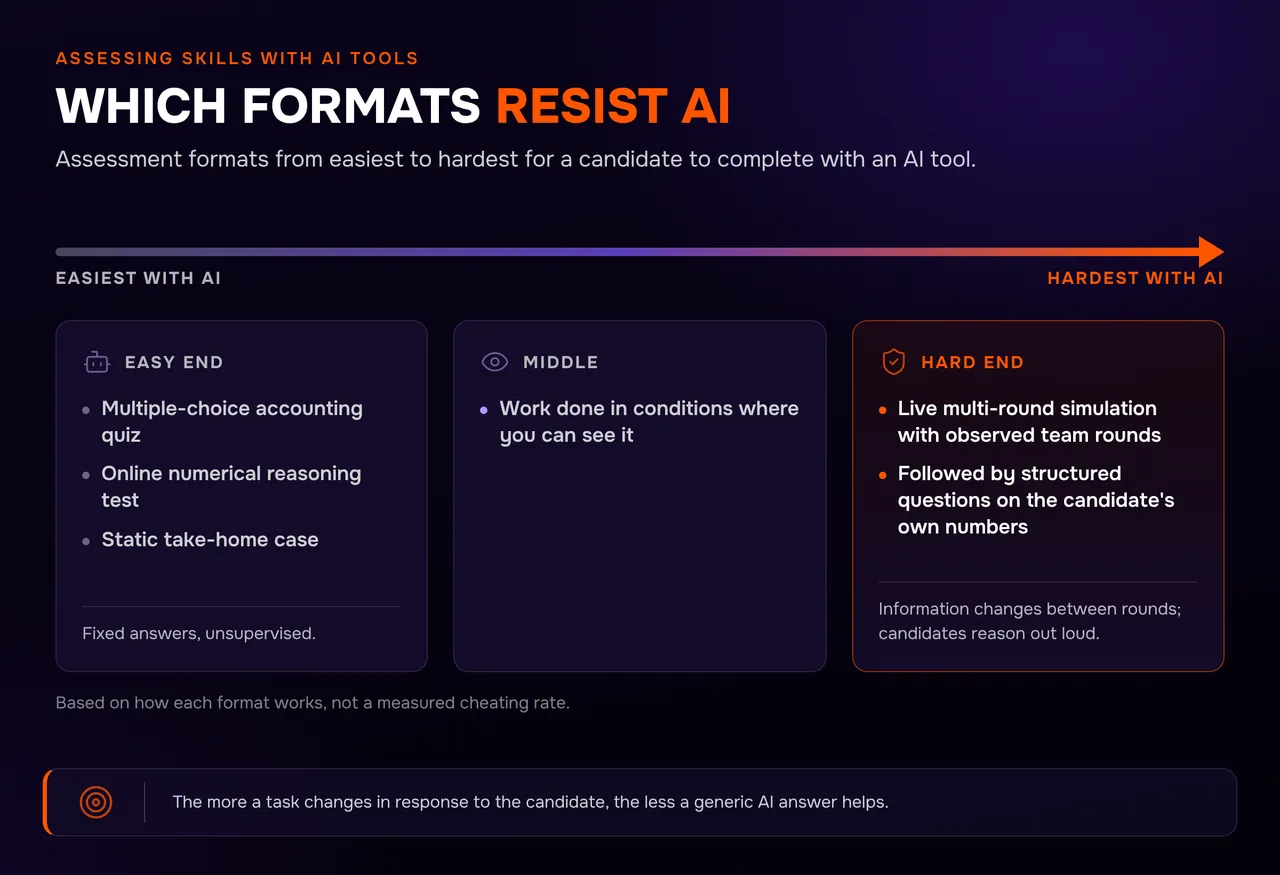
Structured follow-up questions close the remaining gaps. Ask candidates to defend their own numbers: what would make them lower the price by 10%, which comparable they trust least and why they treated the synergies as they did. Compare the written recommendation with the verbal defence. A candidate who understands the analysis handles the second and third question with ease. A candidate who outsourced it tends to repeat the first answer in different words.
Where FINSIMCO fits
We build live, multi-round business simulations for employers who want to see candidates do the work before they reach an interview. Former investment bankers designed our platform, so the finance scenarios reflect the decisions junior staff face on real deals. Our recruitment clients have removed up to 90% of their first-round interviews, and they make about one hire for every four candidates we submit.
If you are planning a skills-based assessment for finance roles and want to discuss how a simulation could fit your process, get in touch with our team or email info@finsimco.com.