Most finance lecturers use experiential learning theory, even if they never call it that. You set a case, ask students what went wrong, connect their answers to a model and give them another problem to solve. David Kolb put a structure around that sequence in 1984, and the structure still serves anyone designing a course.
Most writers on Kolb stop at the diagram. They explain the four stages in general terms, add a list of learning styles and leave you to work out what any of it means for a seminar on discounted cash flow. We take the opposite route. This guide covers the theory in enough depth to be accurate, then spends most of its length on a finance course: one simulation taken through all four stages, with a debrief plan and a reflection rubric you can adapt.
We build business simulations for universities and business schools, so we have a view here. Simulations fit Kolb's cycle, provided you design the reflection and theory stages with the same care as the game itself. Run a simulation with no debrief and your students get an experience with little learning attached.
What is experiential learning theory?
Experiential learning theory is David Kolb's model of how adults learn from experience. Kolb, writing in 1984, defined learning as "the process whereby knowledge is created through the transformation of experience." Learners move through four stages in a repeating cycle: experience, reflection, conceptualisation and experimentation.
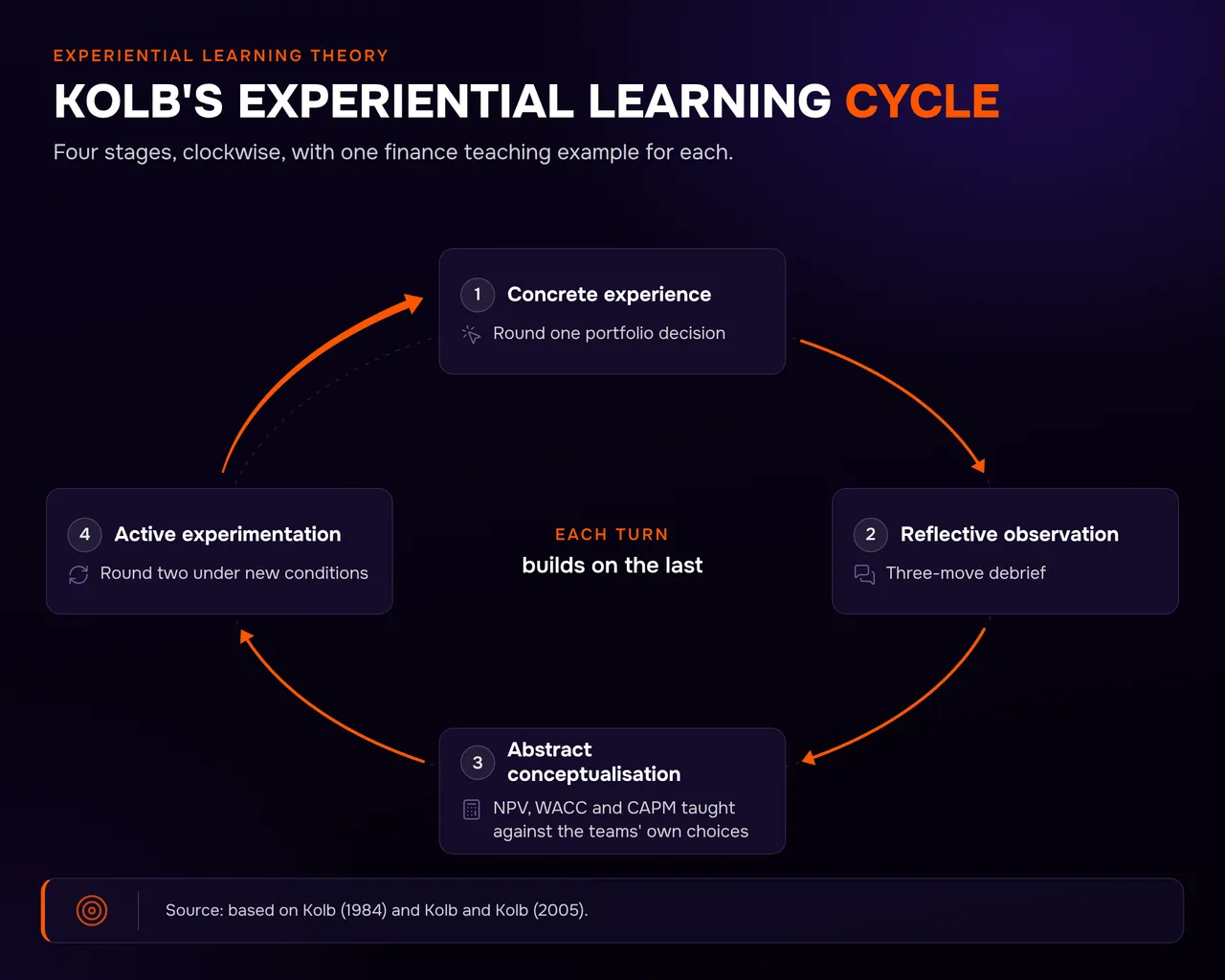
The four stages, in Kolb's terms:
- Concrete experience: the learner does something or meets a new situation.
- Reflective observation: the learner steps back and reviews what happened from more than one angle.
- Abstract conceptualisation: the learner forms or revises a concept that explains the experience.
- Active experimentation: the learner tests that concept in a new situation, which produces the next experience.
Kolb set the theory out in Experiential Learning: Experience as the Source of Learning and Development. His later restatement with Alice Kolb, Learning Styles and Learning Spaces (Academy of Management Learning & Education, 2005), quotes the 1984 definition and remains the most useful single paper for course designers. We map the same cycle against our own design choices on the page covering the learning science behind our simulation platform.
Kolb did not start from nothing. He drew on John Dewey, Kurt Lewin and Jean Piaget, each of whom gave experience a central place in learning. Dewey's point in Experience and Education (1938) is the one finance lecturers should keep in view: not every experience educates, and some experiences mis-educate. A weak exercise can teach students the wrong lesson with great conviction. Your job as course designer is to choose experiences that lead somewhere and to sequence them.
Kolb and Kolb restate the theory as six propositions. Two of them deserve a lecturer's attention. The first holds that "learning is best conceived as a process, not in terms of outcomes." The second states that "all learning is relearning." In a finance classroom the second one bites. Your students arrive with intuitions about money, risk and value, and some of those intuitions are wrong. A student who believes a project that pays back in three years must beat one that pays back in six will not drop that belief because you showed them the NPV formula. They drop it when the belief costs them something they care about.
Kolb's four-stage experiential learning cycle
Kolb and Kolb describe an "idealized learning cycle or spiral" in which the learner "touches all the bases." The four stages sit on two axes. Concrete experience and abstract conceptualisation are opposed ways of grasping experience. Reflective observation and active experimentation are opposed ways of transforming it. Kolb treats these as tensions the learner has to resolve, and the practical consequence for you is plain: if your course leans hard on one end of an axis, you starve the other end.
Most finance modules lean hard on abstract conceptualisation. Students meet the capital asset pricing model as a formula, work through textbook problems and sit an exam. They grasp the concept in the abstract, and few of them ever get to use it in a decision. Kolb's cycle gives you a way to see that imbalance and correct it.
Concrete experience
Students do something with a stake in it. In finance that might be a trading exercise, a valuation of a real listed company, a mock negotiation or a simulation round in which their decisions move cash flows and a share price.
A worked example on the board does not count. Your students watch someone else's experience. The concrete experience needs consequences the student cares about and enough ambiguity that they must commit to a decision before they know the answer. If students can look up the right answer before acting, you have set them an exercise, and they will learn from it what they learn from any exercise.
Reflective observation
Students review what happened and look at it from more than one position. In a finance course this is the debrief, and it is the stage lecturers cut first when a session overruns.
Kolb and Kolb argue that conversation "provides the opportunity for reflection on and meaning making about experiences." Good reflective observation is slower than it looks. Ask students to describe what they did and what happened before they explain why. Compare decisions across teams, because a team that sees another group take the opposite call on the same data starts asking the right questions. Hold back the theory for now. If you name the concept in the first five minutes, students stop reflecting and start waiting for you to tell them the answer.
Abstract conceptualisation
Students connect the experience to a model that explains it. Theory enters here: net present value, the weighted average cost of capital, CAPM, capital structure theory, agency costs.
The order matters. Students who meet a concept after the experience have a problem the concept solves. Students who meet it before tend to treat it as a procedure to memorise and reproduce. In practice you can still teach the formula in a lecture; the change is that you return to it straight after the debrief and ask students to use it on their own decisions, while the result still stings.
Active experimentation
Students take the revised concept and use it to make a new decision. Without this stage the cycle stays open. Students know what they should have done but never find out whether they can do it.
Kolb and Kolb cite Zull's argument that action "closes the cycle by bringing the inside world of reflection and thought into contact" with experience. For you, that means a second round, a new case with a similar structure or a live project. The second attempt also generates the next concrete experience, so a well-built module keeps the spiral turning across several weeks.
Kolb's four learning styles
Kolb's experiential learning theory also describes four learning styles. Each combines two of the four modes, and each comes with stated preferences for how a learner likes to work.
Style | Dominant modes | Stated preferences
|
|---|---|---|
Diverging | Concrete experience, reflective observation | Group work, listening with an open mind, personal feedback |
Assimilating | Abstract conceptualisation, reflective observation | Readings, lectures, analytical models, time to think |
Converging | Abstract conceptualisation, active experimentation | Experiments, simulations, lab work, practical applications |
Accommodating | Concrete experience, active experimentation | Working with others, setting goals, field work |
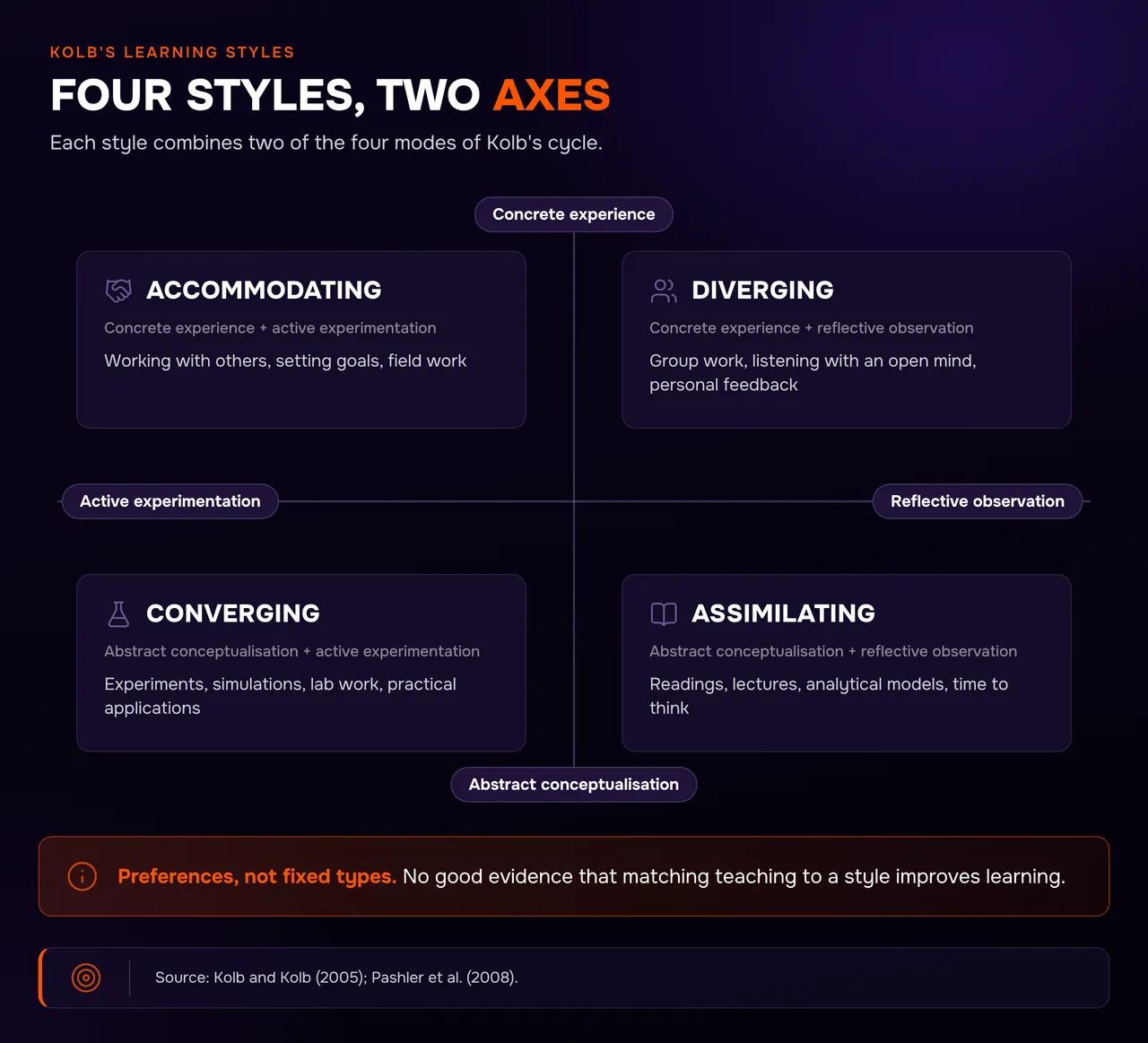
The descriptions and preferences come from Kolb and Kolb's 2005 paper. The same paper defines learning style as "a dynamic state" and warns against "a marked tendency to treat learning style as a fixed personality trait." Many summaries of Kolb skip that warning and present the styles as boxes students belong in.
What the research says about learning styles
Kolb's styles describe preferences. The popular extension of them, that you should match your teaching to each student's style, has no good evidence behind it.
In 2008, Harold Pashler and colleagues reviewed the research for Psychological Science in the Public Interest in Learning Styles: Concepts and Evidence. They tested the "meshing hypothesis," the idea that "instruction is best provided in a format that matches the preferences of the learner." They found "virtually no evidence" for the pattern of results that would support it, and several studies that "flatly contradict" it. Their conclusion: "there is no adequate evidence base to justify incorporating learning-styles assessments" into general educational practice. The authors also note that many learning-style models have never been tested at all, so you should read the review as an absence of support, not as proof that every model is wrong.
For course design the answer is to build for the full cycle. Every student goes through all four stages, whatever their preference. A student who prefers lectures still needs a concrete experience to anchor the theory, and a student who loves the simulation still needs to sit down and work through the discount rate. Use the styles, if at all, as a check that your session offers variety. Don't sort students by inventory score.
How to apply experiential learning theory in your teaching
Applying the theory starts with a change of order. Put the experience first and the theory second, and protect the time for reflection as you would protect lecture content.
Experiential learning in higher education runs into practical limits: large cohorts, fixed timetables, assessment rules and the pressure to cover a syllabus. You can work within all of them if you design each block of teaching around one full turn of the cycle. A two-hour workshop can hold one turn. A semester can hold six or eight, each building on the last.
Five design choices make the biggest difference.
Pick an experience with a real decision in it. Students should face a trade-off where the intuitive answer and the answer the theory supports differ. Capital budgeting under rationing, capital structure choices and acquisition pricing all work, because students' instincts mislead them in ways the theory explains.
Give the debrief as much time as the activity. Our view is that a rushed debrief wastes the experience. Plan the debrief questions before the session, not on the walk to the room.
Name the concept after the debrief. Let students articulate the problem in their own words, then give them the tool that solves it. NPV means more to a team that has just lost money by choosing on payback.
Close the loop with a second attempt. A second round, a follow-up case or a revised submission lets students test what they learned. It also gives you evidence of learning that a single round cannot.
Assess the reflection, not the score. Simulation results reward luck as well as judgement. A written reflection shows you whether the student understood why things happened.
Our guide on how to teach corporate finance with simulations covers course integration in more depth, including where simulations fit across a module on capital budgeting, capital structure and M&A.
Experiential learning examples in finance teaching
Finance lecturers already have several experiential formats to choose from. Each covers some stages of the cycle better than others, and knowing which stage a format neglects tells you what to add.
Format | Strongest stages | What to add
|
|---|---|---|
Case-based learning | Concrete experience (at one remove), reflective observation | A follow-up decision, since the case ends when discussion ends |
Trading or market simulation | Concrete experience, active experimentation | A structured debrief linking results to market theory |
Valuation project on a listed company | Abstract conceptualisation, active experimentation | Feedback on the outcome, since most students never learn whether their valuation held |
Negotiation role-play (e.g. M&A pricing) | Concrete experience, reflective observation | An explicit link to valuation theory and deal structure |
Business simulation over several rounds | All four, once you design the debrief | Debrief questions and a reflection task |
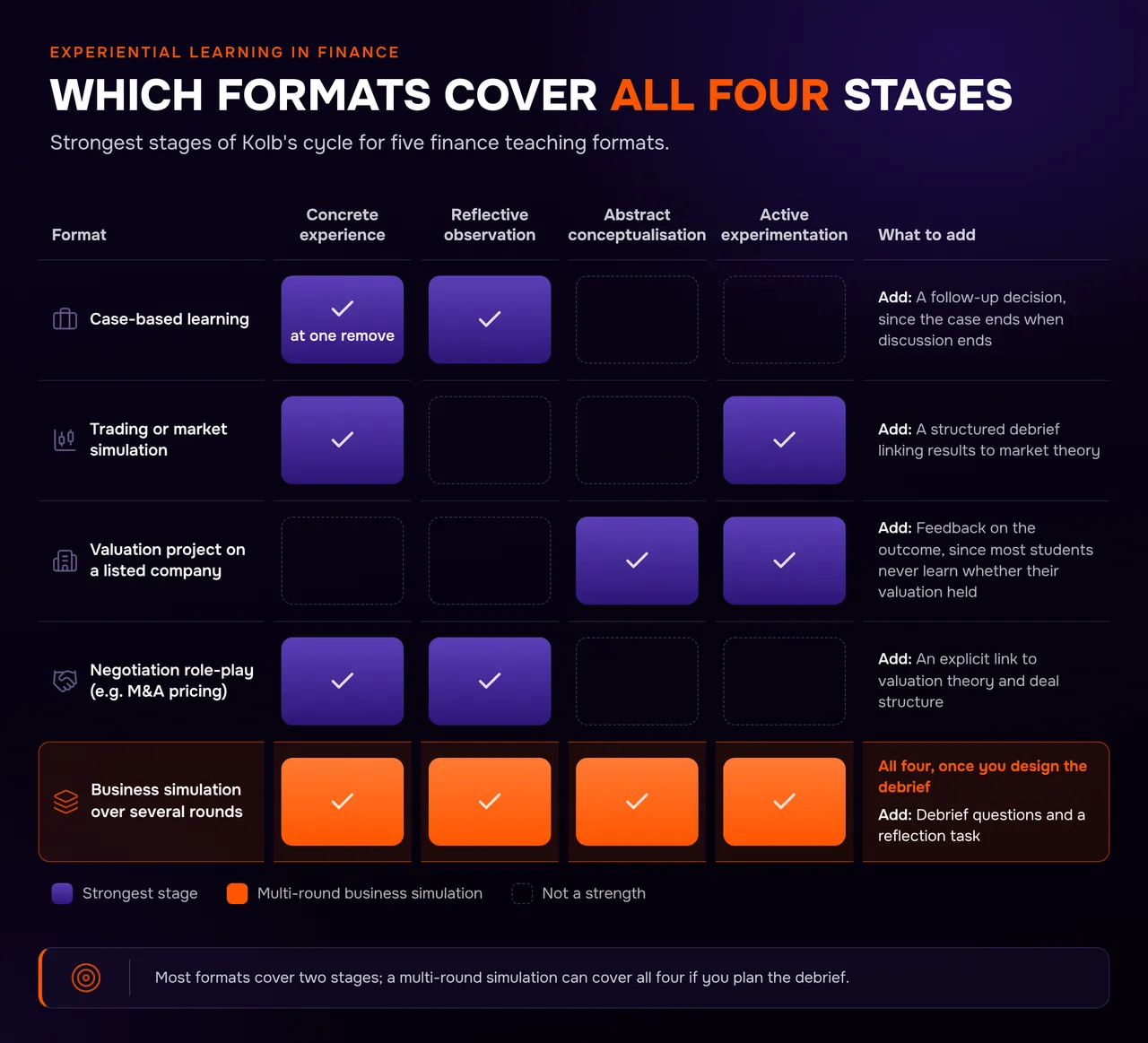
Case-based learning remains the default in many business schools, and for good reason. Students read a real situation and argue for a decision. The weakness is the ending. Once the discussion closes, students never test whether their revised view would work, so the cycle stops at reflection or conceptualisation.
A business simulation with several rounds can cover all four stages in one teaching block, because each round produces a result and the next round tests the lesson. The worked example below shows how that plays out.
A worked example: one simulation, four stages
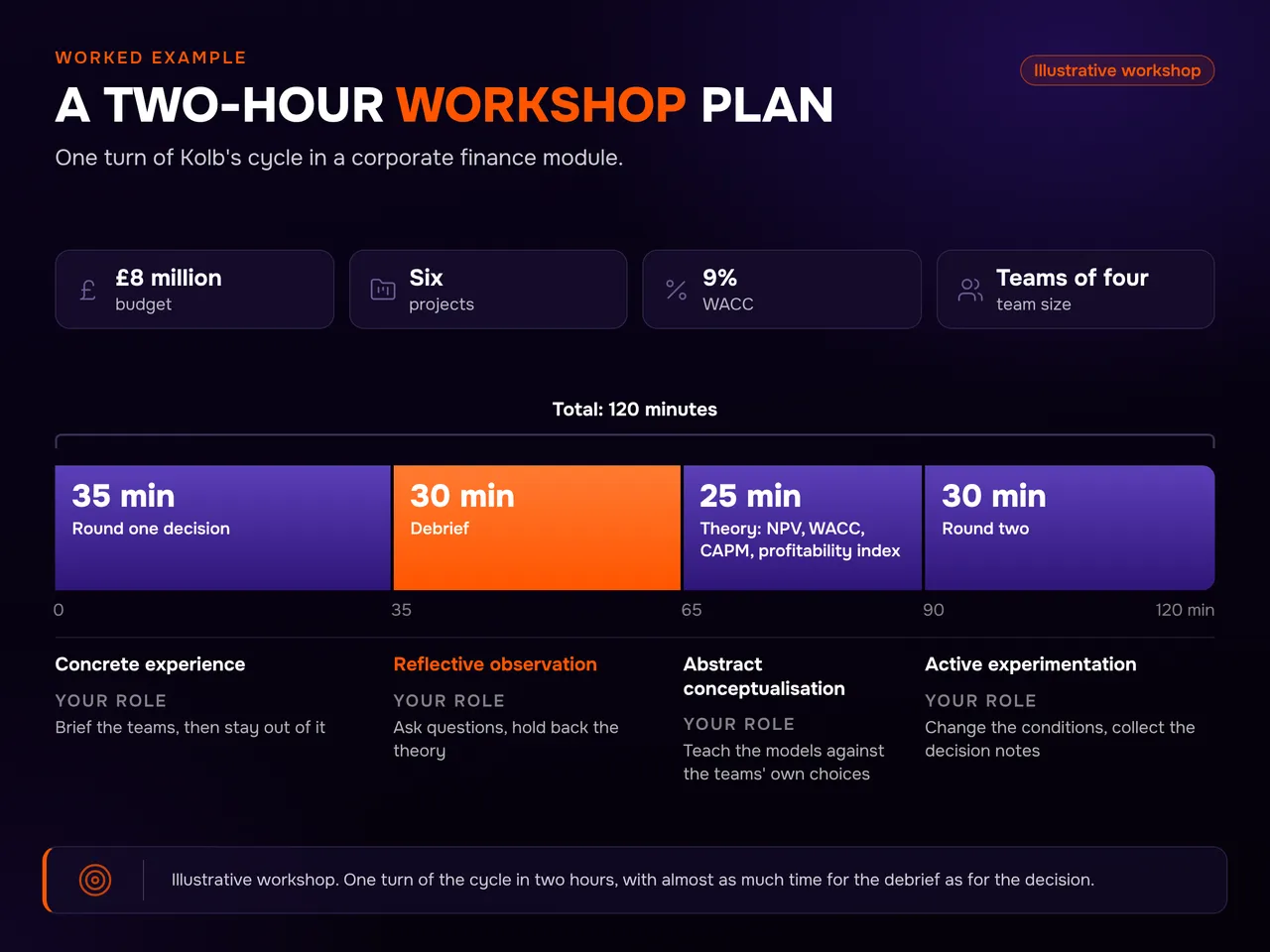
The example below is an illustration we wrote for this guide, not a FINSIMCO case study. The four-stage structure mirrors what we call our Applied Readiness Loop, the sequence our own simulations are built around, so the shape of the workshop is one we rely on ourselves even though the figures here are illustrative. It describes a plausible two-hour workshop for a second-year corporate finance module, with students working in teams of four. You can adapt the structure to a longer block or split it across two sessions.
The scenario. Each team acts as the investment committee of a mid-sized food manufacturer. The board has approved a capital budget of £8 million for the year, and six projects compete for it: an upgrade to an existing production line, a new regional distribution centre, a rooftop solar installation, the acquisition of a small competitor brand, entry into an export market and a new enterprise software system. Each project comes with a cash flow forecast, a payback period and a short description of its risks. The brief sets the company's weighted average cost of capital at 9%.
The design carries two traps, and you set them on purpose. The export project and the acquisition carry more systematic risk than the core business, so discounting them at the company WACC overstates their value. The solar installation has a long payback but a positive NPV. Under the budget limit, the best combination of projects differs from both the shortest-payback set and the set of projects with the highest individual NPVs.
Round one: concrete experience (about 35 minutes). Teams review the six projects, choose a portfolio within the budget and write a short justification for their choice. They submit, and the simulation plays out five years of operation. Each team sees its cash flows, the effect on the company's value and how its portfolio compared with what it expected.
Teams will make different choices. One might favour short payback because it feels safe. Another might discount every project at 9% and fall for the export project's headline NPV. A third might rank projects by NPV, fill the budget from the top and leave money unspent. The point of round one is to let those choices happen without correction.
The debrief: reflective observation (about 30 minutes). Run the debrief in three moves. First, ask each team to show its portfolio and result, and to describe what happened without explaining it yet. Second, ask teams to explain their reasoning. Third, put the portfolios side by side and ask the room what pattern they see.
Questions that work at this stage:
- Which project surprised you most, and what did you expect from it?
- Which number in the brief did you rely on most, and why that one?
- Look at the team whose result differs most from yours. What did they see that you didn't?
- If you had the same budget again tomorrow, which project would you drop first?
Keep the theory back. If a student says "we should have used NPV", ask them what NPV would have told them and why they didn't use it.
The theory: abstract conceptualisation (about 25 minutes). Now bring in the models, each one tied to a decision a team made.
Start with NPV as the decision rule and show why payback ignores both the time value of money and every cash flow after the cut-off. The solar project makes the point for you. Move to WACC and ask what it represents: the return investors require for the company's average risk. Then ask whether a riskier export project deserves the average rate. The answer opens CAPM. Show teams how to estimate a project-specific cost of equity using a beta from companies that already operate in export markets, then build a project discount rate from it. Teams recalculate the export project's NPV at the higher rate and compare it with their round one view. Finish with capital rationing: rank projects by profitability index, the present value of future cash flows per pound invested, and show why that ranking fills a fixed budget better than raw NPV.
Ask each team to rework its round one portfolio with the new tools before moving on.
Round two: active experimentation (about 30 minutes). Change the conditions. Interest rates rise, so the company's cost of capital goes up. The board trims the budget, and a new project appears. Teams build a revised portfolio and attach a short note naming the concept that changed their decision and how.
The simulation plays out again, and the session ends with a five-minute individual task: each student writes down one decision they would now change and the reason. That note becomes the seed of the written reflection described in the next section.
Stage | Activity | Time | Your role
|
|---|---|---|---|
Concrete experience | Round one portfolio decision | 35 min | Brief the teams, then stay out of it |
Reflective observation | Three-move debrief | 30 min | Ask questions, hold back the theory |
Abstract conceptualisation | NPV, WACC, CAPM, profitability index | 25 min | Teach the models against the teams' own choices |
Active experimentation | Round two under new conditions | 30 min | Change the conditions, collect the decision notes |
If you would rather start from a ready-built version, our capital budgeting simulation covers NPV, IRR, profitability index, payback and capital rationing, with a debrief built into each stage.
How to assess reflection in finance courses
Assess the reflection, and keep simulation performance out of the grade or give it a small weight. A team can make a sound decision and get an unlucky draw, and a team can stumble into a good result for the wrong reasons. If you grade the score, students learn to game the simulation.
A short written reflection after round two works well. Ask each student to describe one decision, explain what happened, connect it to the relevant theory and state what they would change. You can mark each script in a few minutes with a rubric like the one below.
Criterion | Developing | Competent | Strong
|
|---|---|---|---|
Account of the experience | Lists events, no decisions | Describes decisions and results | Links each decision to its result |
Analysis | Blames luck or teammates | Identifies one cause | Weighs several causes, including own reasoning |
Link to theory | Names a concept | Applies a concept without error | Uses theory to explain the result and its limits |
Revised action | Vague intention | Specific change | Specific change, tested or justified with figures |
Use of evidence | No figures | Some figures from the simulation | Figures used to support each claim |
The rubric also helps with accreditation. AACSB's 2020 business accreditation standards cover assurance of learning under Standard 5. In an interview on assurance of learning under the 2020 standards, Marine Condette described "a philosophical switch from learning goals to competencies" and explained that schools now need a mix of direct and indirect measures, along with evidence that faculty take part in the process. A rubric-scored reflection gives you a direct measure of a competency such as applying financial theory to investment decisions, and the results feed the curriculum review that the standards expect.
For the accreditors' own view of simulations, hear what AACSB and AMBA leaders say about simulations in business education.
Who developed experiential learning theory?
David Kolb developed experiential learning theory and published it in 1984 in Experiential Learning: Experience as the Source of Learning and Development. He built on John Dewey, Kurt Lewin and Jean Piaget, who each gave experience a central role in learning. Dewey supplied the philosophy of learning through experience, Lewin a field theory of person and environment, and Piaget the interplay of assimilating new experience and accommodating existing concepts to it.
What are the principles of experiential learning?
Kolb and Kolb set out six propositions. Learning is a process, not an outcome. All learning is relearning. It requires resolving tensions between opposed modes of adapting to the world, and it is a holistic process of adaptation. It results from transactions between the person and the environment, and it is the process of creating knowledge. For course design, the first two matter most.
Putting the cycle to work
Kolb's cycle asks little of you in theory and a fair amount in practice. Put the experience first, give the debrief real time, teach the concept against the students' own decisions and let them try again. Skip the learning-style sorting and design every session so that all students touch all four stages.
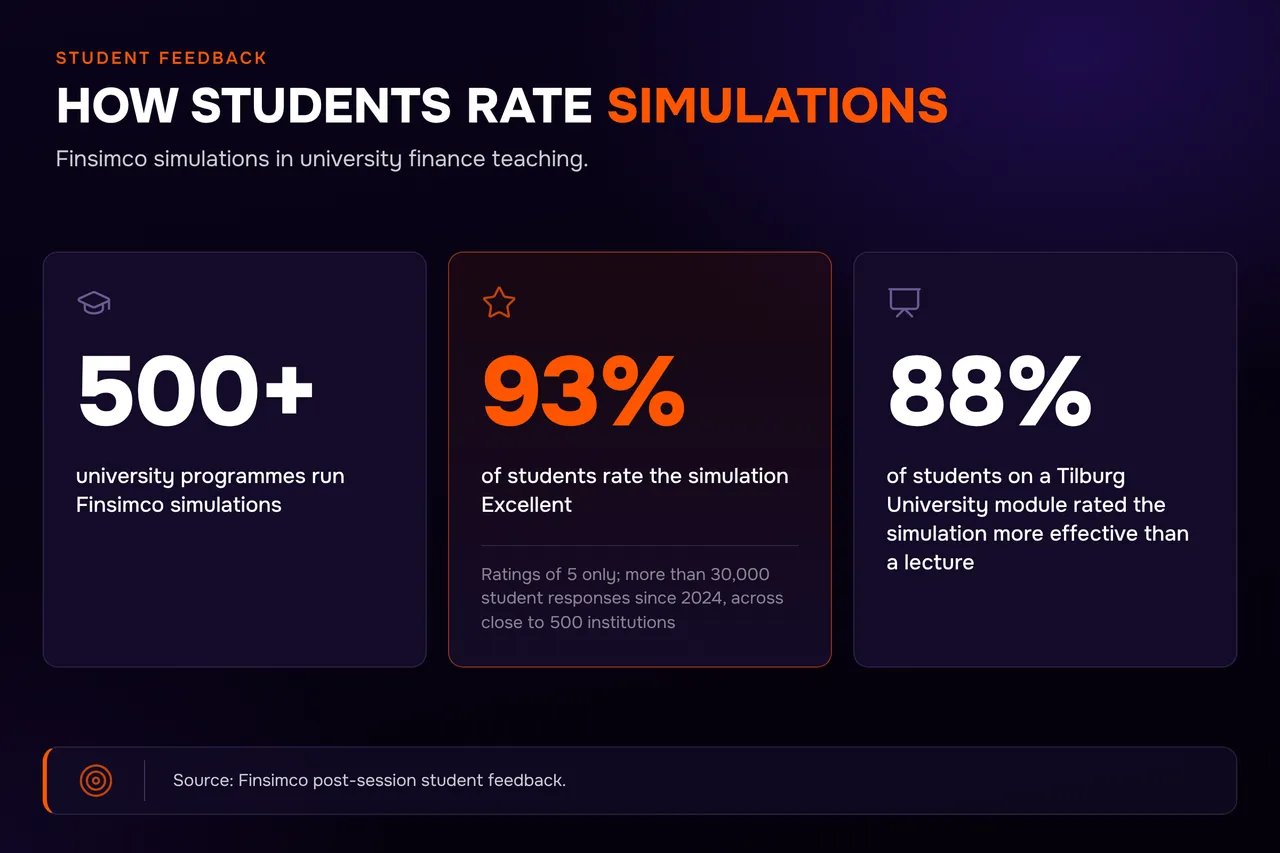
Business simulations make that structure easier to run at scale. Lecturers run FINSIMCO simulations in more than 500 university programmes, and 92 to 93% of students who complete one rate the experience excellent. Across our simulations, students rate the experience 70 to 91% more effective than a lecture, and a module at Tilburg University scored 88% on that same measure. Kolb's cycle is one of the frameworks our own simulations are built on: each one takes students through a full turn of it, and longer programmes repeat the cycle at rising complexity. If you want to build a module around the cycle, or adapt the workshop above to your own course, get in touch with our team at info@finsimco.com and we will talk it through with you.