Candidate assessment is the stage of hiring where you stop reading about an applicant and start looking at evidence of what they can do. In finance, that evidence carries more weight than in most fields. A graduate with a first-class degree and a tidy CV can still freeze when a model breaks an hour before a client call, and you have no way of spotting that from paper.
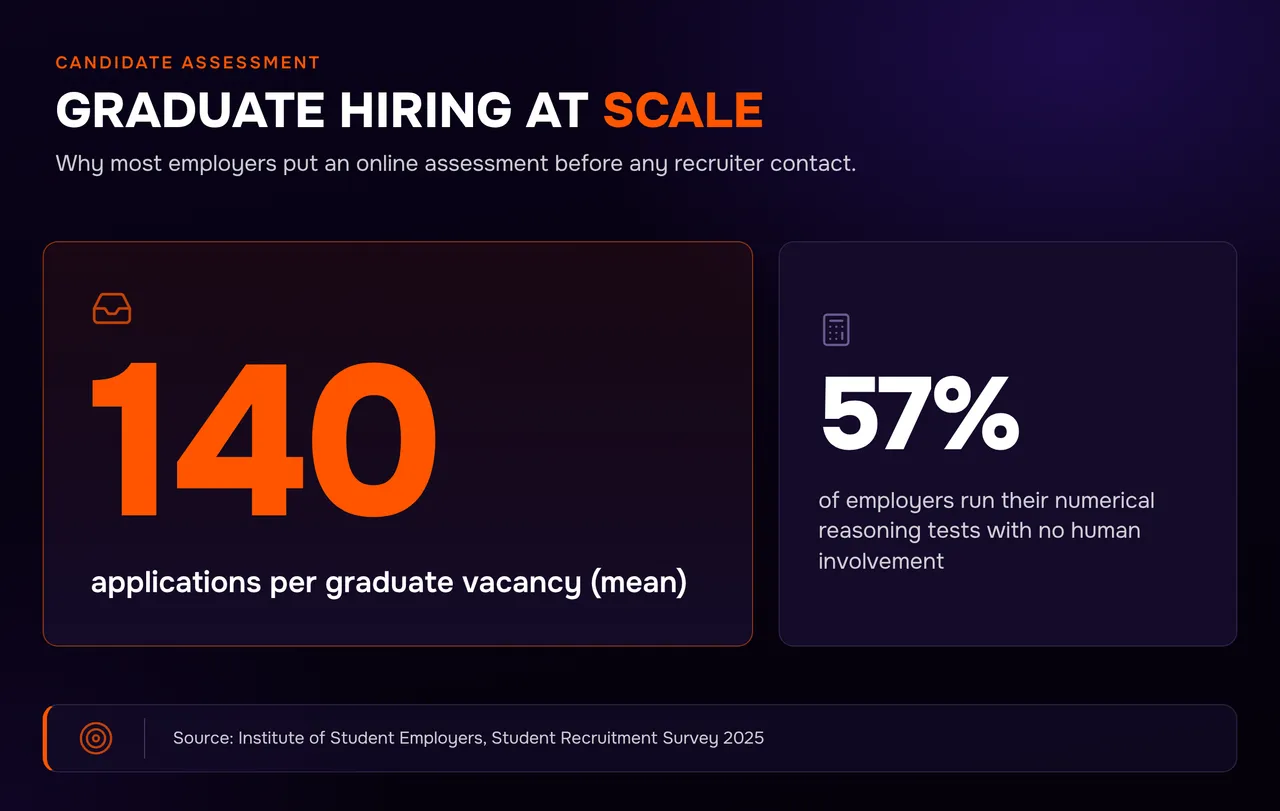
Volume makes the job harder. The Institute of Student Employers' Student Recruitment Survey 2025 found that employers received a mean of 140 applications per graduate vacancy. You cannot interview 140 people for one seat, so most firms put some form of online candidate assessment in front of applicants before a recruiter speaks to anyone.
Below, we cover the main types of pre-employment assessments, what the research says about how well each one predicts performance, and how to choose and use them for finance and graduate recruitment. We build simulation-based assessments for recruitment teams, so we have a view on this. We say where that view shows, and we have tried to keep the comparison fair.
What is candidate assessment?
Candidate assessment is any structured method an employer uses to measure whether an applicant has the skills, knowledge and behaviours a role needs. Structure is what makes it useful. Every candidate faces the same task, assessors score the results against the same standard, and you end up comparing people on something firmer than a hunch.
The term covers a wide range of formats. A 20-minute numerical reasoning test counts. So does a half-day assessment centre, a recorded video interview or a two-hour simulation in which candidates value a business and negotiate a deal with each other. Most employers now run at least the screening stage online, which is why recruiters treat "online candidate assessment" and "pre-employment assessments" as near synonyms.
Assessment sits alongside CVs, application forms and interviews. It earns its place at the two points where those inputs are weakest: early screening, when you have too many applicants to read each one with care, and the final stage, when you need to separate several strong people who all interview well.
Why employers use candidate assessments
Scale. At 140 applications per vacancy, a recruiter who spends five minutes on each CV needs more than eleven hours to clear one role. An assessment lets you rank the whole pool on the same measure in the time it takes candidates to complete it.
Better prediction than a CV. Degree class and university name tell you something about past academic results and a fair amount about a candidate's background. You learn very little from them about how someone handles an unfamiliar problem with incomplete data, which is most of the job in a bank or an advisory firm. In our own data, simulation performance predicts later job performance at roughly 0.54 to 0.62, well above the 0.10 or so you get from CV and grades alone. A CV gives you a university, a degree subject and a list of past roles. A simulation profile gives you decision quality under pressure, how someone reasons through evidence, how they communicate and work with a team, and how fast they learn over the session, benchmarked against everyone else who has run the same scenario.
Consistency you can defend. If every candidate takes the same assessment and you score it the same way, you can explain each decision, check your outcomes for bias and respond if someone challenges a rejection. You will struggle to do any of that with unstructured interviews.
A realistic preview. Candidates who work through a realistic task learn what the job involves. Some decide it is not for them, which saves both sides time. Others come out of it more committed than any careers page could have made them.
We would not say assessments take the decision away from people. They give recruiters and hiring managers better material to decide with.
Types of candidate assessment
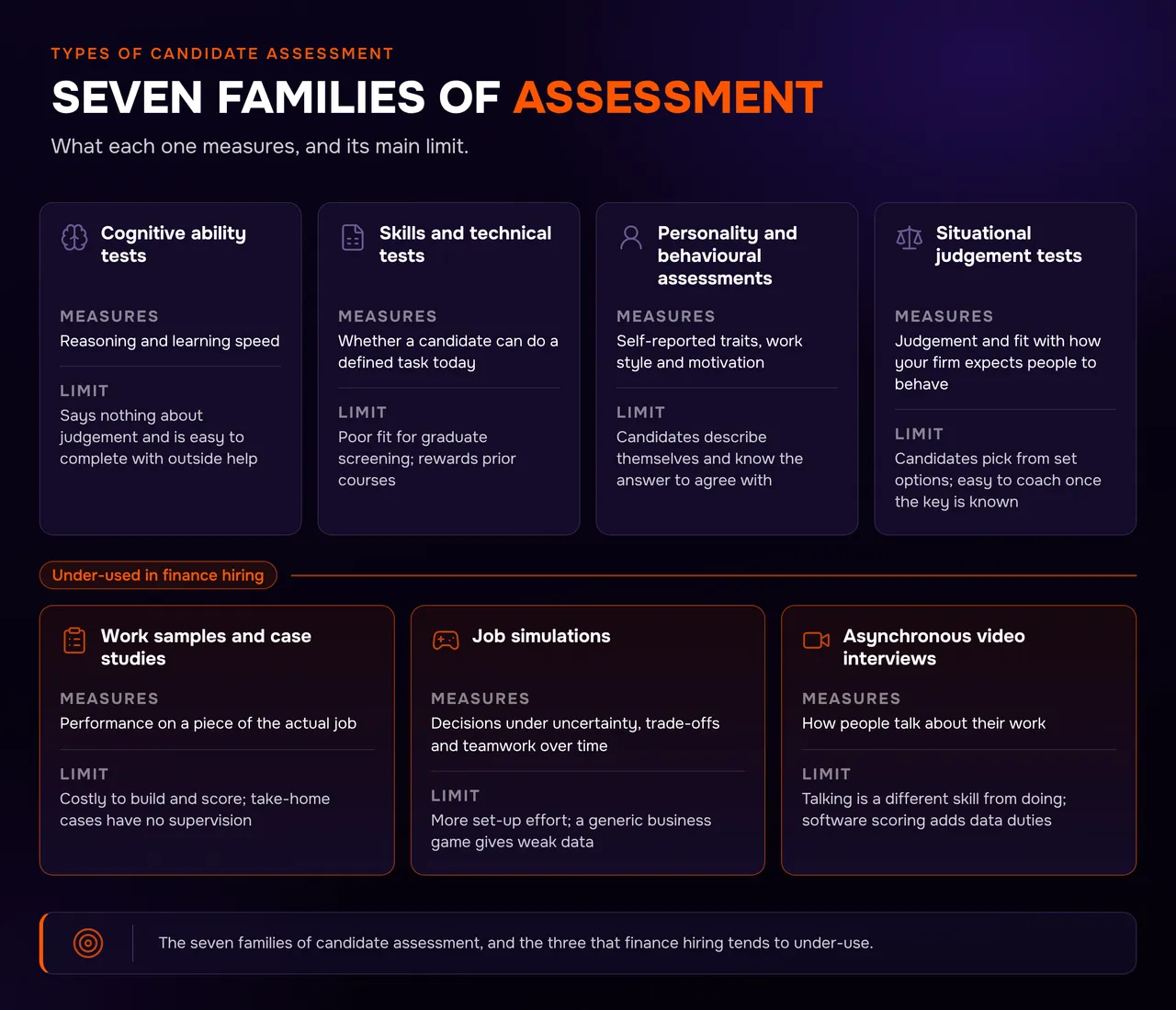
Most candidate assessment tools fall into seven families. They differ in what they measure, how long they take and how easy they are to game, and the right mix depends on the role and the stage. Finance hiring tends to lean on the first two and under-use the last three.
Cognitive ability tests
A cognitive ability test measures general reasoning through timed numerical, verbal and abstract or logical questions. In graduate finance recruitment the numerical reasoning test is the default first filter: candidates read tables and charts and answer multiple-choice questions against the clock.
These tests are cheap and fast, and you can run them on thousands of candidates. The ISE survey found that 57% of employers run their numerical reasoning tests with no human involvement. They measure how fast someone learns and processes information, which matters in analyst roles where the first year is a steep learning curve.
They tell you nothing about judgement, behaviour or how a candidate works with others. Candidates practise them for weeks, so scores reflect preparation as well as ability. And because each question has one fixed answer, a static online reasoning test is one of the easiest formats for a candidate to complete with outside help or an AI tool.
Skills and technical tests
Skills tests check whether a candidate can do a defined task today. In finance that might be an Excel test, an accounting knowledge quiz, a short financial modelling exercise or a coding test for quant and data roles. Researchers call the knowledge-based version a job knowledge test.
They work well for experienced hires, where you expect someone to arrive able to build a three-statement model or read a set of accounts. For graduate roles they are a poor fit at the screening stage. You end up rewarding the candidates who took the right modules or could afford a modelling course, and you screen out strong people from engineering, physics or history who would learn the material in a month.
Personality and behavioural assessments
Personality questionnaires are the part of psychometric testing most people picture: a long list of statements that candidates rate themselves against, producing a profile on traits such as conscientiousness, extraversion or resilience. Behavioural assessments use similar self-report formats to estimate work style or motivation.
They are easy to administer and candidates find them low-stress. The weakness is that candidates describe themselves, and anyone applying to a bank knows that "I pay close attention to detail" is the answer to agree with. We would use a personality profile to shape interview questions and would not use it as a pass or fail cut-off on its own.
Situational judgement tests (SJTs)
A situational judgement test describes a realistic work scenario and asks the candidate to pick or rank the best responses. A finance SJT might say: a senior colleague asks you to change a figure in a client presentation ten minutes before it goes out, and you think the new number is wrong. Candidates choose between options such as making the change, raising it with the colleague or escalating to the deal lead.
SJTs measure judgement and alignment with how your firm expects people to behave. They scale well, and candidates find them more relevant than abstract reasoning puzzles. The ISE found that 53% of employers run their SJTs on full automation.
The limit is that candidates select from options someone else wrote. They never have to produce the response themselves, and once a candidate works out the logic behind your scoring key, coaching becomes easy. Well-written SJTs avoid obvious "right" answers, but that takes skilled item writing and regular refreshes.
Work samples and case studies
A work sample asks the candidate to perform a piece of the actual job. For a credit analyst that could be writing a short credit memo on a borrower. For a corporate finance hire it might be building a simple discounted cash flow model and presenting a recommendation. Case studies are the interview-room version: a business problem, some data and a set time to analyse it and present.
Work samples feel fair to candidates because the link to the job is obvious, and hiring managers trust the results because they recognise the task. They cost more to build and score. Two assessors can give the same case very different marks unless you give them a clear rubric and calibrate them first. Take-home cases add a further problem: you have no idea who, or what, did the work.
Job simulations
A job simulation reproduces a working situation over time. Candidates take on a role, receive information, make decisions and see the consequences, then make the next decision with those consequences in front of them. A work sample captures one task. A simulation captures how someone works through a sequence of them while the situation keeps moving.
Most guides give simulations a paragraph and move on. For finance roles they deserve more attention, because they test the three things analysts and associates get wrong most often in their first year.
Decisions under uncertainty. In a well-built finance simulation, candidates never get all the data. They might have to approve or reject an investment project with partial cost estimates, then learn halfway through that interest rates have risen or a major customer has left. You see whether they revise their view or defend a number they should drop, and whether they can say how confident they are and why.
Trade-offs. Real finance work rarely has one right answer. A team might have a fixed budget across several projects, or a negotiation in which pushing for a higher price risks losing the deal. Candidates have to choose, live with the result and explain the choice to someone senior. A multiple-choice test cannot show you how a person weighs return against risk, or speed against accuracy, when both sides of the trade carry a cost.
Teamwork. Many simulations put candidates in teams and add negotiation rounds against other teams. You see who structures the discussion, who checks the numbers, who listens and who steamrolls. Those behaviours show up on a trading floor or in a deal team from the first week, and you will not pick them up from a CV or a solo test.
What you get out of it. Because the platform records every decision and its timing, you can score far more than the final answer. You can see how a candidate prioritised, how their performance changed from the first round to the last, how well they wrote and spoke, and how they behaved under time pressure. That learning curve across rounds is one of the most useful signals for graduate hiring, where you are betting on potential. Our own reports score four things: performance against the wider candidate pool, analytical and commercial reasoning, behavioural and collaboration signals, and the specific decisions behind every score, so a hiring manager sees the evidence behind the result, not just the result.
Simulations take more effort to set up than an off-the-shelf test, and a generic business game that has nothing to do with your roles will frustrate candidates and give you weak data. The value comes from relevance. Many employers commission custom job simulations built around their own roles and decisions so the scenarios mirror the work new hires will do.
Asynchronous video interviews
In an asynchronous video interview, candidates record answers to set questions on their own schedule, and reviewers or software score the recordings later. The ISE found that 35% of employers used recorded or asynchronous video interviews at the second stage of selection.
They solve a scheduling problem and give every candidate the same questions. They measure how people talk about their work, which is a different skill from doing it. Many candidates find talking to a webcam with no one on the other side uncomfortable, and if you let software score the answers, you take on data protection duties we cover below.
Which assessment types best predict job performance?
Predictive validity is the correlation between an assessment score and later job performance. It runs from 0 to 1, where 1 would mean the score predicts performance without error. In selection research, anything above about 0.3 counts as useful, and nothing gets close to 1.
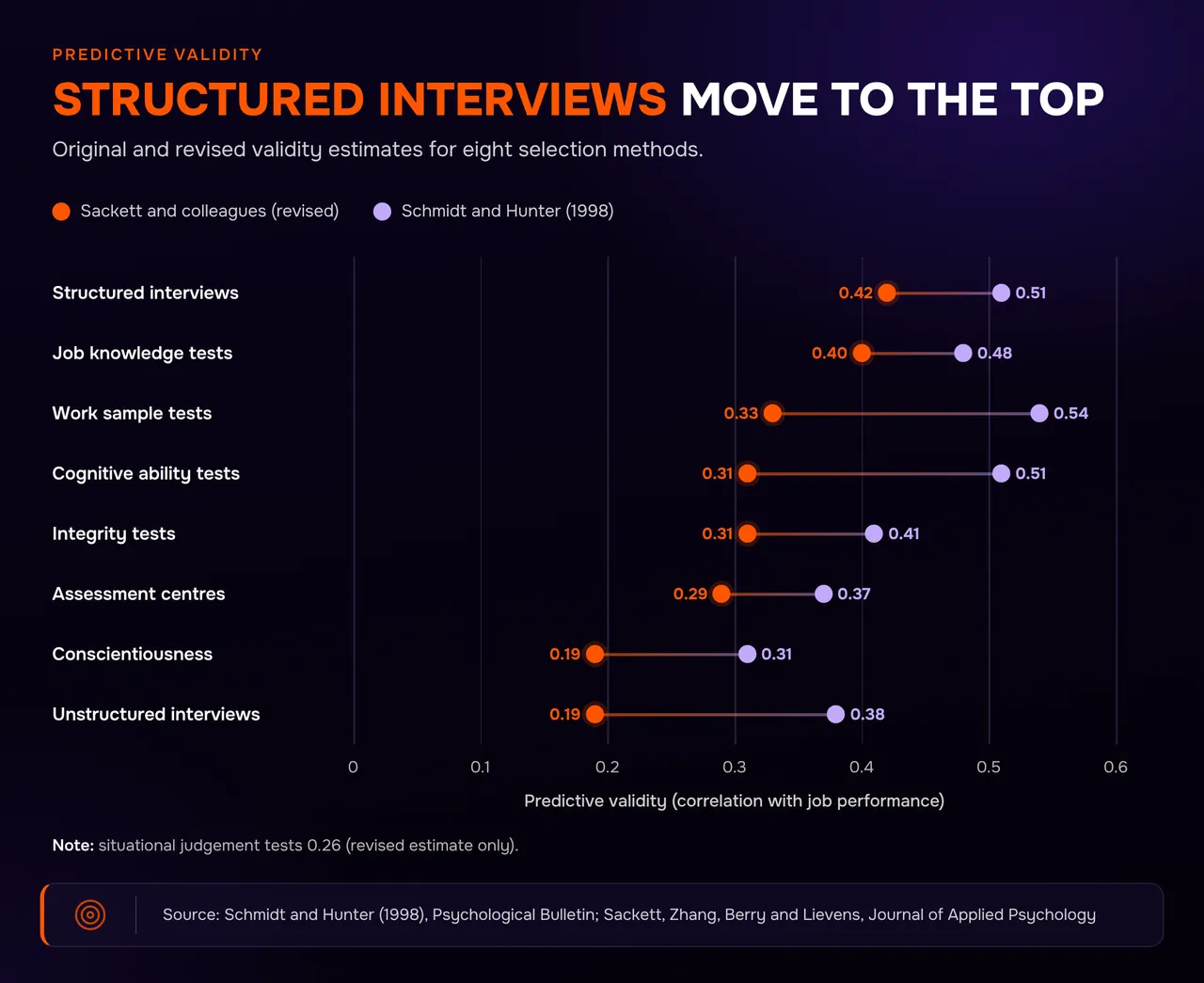
For more than twenty years, the standard reference was Frank Schmidt and John Hunter's 1998 meta-analysis in Psychological Bulletin, which summarised 85 years of research on 19 selection procedures. They put work sample tests at 0.54, general mental ability and structured interviews at 0.51 each, job knowledge tests at 0.48 and integrity tests at 0.41. Their headline conclusion was that general mental ability was the best single predictor across jobs, and that pairing it with a second method added the most. General mental ability plus an integrity test reached 0.65, and general mental ability plus a work sample or a structured interview reached 0.63.
Paul Sackett, Charlene Zhang, Christopher Berry and Filip Lievens revisited those numbers in the Journal of Applied Psychology. They argued that earlier meta-analyses had overcorrected for restriction of range, in large part by applying corrections built for predictive studies to concurrent studies of existing employees. Once they removed that overcorrection, mean validities fell by about 0.10 to 0.20, and the order changed.
Selection method | Schmidt and Hunter (1998) | Sackett and colleagues (revised)
|
|---|---|---|
Structured interviews | 0.51 | 0.42 |
Job knowledge tests | 0.48 | 0.40 |
Work sample tests | 0.54 | 0.33 |
Cognitive ability tests | 0.51 | 0.31 |
Integrity tests | 0.41 | 0.31 |
Assessment centres | 0.37 | 0.29 |
Conscientiousness | 0.31 | 0.19 |
Unstructured interviews | 0.38 | 0.19 |
The revised paper put situational judgement tests at 0.26. As the Society for Industrial and Organizational Psychology summarised it, cognitive ability dropped to fifth place, and structured interviews emerged as the top-ranked procedure.
We draw three practical points from the two studies together.
No method stands far ahead. The top five procedures in the revised estimates sit between 0.31 and 0.42. Choosing the "best" single test matters less than choosing several that measure different things and running them well.
Job-related, structured methods hold up. Structured interviews, job knowledge tests and work samples all stay in the top group. Each one asks candidates to show something tied to the role and scores it against a fixed standard. Unstructured interviews and self-reported personality sit at the bottom in both studies.
Cognitive ability lost its clear lead. Reasoning tests still predict performance, at about the same level as work samples and integrity tests. The case for screening graduates on a numerical reasoning score alone is weaker than many recruiters assume.
Work samples fell further than most in the revised figures, and we would not gloss over that. A simulation is a type of work sample, so the same caution applies. A simulation earns its validity from how close it stays to the real role and how consistent its scoring of behaviour is, which is why we publish how we approach predictive validity in our simulations.
Two caveats apply to every figure in the table. These are averages across many jobs and many versions of each method, and a poor version of a strong method will underperform a good version of a weaker one. The figures tell you where to start. Your own data tells you whether it works, so track how assessed hires perform at six and twelve months and compare that with their scores.
How to choose the right candidate assessment
Picking a candidate assessment starts with the job and ends with the hiring funnel. Start by deciding what you need to measure, then decide when to measure it.
Start from the skills the role needs
Write down what a new hire does in their first year. For a graduate analyst in an advisory firm that list might include building and checking models, pulling data from filings, drafting slides, working late against a deadline and explaining numbers to a senior banker who has five minutes. Then split the list into what someone must bring on day one and what you will teach them.
For graduate roles, the must-haves tend to be learning speed, numerical reasoning, judgement, communication and the ability to work in a team under pressure. Most technical knowledge sits in the "we will teach it" column. For experienced hires the balance flips, and technical depth moves to the top.
Ask hiring managers what separated their best and worst hires of the last two years. You will hear about attention to detail, ownership and how people handled feedback far more often than about which formula someone knew. Choose assessments that measure those qualities head on, and drop any test you cannot link to an item on the list.
Match the format to the hiring stage
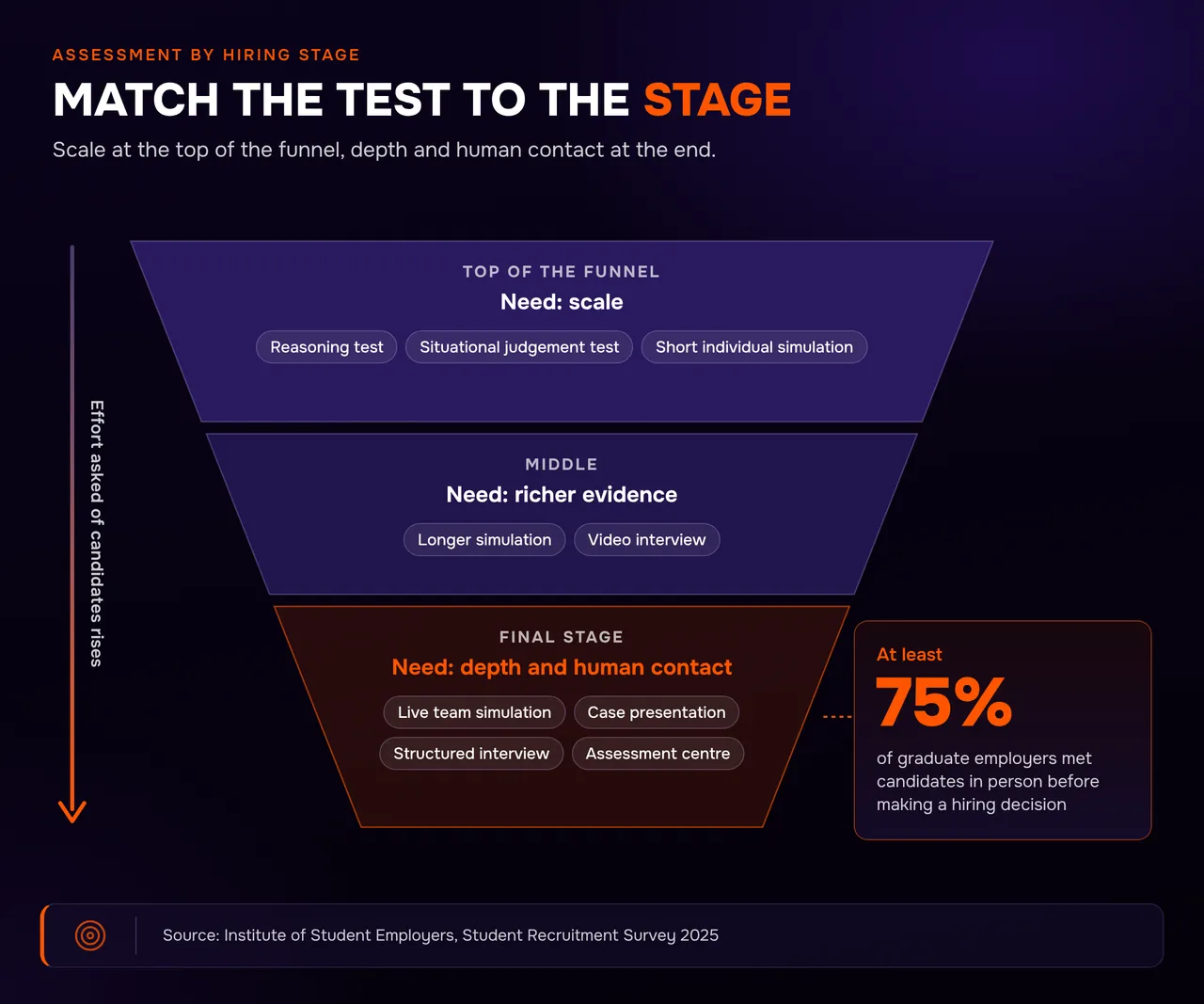
At the top of the funnel you need scale. Short, automated formats such as a reasoning test, an SJT or a brief individual simulation let you narrow thousands of applicants to a manageable group without burning recruiter time.
In the middle stage you can ask for more. A longer simulation or a video interview gives you richer evidence on a smaller group, and candidates who have passed one round are more willing to invest an hour or two.
At the final stage you want depth and human contact. Live team simulations, case presentations and structured interviews belong here, and so do assessment centres if you still run them. The ISE found that at least 75% of graduate employers met candidates in person before making a hiring decision.
Match the effort you ask of candidates to how far they have progressed. A three-hour task before anyone has spoken to them drives strong candidates away, and they are the ones with the most other offers.
Fairness, bias and compliance in candidate assessment
Any candidate assessment that screens people out can screen out some groups more than others. You need to check for that, make the process accessible and handle candidate data within the law. None of what follows is legal advice, so take your own counsel on anything specific.
Adverse impact. Adverse impact means a selection step rejects one group at a higher rate than another by a margin you can see in the numbers. In the US, the federal Uniform Guidelines on Employee Selection Procedures use the four-fifths rule as a rule of thumb: a selection rate for any group below 80% of the rate for the highest group counts, in most cases, as evidence of adverse impact. If 50% of one group passes your numerical test and 35% of another does, the ratio is 70%, and you have a problem to investigate.
A finding of adverse impact does not make a test unlawful on its own. The US Equal Employment Opportunity Commission explains that the employer then has to show the test is job-related and consistent with business necessity, and a challenger can still win by pointing to a less discriminatory alternative that predicts performance as well. UK employers face a similar test under the Equality Act 2010, which bars indirect discrimination unless the employer can justify the practice.
Assessment bias in practice. Monitor pass rates by group at every stage, using whatever diversity data you collect. Review content for language, cultural references or assumed knowledge that some candidates would not have. A graduate test packed with banking jargon penalises a strong maths student who never did a finance internship. Calibrate human assessors on sample responses before they mark real ones, and check their scores against each other.
Accessibility and reasonable adjustments. UK employers must make reasonable adjustments for disabled candidates, and US employers must provide reasonable accommodations in the way they administer tests under the Americans with Disabilities Act. The UK Civil Service's guide to reasonable adjustments for online tests gives a useful benchmark: recruiters can offer 25%, 50%, 75% or 100% extra time on timed tests, and video content comes with transcripts, subtitles and audio description. Tell candidates how to ask for adjustments before they start, and ask any vendor whether their platform supports screen readers, extra time and pausing.
Data protection. Online assessments collect personal data, sometimes including video and audio recordings. In March 2026 the UK Information Commissioner's Office set out its expectations for automated decisions in recruitment. Employers should tell candidates when they use automated decision-making and how it works, test for biased outputs on a regular schedule, and tell candidates how to challenge a decision and request a human review. Before you sign with a provider, find out what data they collect, how long they keep it, where they store it and whether any score triggers an automatic rejection.
What to look for in an online assessment platform
Once you know what you want to measure, the platform decides how well you can measure it at scale. Two areas separate useful platforms from ones that only look modern.
Standardised scoring and reporting
Every candidate should face the same scoring rubric, and you should be able to trace each score back to what the candidate did. A number with no explanation behind it is hard to act on and harder to defend. Look for reports that show strengths, weaknesses and risk flags in plain language a hiring manager can read in two minutes, plus a ranking against a large peer group so you know what "good" looks like.
The best reports feed straight into the next stage. An interview guide that tells your interviewer which areas to probe for each candidate turns the assessment into a better interview, instead of a separate hurdle. Ask for data exports too. You need raw results by stage to run your own adverse impact checks and to compare scores with later performance.
Ask vendors for evidence that their scores predict performance in roles like yours. A provider who cannot show any outcome data is asking you to take the validity on trust.
Protecting results from cheating and AI tools
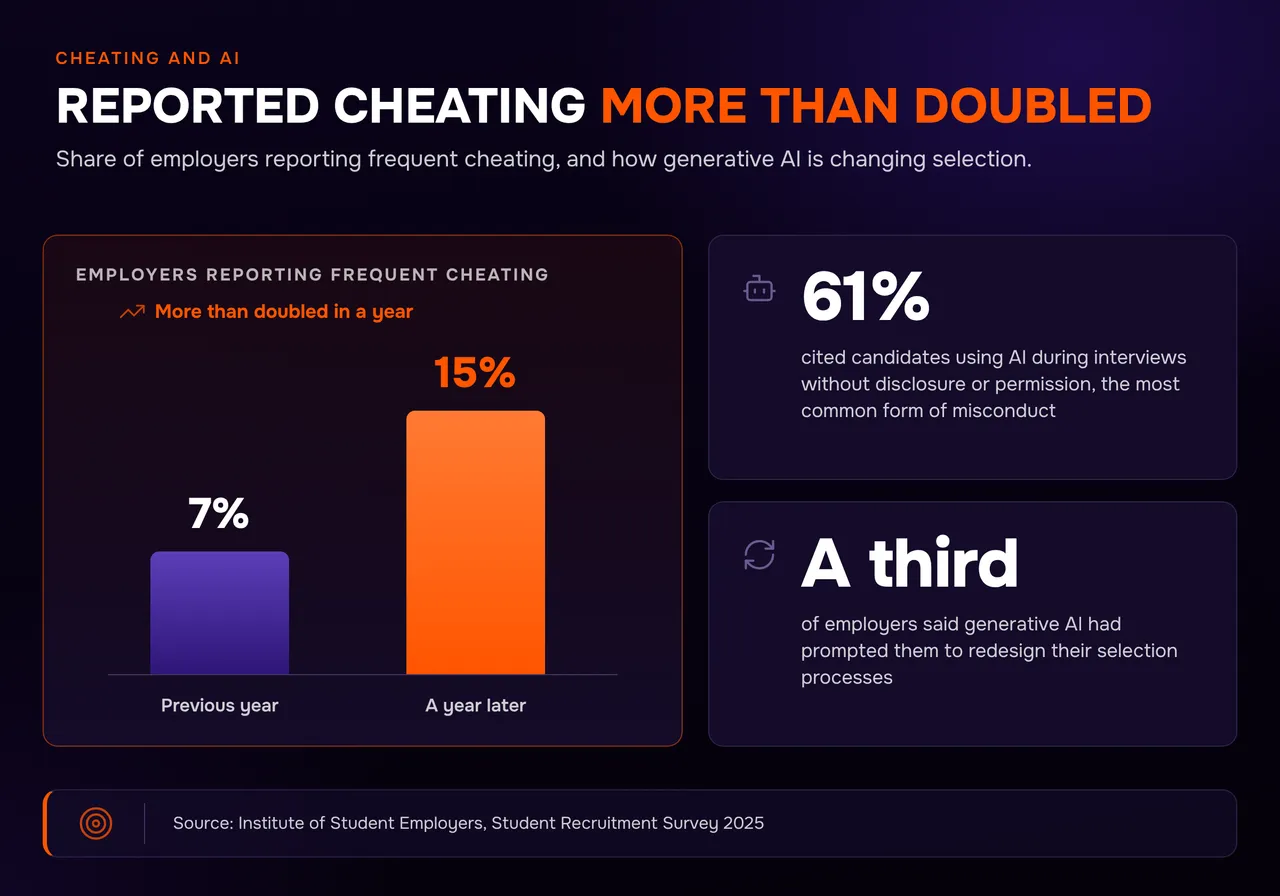
Cheating has become a mainstream concern in graduate hiring. In the ISE survey, the share of employers who reported frequent cheating more than doubled in a year, from 7% to 15%. The most common form of misconduct employers reported, cited by 61%, was candidates using AI during interviews without disclosure or permission. A third of employers said generative AI had prompted them to redesign their selection processes.
Static online tests are the easiest targets. A numerical reasoning item has one correct answer, an SJT has a scoring key, and a take-home case has no supervision. A candidate with a chatbot open in another window can answer each of those in seconds. Remote proctoring helps, but candidates find webcam monitoring intrusive, and it does little against a second device.
Multi-round interactive simulations are much harder to game. Each decision changes the situation the candidate faces next, new information arrives partway through, and teams have to discuss and negotiate live. A candidate can ask a tool to check a calculation, but the tool cannot sit in the team room, read how the other side is negotiating or own the consequences of a decision made two rounds earlier. Because the platform logs timing and decision patterns, unusual behaviour also stands out in the data. No assessment is immune to misuse, and any vendor who claims otherwise is overselling.
A simple test before you buy: try to complete the assessment yourself with an AI assistant open. If you can score well without understanding the material, so can your candidates.
Candidate assessment best practices
The method you pick matters, but how you run it decides whether you get value from it. These practices apply whichever candidate assessment tools you use.
Combine more than one method
Schmidt and Hunter's combinations are the clearest argument for using more than one method: each pairing with general mental ability predicted better than either method alone. The revised estimates leave no single method far ahead, so that logic holds.
Pair a measure of ability with a measure of how someone behaves on the job. For a graduate analyst role, that might mean a short reasoning test to screen, a team-based simulation in the middle stage and a structured interview at the end. Each step measures something the others miss.
Resist the urge to stack five tests at the screening stage. Every extra step adds drop-out, and the strongest candidates leave first because they have other options.
Treat the score as an input, not a verdict
Every assessment carries measurement error. Two candidates a few points apart on a reasoning test are, for practical purposes, the same. Group candidates into broad bands, such as strong, borderline and below standard, rather than ranking them to the decimal point.
Use the report to sharpen the interview. If a candidate scored well on analysis but struggled in the team round, ask about a time they disagreed with a group decision. You get a better conversation and a fairer decision. Keep a person accountable for the final call, which the ICO also expects wherever automated scores feed hiring decisions.
Keep the candidate experience short and relevant
Graduates apply to many firms at once, and they judge you on the process. A long test that has nothing to do with the job tells them you do not value their time. A realistic task tells them what the work involves and that you thought about how to assess it.
Tell candidates in advance how long each stage takes, what it measures and how to request adjustments. Give feedback where you can, even a short automated summary, because people remember the firms that told them how they did. For more on design choices that keep candidates engaged, read our guide to improving candidate experience with gamified assessments.
Choosing assessments for finance and graduate roles
Finance roles share a core of numerical reasoning and judgement, but they differ in what a new hire does day to day. The table below maps common roles to the candidate assessment types that fit them best.
Role | What matters early on | Assessment types that fit
|
|---|---|---|
Graduate analyst (banking, advisory) | Numerical reasoning, speed, teamwork | Reasoning screen; team simulation with valuation and negotiation; structured interview |
Audit associate | Accuracy, scepticism, ethics | SJT on professional conduct; work sample reviewing accounts for errors; structured interview |
Credit analyst | Risk judgement, reading financials, clear writing | Credit memo work sample; simulation with changing borrower data |
Corporate finance and FP&A | Modelling, prioritising, business partnering | Modelling skills test; capital budgeting simulation; case presentation |
Graduate risk analyst | Decisions under uncertainty, communication | Reasoning screen; portfolio simulation with market shocks; structured interview |
Experienced hire (associate and above) | Technical depth, judgement | Job knowledge test; case study; structured interview |
Graduate recruitment needs a different lens. With graduates you are assessing potential, so avoid any test that rewards knowledge only some candidates had the chance to acquire. A good finance simulation gives candidates the context they need inside the task, which lets a physics graduate compete on equal terms with someone who did two banking internships. You see how fast each of them learns, and that tells you more about year two than their current knowledge does.
Timing matters as much as format. Many firms now run assessment as part of their campus presence, inviting students to a live simulation that doubles as an employer branding event and a first-round screen. If that model interests you, our page on campus recruitment with live simulation events explains how it works.
Experienced hires need less screening and more depth. You can test technical knowledge head on, and a case study or structured interview with senior team members will tell you more than a reasoning test about someone with five years in leveraged finance.
Can a candidate fail an assessment and still get hired?
Yes, and sometimes you should hire them. Every score carries measurement error, and no single assessment covers everything a role needs. Most employers set a minimum standard and then weigh scores against interviews and other evidence. If a candidate falls just short of a cut-off but shows clear strengths elsewhere, let a hiring manager review the case. Record the reason, so you apply the same logic to every candidate.
What is an example of a candidate assessment test?
A finance job simulation is a good example. Candidates join a team, receive a company's financials and decide whether to approve an investment project. Halfway through, interest rates rise or a key customer leaves, and they revise their numbers, agree a position with teammates and defend it to a mock board. Assessors score the analysis, the decisions and the communication. Our guide to assessing finance candidates with real-world scenarios gives more examples.
Where FINSIMCO fits
We build business simulations for candidate assessment and teaching. Former investment bankers designed the platform, and more than 100,000 students and young professionals complete FINSIMCO simulations each year across 500+ university programmes. AACSB and AMBA endorse our work.
For recruitment teams, we run simulations that test how candidates analyse, decide and work in teams under realistic finance conditions. Our recruitment clients have removed up to 90% of their first-round interviews, and they hire about one person for every four candidates we submit.
If you are reviewing how you assess candidates for finance or graduate roles, get in touch. We can talk through where a simulation would fit in your process and what you would want it to measure.