Duration
About 2-3 hours
You set every stage timing from the professor panel, so it fits one block or splits across two sessions.

Sustainable Finance Simulation
The Finsimco Sustainable Finance Simulation gives each student a fund that has promised to be sustainable and 30 companies to choose from. They decide what goes in, what to do about the companies that disappoint, then defend what the fund claims.
Duration
You set every stage timing from the professor panel, so it fits one block or splits across two sessions.
Format
Each student works alone and asynchronously, taking the screening, engagement and reporting roles.
Level
Adjustable to the level you teach. The same activity suits a first-year class or an MBA group.
Professor tools
Manage students, adjust stage timings, control progression and monitor individual inputs.
Prerequisites
No background needed. ESG ratings, green bonds, engagement and greenwashing are all explained inside.
Delivery
The web-based simulation supports in-person, remote, blended and homework-supported delivery.
Assessment
Every submission is individual, so each student's decisions and reasons export for grading, or run it ungraded.
Course fit
Designed for Sustainable Finance, ESG Investing, Responsible Investment and Corporate Governance courses.
The topics a sustainable finance module has to cover: ESG ratings and why two providers disagree about the same company, exclusion against integration against engagement, stewardship and voting, green bonds and what the money is tied to, ESG disclosure and reporting standards, and greenwashing.
Written to drop into your module descriptor without rewriting. On completing the simulation, your students will be able to:
Each student runs the fund alone, holding the screening, engagement and reporting roles in turn. All three want something different from the same 30 companies, and only one fund gets submitted.
Students decide which companies the fund will hold and which it will not, using ESG ratings that do not agree with each other and having to pick one to trust.
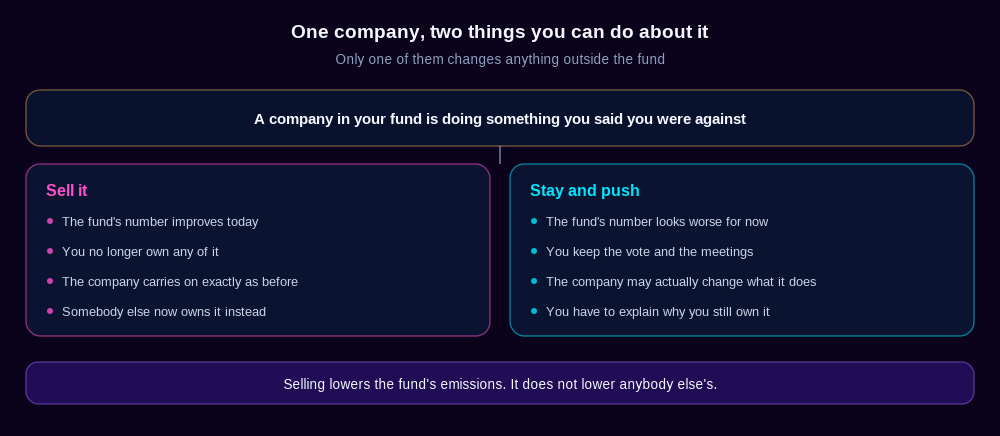
Students decide whether to sell a company that is behaving badly or keep it and push for change, knowing selling makes the fund look better immediately.
Students decide what the fund is allowed to say it has achieved, which has to be something the evidence behind them actually supports.
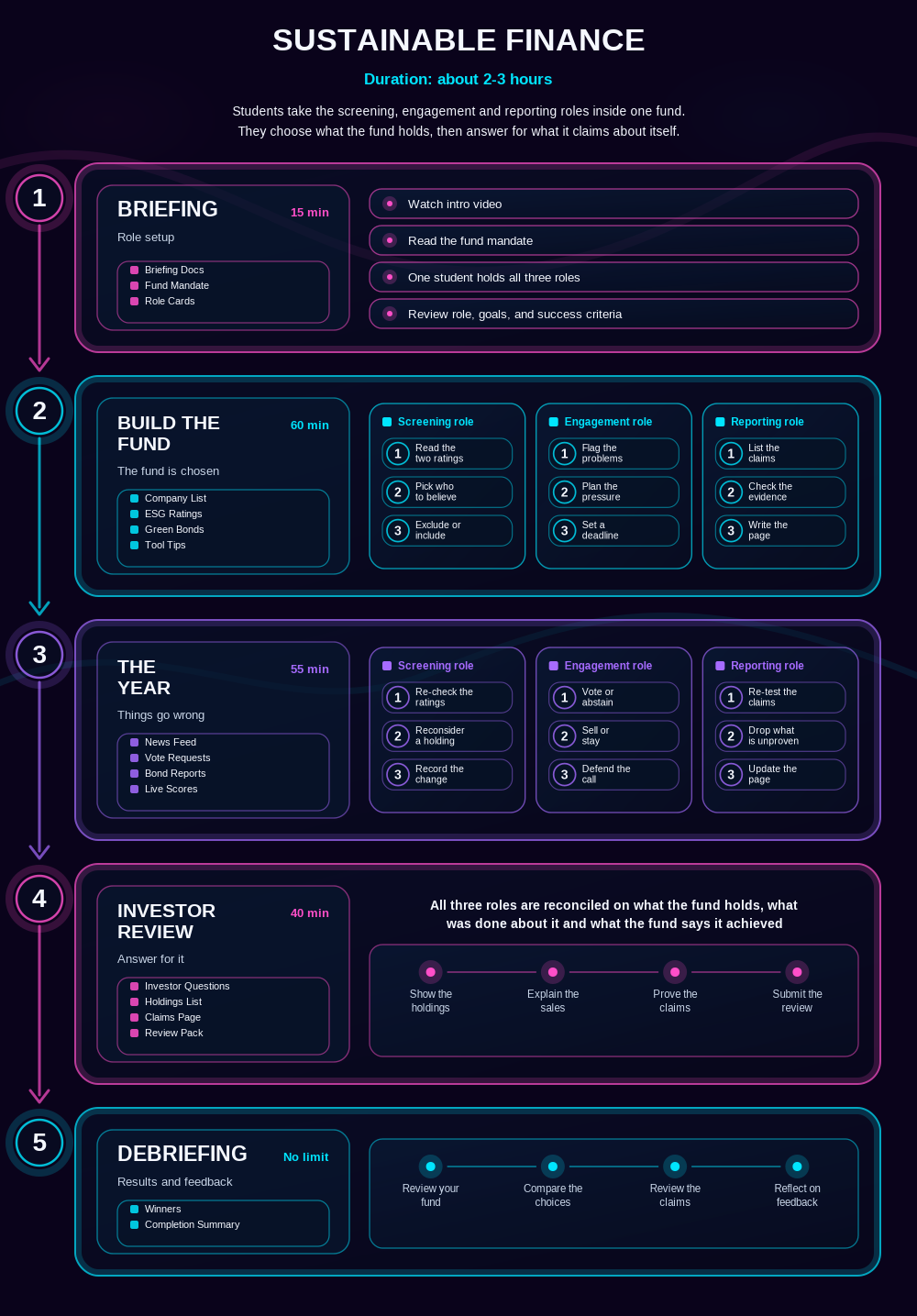
Five stages. Students build a fund that calls itself sustainable, live through a year that tests it, then defend what it claims.
Stage 1 · 15 min
briefing docs · fund mandate · role cards
Students watch the intro video, read a fund mandate that promises to be sustainable without saying exactly how, and take on all three roles, checking what each one is judged on before any company is chosen.
Stage 2 · 60 min
company list · ESG ratings · green bonds · tool tips
The fund gets built. Working as screening, the student decides which of 30 companies are in; as engagement, flags the ones that need pushing and says what will be asked of them; as reporting, writes the page the fund will publish. The fund is submitted with a reason for every company left out.
Stage 3 · 55 min
news feed · vote requests · bond reports · live scores
A year runs. One holding turns out to be doing something the ratings missed, a green bond's money has gone somewhere the investors did not expect, and a vote comes up that the fund has to cast. Students decide what to sell, what to stay in and fight, and what they can still say.
Stage 4 · 40 min
investor questions · holdings list · claims page · review pack
Students are asked which company they sold and what that changed in the real world, which rating they chose to believe and why, what the green bond actually paid for, and which of their claims they can still stand behind.
Stage 5 · No limit
winners · completion summary
Students review their own fund, compare screening and engagement choices across the cohort, revisit the decisions that produced them and reflect on the feedback. Winners and the completion summary give you a structure for the discussion.
The student interface carries the companies, the ratings and the reasoning. The professor panel carries the timeline, the controls and every individual fund.
Students work company by company, with both ESG ratings, the carbon intensity and the sector sitting next to the box they tick, and a written reason required for every company included and every company left out.
A year later the ratings look different. The company that scored well has done something neither provider caught, and the student has to decide whether selling it would change anything at all.
Your view. Adjust any stage timing, start or stop the session, and compare who sold, who stayed and engaged, and what each student ended up claiming.
Explore the student and professor experience, and discuss timing, setup and syllabus fit.
It works best once students know what a fund is and need to see what sustainable actually commits it to.
What a fund is and how it holds shares. No ESG background is needed: ratings, green bonds, engagement and greenwashing are all explained inside the activity.
Early to mid module, typically weeks three to seven, as the session that turns a definition into a decision.
Impact investing, climate risk and transition finance, reporting standards and taxonomies, and any assessment asking students to judge a sustainability claim.
The sustainable finance course guide sets out where it sits in a full module.
The three mistakes students make on this topic almost every time. Recognising them is usually the moment the subject lands, and it is the core of the learning science behind it.
1
Selling a high-emitting company makes the fund's numbers look better the same afternoon, and changes nothing about the company, which carries on exactly as before with a different owner. Students reach for it because it is the only lever that works instantly. Watching the fund's score improve while the world does not is the fastest route into what stewardship is actually for.
2
Two providers score the same company differently, sometimes very differently, because they are measuring different things. Students pick whichever rating supports the holding they already wanted and move on. The simulation shows them both ratings side by side and asks which one they believe, which is the question the whole industry is still arguing about.
3
A fund that avoided an industry has not reduced anything; it has just not bought it. Students write claims that sound true and cannot be stood up when an investor asks what changed. Separating what the fund did from what the fund says is the single most useful habit the session builds, and it is exactly what a greenwashing rule tests.
The debrief runs itself. Every student sees their results, the cohort comparison and the decisions that produced them, with nothing for you to prepare. If you would rather lead the discussion, these five questions work straight from a slide, and they use what your cohort actually did.
Assessment is optional. Run the simulation ungraded as an applied activity, or use platform data as supporting evidence. Every student generates a holdings list, a set of exclusions, engagement and voting decisions, a claims page and written reasons. Because the simulation is single-player, every input belongs to one named student, so there is no group-work marking to untangle. All of it exports as CSV or PDF, per student, so you can assess reasoning rather than a result.
On generative AI: written rationales are exactly what marking teams now worry about. Because every rationale here is tied to a holding the student chose inside the platform, with the two ratings and the year's news sitting next to it, the reasoning can be checked against the evidence rather than taken on trust.
93% of students rate Finsimco simulations Excellent, across more than 30,000 responses.
Teaching notes, a setup and facilitation guide and a gameflow diagram come with it, and we support your first delivery directly.
Run it ungraded the first time. Assessment is optional and can be added once you have seen how your cohort responds.
Pause or stop at any point and resume later without losing submitted data, so an overrun costs you a timetable slot, not the activity.
Read what lecturers say.
Ron Tuninga, Managing Director for EMEA at AACSB, and Victor Hedenberg, Membership Director at AMBA, on why simulation-based learning belongs in business education. Watch both interviews.
If this one is not quite right for your module, these are the closest alternatives.

What gets measured, and what gets managed.
Learn More
Building and rebalancing a global portfolio.
Learn More
Who decides, and who answers for it.
Learn More
Appraising an investment whose risks arrive decades after the decision.
Learn More
What the pricing advantage actually buys.
Learn More
Putting money into a company for what it builds as well as what it returns.
Learn MoreA one-page summary of this simulation, covering stages and timings, roles, concepts, learning outcomes and the debrief questions, plus a full sample teaching pack from one of our live simulations, so you can see exactly what you would be running.
During the call, we can: