Duration
About 2-3 hours
You set every stage timing from the professor panel, so it fits one block or splits across two sessions.

Liquidity Risk Management Simulation
The Finsimco Liquidity Risk Management Simulation gives each student a profitable bank and a fortnight in which its depositors start leaving. They decide what to hold in cash, where the funding comes from, then find out which day they run out.
Duration
You set every stage timing from the professor panel, so it fits one block or splits across two sessions.
Format
Each student works alone and asynchronously, taking the cash, funding and plan roles in turn.
Level
Adjustable to the level you teach. The same activity suits a first-year class or an MBA group.
Professor tools
Manage students, adjust stage timings, control progression and monitor individual inputs.
Prerequisites
No banking background needed. Liquid assets, funding, the coverage ratio and stress tests are taught inside.
Delivery
The web-based simulation supports in-person, remote, blended and homework-supported delivery.
Assessment
Every submission is individual, so each student's decisions and reasons export for grading, or run it ungraded.
Course fit
Designed for Liquidity Risk, Bank Management, Financial Institutions and Risk Management courses.
The topics a liquidity risk module has to cover: liquid assets and what actually counts as one, the difference between being solvent and having cash, retail against wholesale funding and how quickly each one leaves, the liquidity coverage ratio and the thirty-day stress it assumes, liquidity stress testing and the survival horizon, and the contingency funding plan.
Written to drop into your module descriptor without rewriting. On completing the simulation, your students will be able to:
Each student runs the bank alone, holding the cash, funding and plan roles in turn. All three want something different from the same balance sheet, and only one buffer gets submitted.
Students decide how much of the bank sits in things that can be sold today, knowing that the safest assets are also the ones that earn the least while nothing is happening.
Students decide where the bank's money comes from, and how much of it belongs to people who can ask for it back the same afternoon.
Students decide what the bank does once money starts leaving, and in what order, because the cheapest option on day one has usually gone by day five.
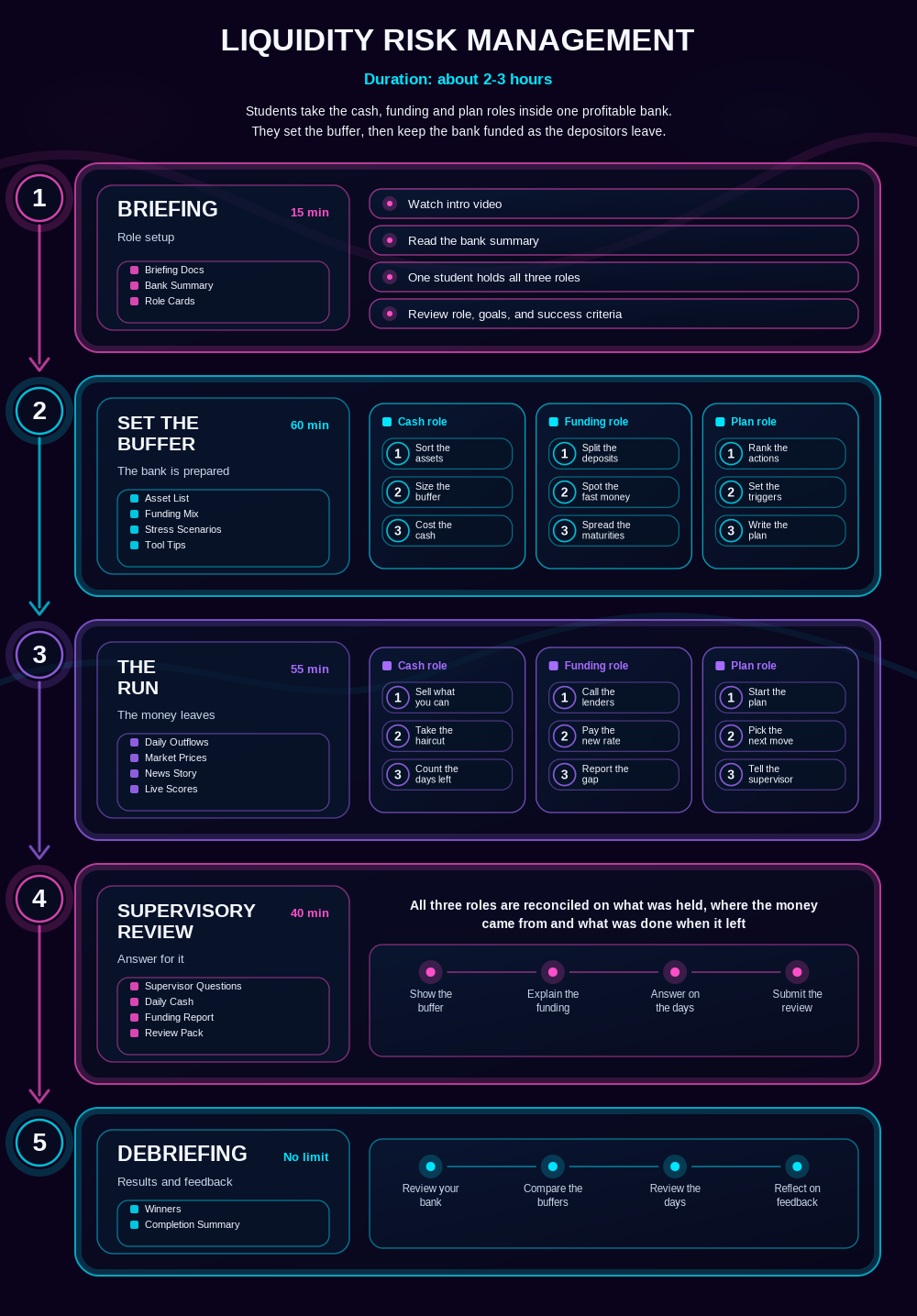
Five stages. Students set a liquidity buffer, then keep the bank funded as the depositors leave day by day.
Stage 1 · 15 min
briefing docs · bank summary · role cards
Students watch the intro video, read a summary of a profitable bank with a comfortable balance sheet, and take on all three roles, checking what each one is judged on before anything is set.
Stage 2 · 60 min
asset list · funding mix · stress scenarios · tool tips
The bank gets ready. Working as cash, the student decides how much to hold in assets that can be sold today; as funding, works out how much of the money could leave within a week; as the plan, writes down what will be done first if it starts. The buffer is submitted with a reason for its size.
Stage 3 · 55 min
daily outflows · market prices · news story · live scores
Money starts leaving. A news story makes it faster, the assets that looked sellable fetch less than the book says once everybody wants to sell them, and the lenders who were happy to fund the bank last month now want a higher rate or a shorter term.
Stage 4 · 40 min
supervisor questions · daily cash · funding report · review pack
Students are asked how many days the bank could have lasted, which assets turned out not to be liquid, which funding left first and whether they expected it to, and what they would hold differently knowing the fortnight they have just had.
Stage 5 · No limit
winners · completion summary
Students review their own bank, compare buffers and funding choices across the cohort, revisit the decisions that produced them and reflect on the feedback. Winners and the completion summary give you a structure for the discussion.
The student interface carries the assets, the funding and the reasoning. The professor panel carries the timeline, the controls and every individual buffer.
Students work asset by asset, with how fast it could be sold, what it would actually fetch in a bad week and what it earns while nothing is happening sitting next to the box they set, and a written reason required for the size of the buffer.
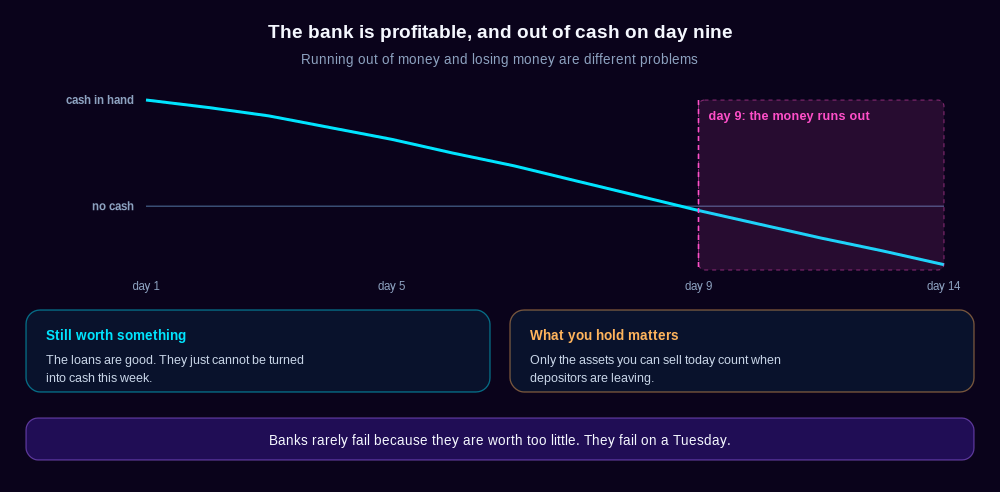
Day by day the cash falls. The column that surprises students is what the assets actually sold for, because in the week everybody wants to sell, the book value stops being the price.
Your view. Adjust any stage timing, start or stop the session, and compare how big each student's buffer was with how many days it actually bought them.
Explore the student and professor experience, and discuss timing, setup and syllabus fit.
It works best early, as the session that separates running out of money from losing money.
What a deposit and a loan are. No banking background is needed: liquid assets, the coverage ratio, stress testing and contingency plans are all explained inside the activity.
Early module, typically weeks two to six, before the ratios are introduced, because the ratios make far more sense once a cohort has run out of cash themselves.
The liquidity coverage ratio and net stable funding ratio in detail, intraday liquidity, resolution planning, central bank facilities, and any assessment asking students to defend a buffer.
The liquidity risk course guide sets out where it sits in a full module.
The three mistakes students make on this topic almost every time. Recognising them is usually the moment the subject lands, and it is the core of the learning science behind it.
1
Every pound in a safe, sellable asset is a pound earning almost nothing, and for most of the time that looks like waste. Students fund the buffer as thinly as the rules allow and spend the rest on things that pay. The cost of the buffer is visible every single day and the benefit appears on about one day in a thousand, which is exactly why this is hard and exactly why it is worth making a cohort live through that day.
2
The price in the book assumes a normal market and a patient seller. In a run the bank is neither, and everyone else is selling the same things on the same morning. Students discover the difference between a valuation and a bid, which is the most practical idea in the subject and one a formula will never deliver.
3
Nothing about the bank's worth changes during the fortnight. The loans are good, the capital is intact, the profit is real. What changes is the date on which money has to be handed over. Students who keep checking whether the bank is still solvent are asking a question that was never the problem, and separating the two is the point of the whole session.
The debrief runs itself. Every student sees their results, the cohort comparison and the decisions that produced them, with nothing for you to prepare. If you would rather lead the discussion, these five questions work straight from a slide, and they use what your cohort actually did.
Assessment is optional. Run the simulation ungraded as an applied activity, or use platform data as supporting evidence. Every student generates a buffer, a funding split, a contingency plan, a day-by-day cash position and written reasons. Because the simulation is single-player, every input belongs to one named student, so there is no group-work marking to untangle. All of it exports as CSV or PDF, per student, so you can assess reasoning rather than a result.
On generative AI: written rationales are exactly what marking teams now worry about. Because every rationale here is tied to a buffer or a funding choice the student made inside the platform, with the day-by-day cash position sitting next to it, the reasoning can be checked against the evidence rather than taken on trust.
93% of students rate Finsimco simulations Excellent, across more than 30,000 responses.
Teaching notes, a setup and facilitation guide and a gameflow diagram come with it, and we support your first delivery directly.
Run it ungraded the first time. Assessment is optional and can be added once you have seen how your cohort responds.
Pause or stop at any point and resume later without losing submitted data, so an overrun costs you a timetable slot, not the activity.
Read what lecturers say.
Ron Tuninga, Managing Director for EMEA at AACSB, and Victor Hedenberg, Membership Director at AMBA, on why simulation-based learning belongs in business education. Watch both interviews.
If this one is not quite right for your module, these are the closest alternatives.

Cash conversion under a funding constraint.
Learn More
Raising debt and living with the terms.
Learn More
Reading what the accounts do and do not say.
Learn More
Borrowing short and lending long, for a year.
Learn More
What follows when the funding runs out and the debt has to be reworked.
Learn More
Deciding who to lend to, and at what price.
Learn MoreA one-page summary of this simulation, covering stages and timings, roles, concepts, learning outcomes and the debrief questions, plus a full sample teaching pack from one of our live simulations, so you can see exactly what you would be running.
During the call, we can: