It is ideal for MBA students, finance undergraduates, aspiring venture capitalists, entrepreneurs seeking to understand the investor mindset, and professionals in corporate venture or startup ecosystems.

Venture Capital Analyst Simulation
The Venture Capital Analyst Simulation plunges participants into the competitive and high-risk world of venture capital. Move beyond theory and learn what it truly takes to identify, evaluate, and invest in the next unicorn.

Venture Capital Analyst Simulation Overview
In this intensive simulation, participants step into the role of an Analyst at a prestigious venture capital firm. Your team is tasked with deploying a $50 million fund over multiple simulated investment rounds. You will be presented with a diverse pipeline of real-world startup profiles, each with its own unique business model, financial projections, market traction, and founding team.
The challenge is to sift through the noise, identify the most promising opportunities, and build a balanced portfolio that maximizes returns while managing inherent risks. You will grapple with realistic cap tables, perform valuation analyses using industry-standard methods, and negotiate terms with entrepreneurs. The simulation captures the dynamic nature of the VC industry, where new information emerges, market conditions shift, and your portfolio companies face unexpected challenges and opportunities.
Although ideal for undergraduate and graduate finance courses, executive training, and corporate finance skill workshops, the simulation is modular and scalable, allowing instructors to vary complexity.

Venture Capital Analyst Simulation Concepts
Participants work through realistic scenarios, which can be customized to emphasize or exclude specific topics depending on the learning goals. This modular structure allows the simulation to be tailored to any type of session. Key concepts include:
- Venture Capital Financing Lifecycle
- Startup Valuation Methodologies (Scorecard, Risk Factor Summation, Berkus Method, VC Method)
- Financial Modeling and Projection Analysis
- Term Sheet Structuring and Key Clauses (Liquidation Preference, Participation Rights, Anti-dilution)
- Capitalization Table (Cap Table) Management
- Due Diligence Process
- Portfolio Strategy and Diversification
- Deal Sourcing and Pipeline Management
- Exit Strategies (IPO, M&A, Secondary Sale)

Gameflow
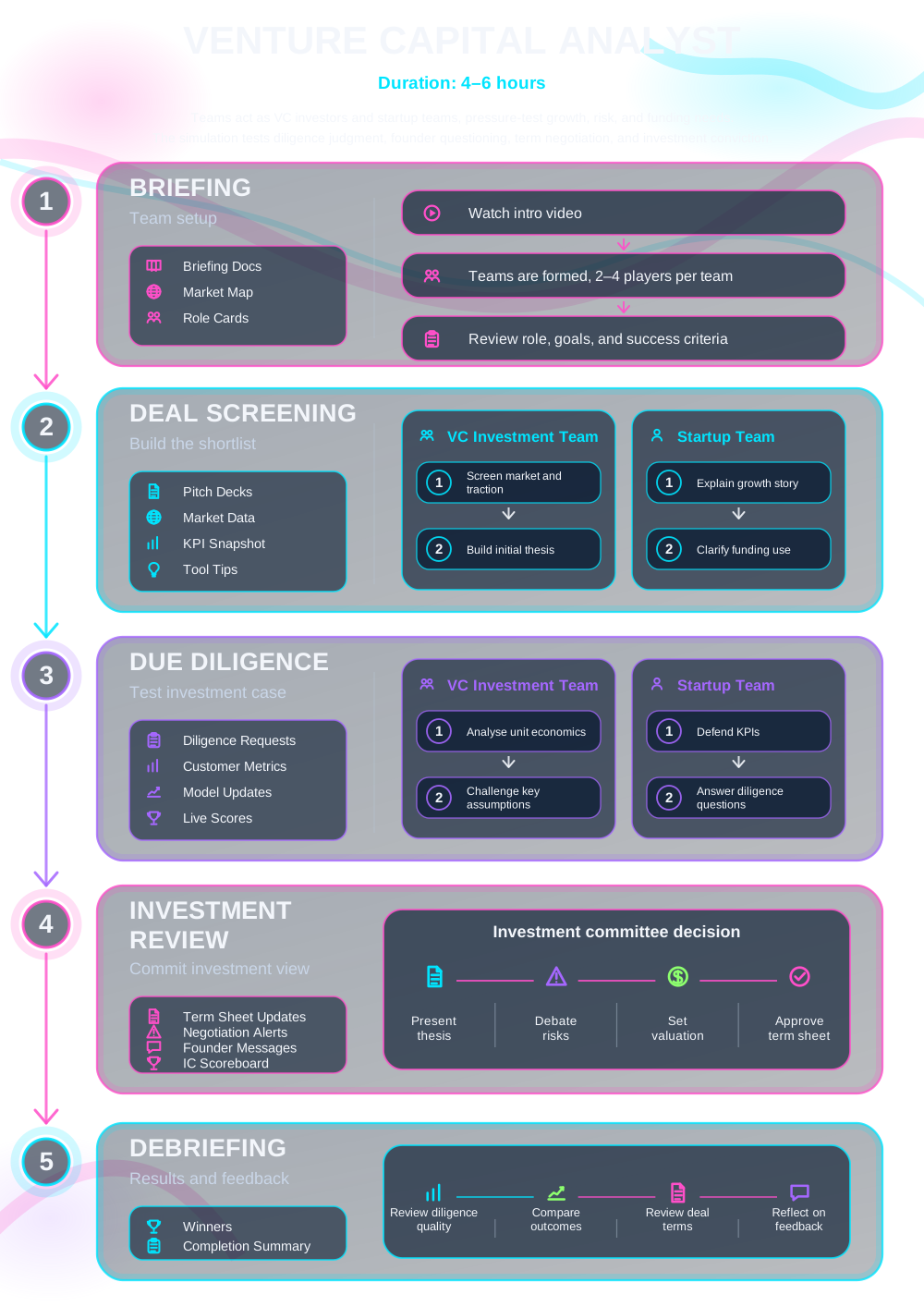

What Participants Do
In the simulation, participants will:
- Evaluate a constant stream of startup applications to identify those fitting your fund's thesis.
- Dive deep into a startup's financials, market size, competitive landscape, technology, and team.
- Apply multiple valuation methods to determine a fair pre-money valuation for potential investments.
- Build financial models to project startup performance under various growth and market conditions.
- Draft and negotiate key economic and control terms with startup founders.
- Make investment decisions to construct a diversified portfolio and manage your fund's capital.
- Model the impact of your investment and subsequent funding rounds on ownership stakes.
- Decide when and how to exit investments to realize returns for your fund's Limited Partners.

Learning Objectives
By the end of the simulation, participants will be able to:
- Analyze a startup's potential from an investor's perspective, assessing its team, technology, market, and financials.
- Apply common pre-money valuation techniques to early-stage companies with limited financial history.
- Interpret and structure a venture capital term sheet, understanding the implications of key clauses.
- Construct a basic financial model to project a startup's funding needs and potential valuation at exit.
- Develop a coherent investment thesis and build a diversified venture portfolio aligned with that strategy.
- Communicate investment recommendations persuasively, justifying the risk-reward profile to partners.
How the Venture Capital Analyst Simulation Works
This simulation can be run individually or in teams in academic or corporate contexts. Each cycle represents a stage of getting through a pressing financial situation.
1. Team Formation Participants are grouped into VC firms, each with a fixed amount of capital.
2. Deal Sourcing The platform provides a dynamic deal flow with detailed startup profiles.
3. Screening and Analysis Teams screen startups, shortlist the most promising, and conduct in-depth due diligence using provided data rooms.
4. Investment Proposal Teams create a formal investment memo, including valuation, term sheet, and investment rationale.
5. Negotiation and Execution Teams negotiate terms (mock founder, controlled by facilitator) and formally "invest".
6. Portfolio Management As the simulation progresses through rounds, teams monitor their portfolio, decide on follow-on investments, and react to new company performance data.
Frequently Asked Questions
Assessment
Assessment of participant performance can be tailored according to the host institution’s objectives (business school, corporate training, assessment centre). Typical assessment criteria include:
- The final Internal Rate of Return (IRR) and Multiple on Invested Capital (MOIC) of your fund.
- Quality of analysis, valuation justification
- Clarity of recommendation for a selected investment.
- Ability to secure favorable and fair terms during negotiations.
- Contribution to your team's overall effort and strategy.