It's ideal for students and professionals pursuing careers in corporate finance, treasury, accounting, financial analysis, or consulting, and for anyone who wants to understand how companies manage their financial lifeblood.

Treasury Management Simulation
Students master corporate liquidity by actively managing short-term financial stability and strategic investments with our treasury management simulation game.

Treasury Management Simulation Overview
The Treasury Management simulation is a highly realistic financial simulation crafted by experienced treasury and corporate finance professionals. It accurately replicates the core responsibilities of a corporate treasury department.
Participants navigate the daily balancing act of ensuring operational liquidity while maximizing returns on surplus cash. They engage in cash flow forecasting, working capital management, investment of excess funds, and strategic risk hedging, all within a dynamic market environment that reacts to their decisions and global economic events.
This multiplayer simulation emphasizes critical thinking through real-time analysis, strategic planning, and stakeholder communication. Participants are assessed based on their ability to maintain a safe liquidity position, optimize the company's financial returns, and mitigate key financial risks.

Treasury Management Simulation Concepts
Participants work through realistic scenarios, which can be customized to emphasize or exclude specific topics depending on the learning goals. This modular structure allows the simulation to be tailored to any type of session. Key concepts include:
- Cash flow forecasting and liquidity management
- Working capital optimization
- Short-term investment strategies and instruments (money market funds, commercial paper)
- Foreign exchange risk identification and hedging techniques
- Interest rate risk management
- Bank relationship management and credit facilities
- Cash pooling and netting structures
- Treasury technology and systems
- Corporate governance and internal controls in treasury
- Strategic communication with CFO and other stakeholders

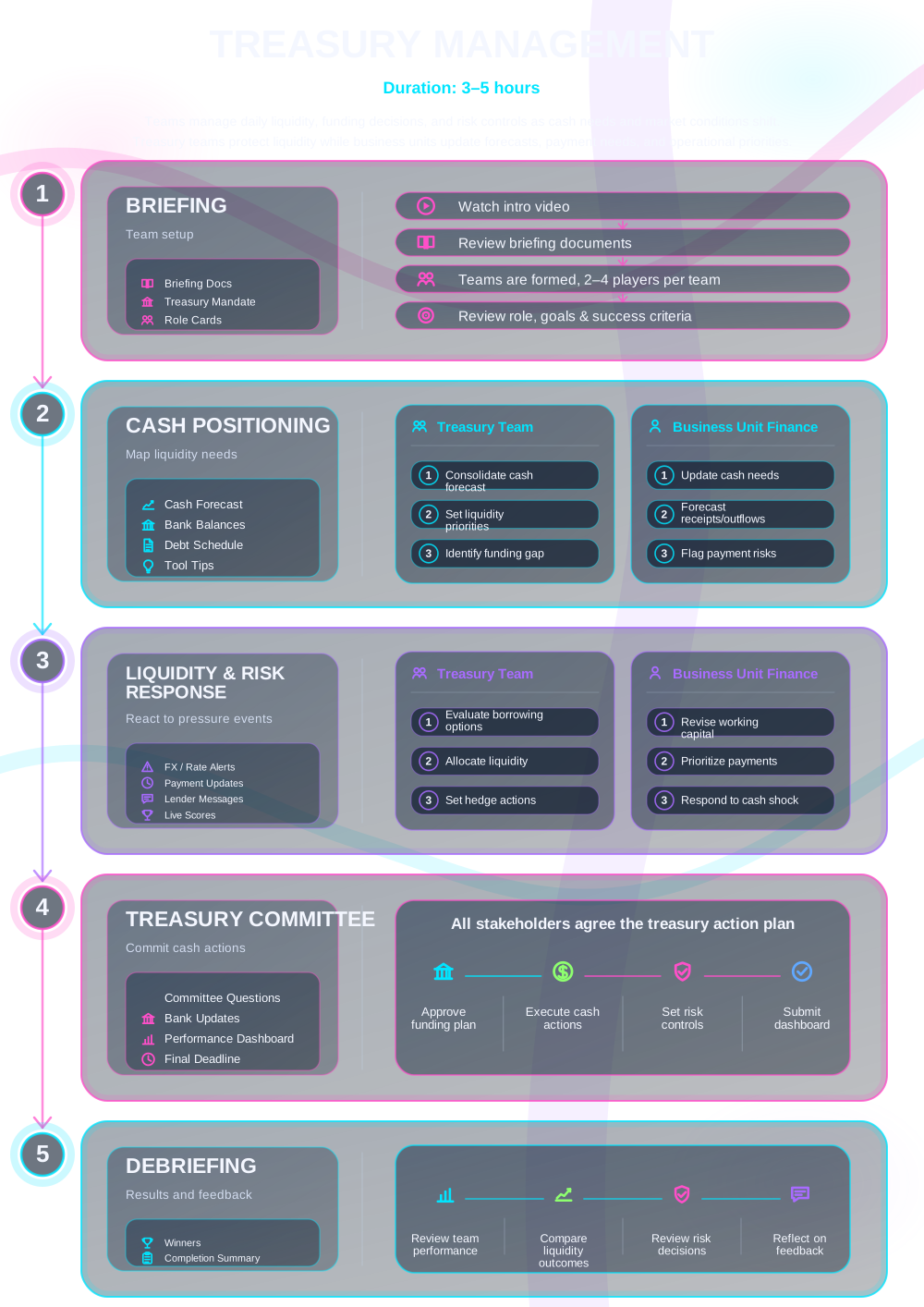
Gameflow

What Participants Do
In the simulation, participants will:
- Analyze incoming and outgoing cash flows to build accurate short and medium-term forecasts.
- Make daily decisions on investing surplus cash or drawing on credit lines to cover deficits.
- Select appropriate short-term investment instruments based on return, risk, and liquidity needs.
- Identify exposure to currency and interest rate fluctuations and execute hedges using forwards or options.
- Negotiate terms with banking partners for credit facilities and services.
- Present treasury strategy and performance updates to a simulated board or CFO.
- Respond to economic shocks, such as sudden market volatility or a supply chain disruption impacting payments.
- Reflect on the trade-off between liquidity safety and financial return.

Learning Objectives
By the end of the simulation, participants will be able to:
- Understand the core functions and strategic importance of a corporate treasury department.
- Apply techniques for effective cash flow forecasting and liquidity management.
- Evaluate and select appropriate short-term investment and funding instruments.
- Identify key financial risks and propose basic hedging strategies.
- Appreciate the impact of treasury decisions on corporate financial health and stakeholder confidence.
- Communicate treasury performance and strategy clearly to senior management.
- Develop judgment under conditions of market uncertainty and operational pressure.
- Build confidence in managing corporate financial resources.
How the Treasury Management Simulation Works
This simulation can be run individually or in teams in academic or corporate contexts. Each cycle represents a stage of getting through a pressing financial situation.
1. Receive a Company Brief Participants are introduced to a company's financials, operational cycle, and strategic objectives.
** 2. Analyze the Financial Position** They review cash positions, forecasted flows, market data, and risk exposures.
3. Make Treasury Decisions Participants decide on investments, funding, hedging, and working capital initiatives.
4. Collaborate and Negotiate Teams may assign specific roles (cash manager, risk analyst) and negotiate with simulated banks.
5. Communicate Strategy Participants prepare briefs or presentations to explain their decisions to the "CFO".
6. Review and Adapt The simulator provides feedback on liquidity coverage, investment returns, risk exposure, and bank ratings. New market events force strategy evolution in subsequent rounds.
Frequently Asked Questions
Assessment
Assessment of participant performance can be tailored according to the host institution’s objectives (business school, corporate training, assessment centre). Typical assessment criteria include:
- Financial performance (liquidity safety, investment returns, cost savings).
- Effectiveness of risk management and hedging decisions.
- Quality and clarity of strategic communication to stakeholders (CFO, board).
- Analytical rigor in cash forecasting and decision rationale.
- Collaboration and adaptability within the treasury team.