This simulation is ideal for students and professionals pursuing careers in investment banking, equity research, corporate finance, and private equity who need to master practical valuation skills.

Trading Comparables Simulation
In this Trading Comparables Simulation, participants master the art of valuation by identifying, analyzing, and applying peer multiples to determine a company's true market value in competitive, time-pressured scenarios.

Trading Comparables Simulation Overview
Participants immerse themselves in the core of investment analysis by conducting a "Trading Comparables" (Comps) valuation, a fundamental methodology used daily on Wall Street and in financial centers worldwide.
The simulation replicates the intense, detail-oriented process of building a comps model from scratch. Each round introduces new layers of complexity, shifting market data, new company profiles, urgent client requests, and competitive pressure from rival teams. Participants must sift through financial statements, select the most relevant peer companies, normalize financial metrics, calculate key trading multiples (like P/E, EV/EBITDA), and justify their valuation conclusions.
This simulation is designed for university finance programs, MBA courses, and corporate training workshops. It transforms abstract valuation theory into a tangible, skill-building experience, demonstrating how market sentiment, financial nuance, and strategic narrative converge to influence a company's perceived worth.

Trading Comparables Simulation Concepts
Participants work through realistic scenarios, which can be customized to emphasize or exclude specific topics depending on the learning goals. This modular structure allows the simulation to be tailored to any type of session. Key concepts include:
- Principles of relative valuation and its applications
- Selection of truly comparable companies (peer group selection)
- Analysis and normalization of key financial metrics (Revenue, EBITDA, Net Income)
- Calculation and interpretation of trading multiples (P/E, EV/Revenue, EV/EBITDA)
- Identifying and adjusting for outliers and non-recurring items
- Benchmarking against industry and sector averages
- Synthesizing analysis into a defensible valuation range
- Communicating valuation assumptions and conclusions effectively
- The impact of market conditions on comparable multiples
- Integrating comps analysis into broader investment banking and research reports

Gameflow
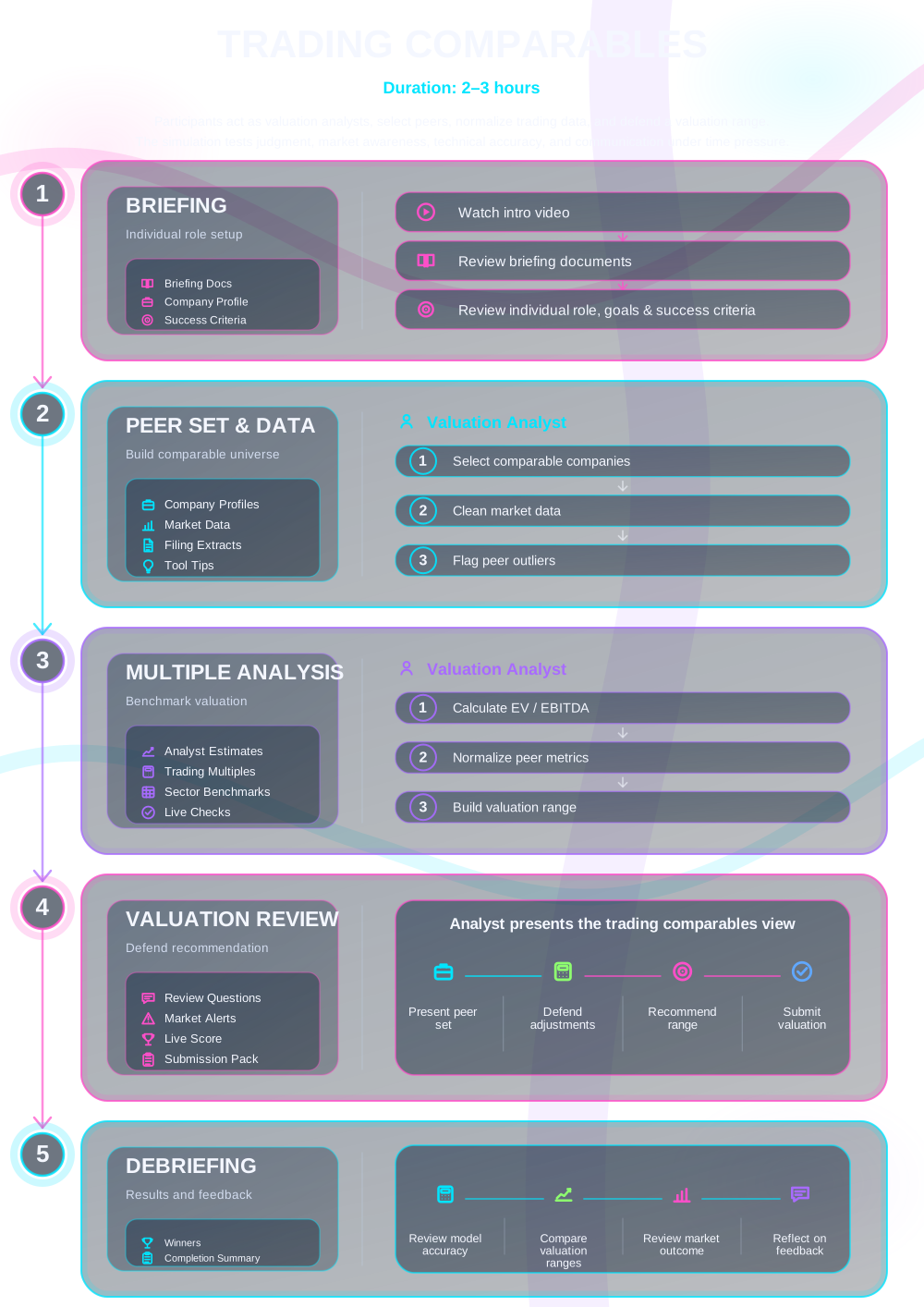

What Participants Do
In the simulation, participants will:
- Screen and select an appropriate peer group for a target company
- Extract and normalize financial data from real-world styled statements
- Calculate a full suite of trading and transaction multiples
- Analyze the drivers behind multiple spreads across the peer set
- Defend their peer selection and valuation assumptions in a team setting
- Adjust their model and conclusions in response to new market data
- Craft a concise summary of their valuation findings
- Negotiate and debate valuation points with other teams acting as clients or reviewers

Learning Objectives
By the end of the simulation, participants will be able to:
- Understand the role and construction of trading comparables in real-world finance.
- Build a robust peer group based on industry, size, growth, and profitability.
- Extract, adjust, and analyze key income statement and balance sheet items.
- Calculate and interpret major equity and enterprise value multiples.
- Develop a credible valuation range and articulate the key value drivers.
- Critically assess the strengths and limitations of the comparables approach.
- Present valuation findings in a clear, professional, and persuasive manner.
- Work effectively under time constraints mirroring professional deadlines.
- Collaborate within a team to reconcile different analytical perspectives.
How the Trading Comparables Simulation Works
This simulation can be run individually or in teams in academic or corporate contexts. Each cycle represents a stage of getting through a pressing financial situation.
1. Receive the Mandate Teams are introduced to the target company and the valuation context.
** 2. Conduct Peer Analysis** Teams research and select a peer group from a universe of potential companies, justifying their choices.
3. Build the Model Participants gather financial data, perform necessary adjustments, and calculate trading multiples in a structured spreadsheet environment.
4. Analyze and Synthesize Teams analyze the output, identify outliers, determine a valuation range, and prepare their narrative.
5. Present and Defend Teams present their valuation summary and key assumptions, often to other teams or a facilitator acting as a senior banker or client.
6. Review and Adapt Based on feedback and new information, teams may refine their model and conclusions in subsequent rounds.
Frequently Asked Questions
Assessment
Assessment of participant performance can be tailored according to the host institution’s objectives (business school, corporate training, assessment centre). Typical assessment criteria include:
- Accuracy and justification of peer group selection
- Correctness of financial data extraction and normalization
- Accuracy of multiple calculations and derivation of the valuation range
- Quality of analytical insights identifying value drivers and outliers
- Clarity, structure, and persuasiveness of the final valuation summary
- Team collaboration and effective division of analytical tasks