No, this simulation is designed for all finance professionals (investment bankers, private equity associates, portfolio managers, and corporate financiers) who need to understand how tax affects their deals and investments. It focuses on strategy, not compliance.

Tax Simulation
Master the Taxation in this hands-on simulation, getting into the practical cases of taxes’ influence on the company’s efficiency and overall health.

Tax Simulation Overview
In the complex world of finance, tax is not just a compliance issue—it is a core strategic lever. Whether executing an M&A deal, structuring a leveraged buyout, or managing an investment portfolio, the tax implications can be the difference between a successful transaction and a failed one. This simulation moves participants beyond textbook theory and into the practical, high-stakes arena where tax strategy directly impacts the bottom line.
Participants are immersed in a dynamic, competitive environment where they must analyze, strategize, and execute financial decisions with tax efficiency as a primary objective. They will grapple with real-world scenarios involving corporate restructuring, investment analysis, and deal financing, learning to optimize after-tax returns and create value for stakeholders.
Although ideal for undergraduate and graduate finance courses, executive training, and corporate finance skill workshops, the simulation is modular and scalable, allowing instructors to vary complexity.

Tax Simulation Concepts
Participants work through realistic scenarios, which can be customized to emphasize or exclude specific topics depending on the learning goals. This modular structure allows the simulation to be tailored to any type of session. Key concepts include:
- Tax Shield Valuation
- Capital Gains vs. Ordinary Income
- Net Operating Losses
- Deal Structuring
- Debt vs. Equity Financing
- Entity Selection
- International Tax Considerations
- Effective Tax Rate Management

Gameflow
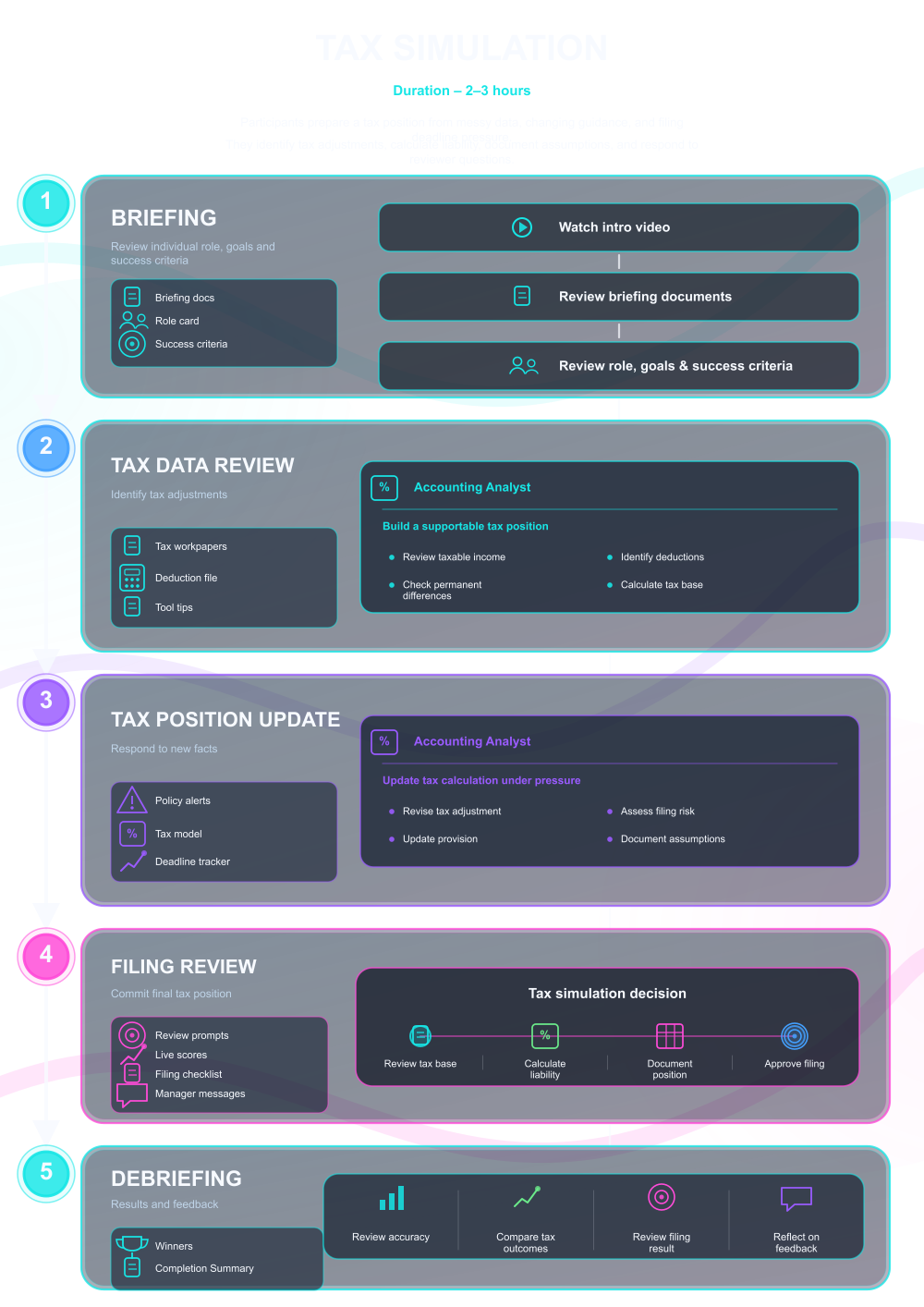

What Participants Do
In the simulation, participants will:
- Conduct tax due diligence on potential acquisition targets, identifying tax attributes and liabilities.
- Build financial models to compare the after-tax outcomes of various M&A and financing structures.
- Participate in negotiations where tax implications are a critical component of the purchase price and agreement.
- Decide on the optimal mix of debt and equity to minimize the overall cost of capital, considering the tax shield.
- Make investment and divestment decisions for a simulated fund, managing for after-tax alpha.
- Adapt strategies in response to simulated changes in tax law and policy.

Learning Objectives
By the end of the simulation, participants will be able to:
- Integrate tax considerations seamlessly into financial analysis and decision-making.
- Evaluate the tax consequences of different corporate structures and transaction types.
- Quantify the value of tax shields and other tax attributes in financial modeling.
- Design tax-efficient strategies for M&A, financing, and investments.
- Communicate the impact of tax strategies effectively to management and clients.
How the Tax Simulation Works
This simulation can be run individually or in teams in academic or corporate contexts. Each cycle represents a stage of getting through a pressing financial situation.
1. Introduction and Teams Participants are divided into teams, each acting as the financial strategy arm of a firm or an investment fund.
2. Initial Scenario Each team is presented with a baseline company or portfolio, including its financials and tax profile.
3. Decision Rounds Teams receive new opportunities — a potential acquisition, a financing offer, or an investment option, using the provided interface and their own spreadsheet models. They analyze the after-tax returns and risks of each option, and then decide on their course of action, selecting from various structuring options and submitting their strategic decisions.
4. Results and Market Update The simulation engine processes all decisions, calculating the financial and tax outcomes for each team. A new market round begins, often with new tax laws or economic conditions.
5. Debrief and Ranking After the final round, a comprehensive debrief explains the outcomes. Teams are ranked based on key performance indicators like after-tax return on equity and shareholder value creation.
Frequently Asked Questions
Assessment
Assessment of participant performance can be tailored according to the host institution’s objectives (business school, corporate training, assessment centre). Typical assessment criteria include:
- Efficiency of generating profits from shareholder investments after all obligations, including taxes.
- How well the team managed its ETR relative to opportunities and industry peers.
- The quality and tax-efficiency of chosen M&A and financing structures.
- The ability to prioritize investments based on after-tax returns.
- How the team adjusted its strategy in response to simulated changes in tax law.