It's ideal for undergraduate and graduate students in finance, business analytics, economics, and data science, as well as professionals in finance roles seeking to strengthen their quantitative skills.

Statistics for Finance Simulation
In this Statistics for Finance Simulation, participants step into the role of quantitative analysts, moving beyond theory to apply statistical methods to real market data, build predictive models, and make evidence-based investment and risk decisions.

Statistics for Finance Simulation Overview
This simulation immerses participants in the quantitative heart of finance. Acting as analysts at a fund or financial institution, they are tasked with transforming raw, often messy, market data into actionable insights. Each round presents a new challenge: forecasting asset prices, optimizing a portfolio, backtesting a trading strategy, or quantifying risk exposure.
Participants must choose appropriate statistical techniques, interpret model outputs correctly, and communicate their findings to decision-makers. The simulation emphasizes the practical application of statistics in finance, bridging the gap between classroom formulas and the judgment required to use them effectively under time pressure and uncertainty. It is ideal for university finance, economics, and data science programs, as well as for corporate training in banks, asset management firms, and fintech companies.
Although ideal for undergraduate and graduate finance courses, executive training, and corporate finance skill workshops, the simulation is modular and scalable, allowing instructors to vary complexity.

Statistics for Finance Simulation Concepts
Participants work through realistic scenarios, which can be customized to emphasize or exclude specific topics depending on the learning goals. This modular structure allows the simulation to be tailored to any type of session. Key concepts include:
- Descriptive Statistics and Data Visualization
- Probability Distributions in Finance
- Correlation, Covariance, and Diversification
- Regression Analysis
- Time Series Analysis and Forecasting
- Hypothesis Testing and Backtesting
- Monte Carlo Simulation
- Performance and Risk Metrics

Gameflow
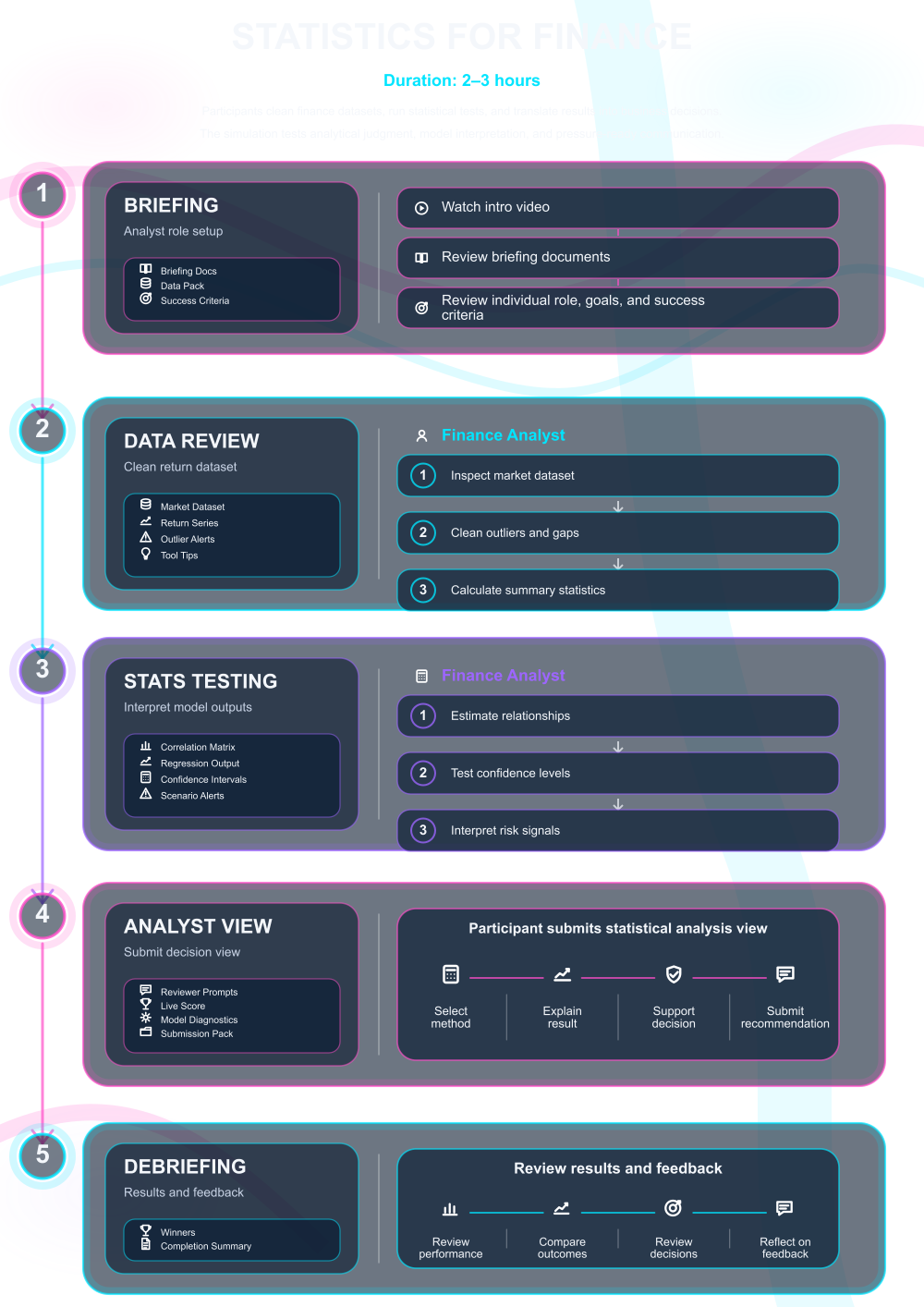

What Participants Do
In the simulation, participants will:
- Clean and prepare real-world financial datasets for analysis.
- Select and apply statistical models to solve specific finance problems (forecasting, optimization).
- Interpret model results and diagnose potential issues like multicollinearity or overfitting.
- Translate statistical outputs into clear, concise investment or risk management recommendations.
- Present and defend their data-driven decisions to a simulated "investment committee".
- Iterate and refine their models based on new data and simulated market events.

Learning Objectives
By the end of the simulation, participants will be able to:
- Understand the role of statistical analysis in core financial functions.
- Select appropriate statistical techniques for different finance problems.
- Build, interpret, and critique regression and time-series models using financial data.
- Apply statistical concepts to portfolio optimization and risk assessment.
- Effectively communicate complex statistical findings to a non-technical audience.
- Develop critical judgment for evaluating the validity and limitations of quantitative models.
How the Statistics for Finance Simulation Works
This simulation can be run individually or in teams in academic or corporate contexts. Each cycle represents a stage of getting through a pressing financial situation.
1. Receive the Analytical Brief Teams get a business problem and relevant datasets.
** 2. Data Exploration and Analysis** Participants explore the data, run statistical tests, and build preliminary models using integrated tools.
3. Make Data-Driven Decisions They submit their analysis, model choices, and final recommendations.
4. Collaborate and Debate Teams may present their findings, challenge each other's assumptions, or role-play as analysts and portfolio managers.
5. Review Outcomes The platform provides feedback on the statistical validity and financial performance of their decisions. New market data is introduced in the next round, requiring model adjustment.
Frequently Asked Questions
Assessment
Assessment of participant performance can be tailored according to the host institution’s objectives (business school, corporate training, assessment centre). Typical assessment criteria include:
- Correct application and interpretation of statistical methods.
- Quality and practicality of finance-driven recommendations.
- The risk/return outcomes of their strategies in the simulation.
- Clarity and persuasiveness in presenting data-driven insights.
- Peer review and self-assessment components can also be integrated for a holistic evaluation.