No prior deep finance experience is required. The simulation includes built-in instructional support, step-by-step guidance and materials suited for beginners, though participants with some finance background will benefit further.

Small Business Finance Simulation
In the Small Business Finance Simulation, participants step into the role of entrepreneurs and financial managers of a small business, participating in the financial decisions that shape the company’s growth, sustainability and strategic flexibility.

Small Business Finance Simulation Overview
The simulation presents a rich and immersive environment where participants manage a business’s finances across budgeting, cash flow, financing, investment and risk-management decisions.
Over multiple rounds, teams will face realistic scenarios: seasonal demand changes, cost pressures, new growth initiatives, borrowing decisions, and unexpected shocks (e.g., supply disruptions or regulatory changes).
The aim is to mirror the financial ecosystem of a small business: making trade-offs between growth and stability, balancing short-term liquidity with long-term investment, choosing whether (and how) to raise debt or equity, and responding to both internal and external pressures.

Small Business Finance Simulation Concepts
Participants work through realistic scenarios, which can be customized to emphasize or exclude specific topics depending on the learning goals. This modular structure allows the simulation to be tailored to any type of session. Key concepts include:
- Financial statements for small businesses (income statement, balance sheet, cash-flow statement)
- Budgeting and working capital management
- Cash-flow forecasting and liquidity planning
- Capital structure: debt, equity and hybrid financing for small businesses
- Cost of capital and small business investment appraisal (NPV, IRR, payback)
- Risk management: operational risk, financial risk, market risk for small firms
- Growth strategy vs. cash preservation trade-offs
- Pricing, margin management, cost control
- External financing decisions
- Business valuation in the context of small enterprises
- Scaling up: when and how to invest in growth, hire, expand, or export
- Exit planning (sale, merger, IPO in miniature) for SMEs

Gameflow
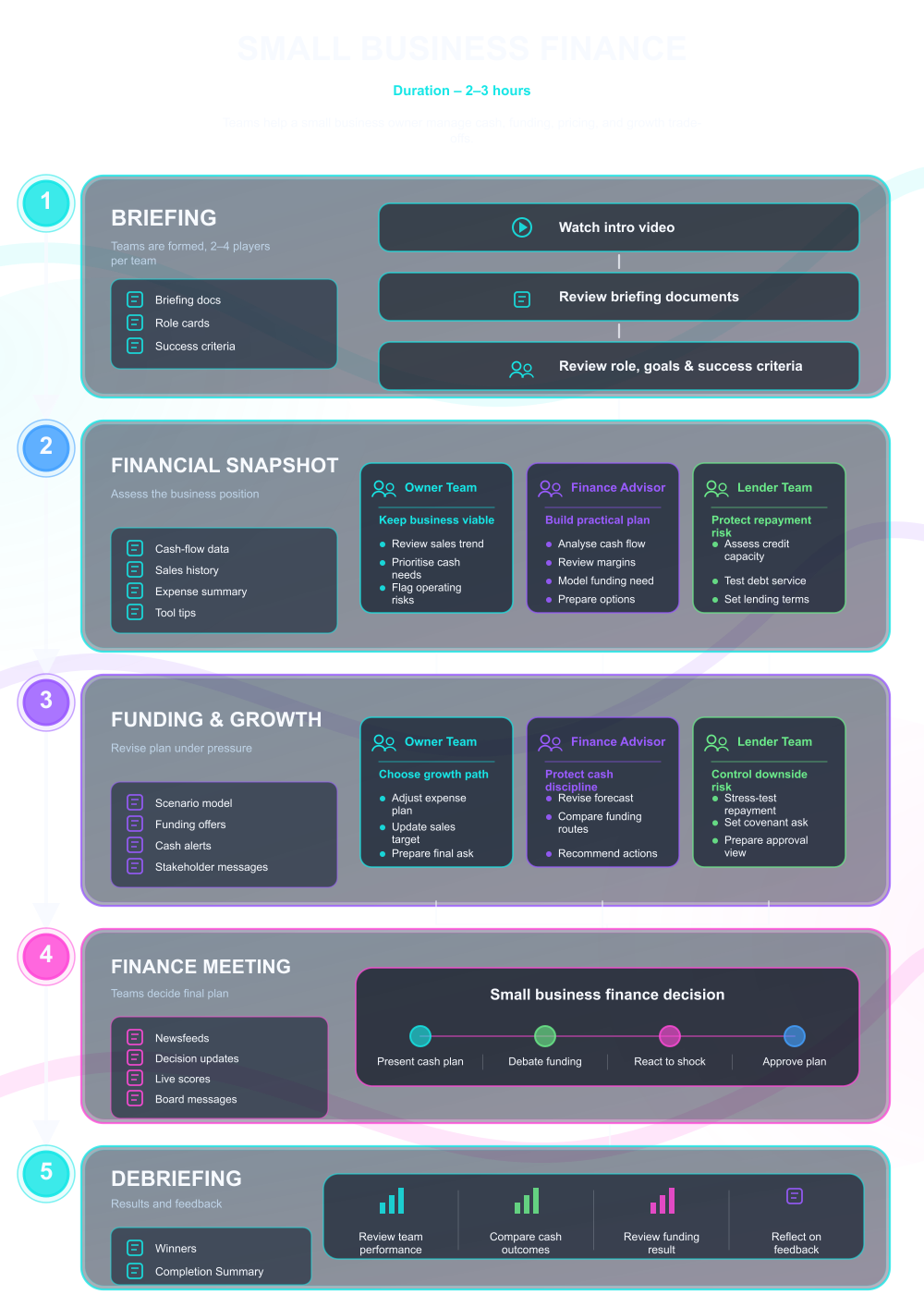

What Participants Do
In the simulation, participants will:
- Review a business brief, identifying the industry, size of company, initial financial condition and strategic options
- Prepare a budgeting and forecast model, estimating revenues, costs, and cash-flow over the next period
- Decide on financing strategy, choosing debt or equity, set terms, negotiate with virtual lenders or investors
- Set inventory levels, credit terms, cash reserves, supplier payments
- Launch a new product line, expand to a new market, upgrade technology, or restructure operations
- Monitor performance, tracking key metrics and adjusting strategy accordingly
- Pitch to internal stakeholders or investors on progress, strategy, and required financing

Learning Objectives
By the end of the simulation, participants will be able to:
- Understand how small business financial statements interrelate and drive business decisions
- Construct and interpret cash-flow forecasts and understand their importance for SME health
- Evaluate financing options available to small businesses and assess their impact on risk, flexibility and growth
- Manage working capital proactively and understand the implications of poor liquidity management
- Make investment decisions in a small business context, using appraisal techniques appropriate to SMEs
- Understand the trade-offs between growth initiatives and maintaining financial stability
- Respond effectively to financial shocks, and adjust strategy mid-course
- Communicate small business financial performance and strategy to stakeholders (investors, banks, management)
- Develop judgment in balancing profitability, growth and risk in a small-business setting
- Build confidence in non-financial and financial decision-making as entrepreneurs or managers
The simulation’s flexible structure ensures that these objectives can be calibrated to match the depth, duration, and focus areas of each program, whether in higher education or corporate learning.
How the Small Business Finance Simulation Works
This simulation can be run individually or in teams in academic or corporate contexts.
1. Scenario Briefing Participants receive background information about the small business: industry sector, size, starting financials, market conditions and strategic choices.
2. Situation Analysis Teams review the business’s initial financials, market outlook, funding constraints and strategic options.
3. Decision Round Teams make a set of decisions—budget allocation, financing choice, investment plan, working capital tactics, pricing and growth moves.
4. Events and Feedback The system injects a simulated shock or market development (e.g., supplier disruption, demand drop, interest-rate hike). The model updates business performance accordingly.
5. Performance Review Teams receive key performance indicators (cash flow, profitability, debt coverage, liquidity, growth metrics) and compare outcomes against peers or benchmarks.
6. Repeat Cycle The simulation proceeds through multiple rounds (e.g., 3-4 rounds or more), allowing teams to adapt their strategy, learn from outcomes, and iterate decisions.
Frequently Asked Questions
Assessment
Assessment of participant performance can be tailored according to the host institution’s objectives (business school, corporate training, assessment centre). Typical assessment criteria include:
- Successful Financial Performance (cash flow, profitability, growth, debt management)
- Logic of investment and financing decisions, adaptation to shocks, realism of the plan
- Effectiveness of managing the business working capital, debt service and liquidity under stress
- Clarity and persuasiveness of business updates, investor/lender pitches or team memos
- Ability to learn from one round to the next, modify strategy and improve outcomes
- Collaboration, division of work, integration of roles, and final coherence
Assessment may incorporate peer and self-review components, facilitator scoring, and debrief discussion. Results may feed into grades, executive feedback, certification or development plans.