Finance professionals, business analysts, consultants, MBA students, and anyone involved in budgeting, forecasting, valuation, or strategic planning.

Scenario and Sensitivity Analysis Simulation
The Scenario and Sensitivity Analysis Simulation immerses learners in a dynamic environment where they model financial outcomes, stress-test assumptions, and make strategic decisions under variable conditions.

Scenario and Sensitivity Analysis Simulation Overview
In today’s volatile markets, static forecasts are not enough. Professionals must anticipate how changes in key assumptions—interest rates, commodity prices, demand, competition, or regulations that affect business performance and valuation.
This simulation provides a hands-on platform where participants build financial models, define scenarios (Base, Upside, Downside, Stress), and run sensitivity analyses to quantify risks and opportunities. They learn to present data-driven insights that support resilient planning and strategic agility.
Although ideal for undergraduate and graduate finance courses, executive training, and corporate finance skill workshops, the simulation is modular and scalable, allowing instructors to vary complexity.

Scenario and Sensitivity Analysis Simulation Concepts
Participants work through realistic scenarios, which can be customized to emphasize or exclude specific topics depending on the learning goals. This modular structure allows the simulation to be tailored to any type of session. Key concepts include:
- Scenario Analysis vs. Sensitivity Analysis
- Identifying key value and risk drivers
- Building flexible, scenario-ready financial models
- Monte Carlo simulation principles
- Interpreting output distributions and confidence intervals
- Risk-adjusted decision making
- Communicating findings to stakeholders

Gameflow
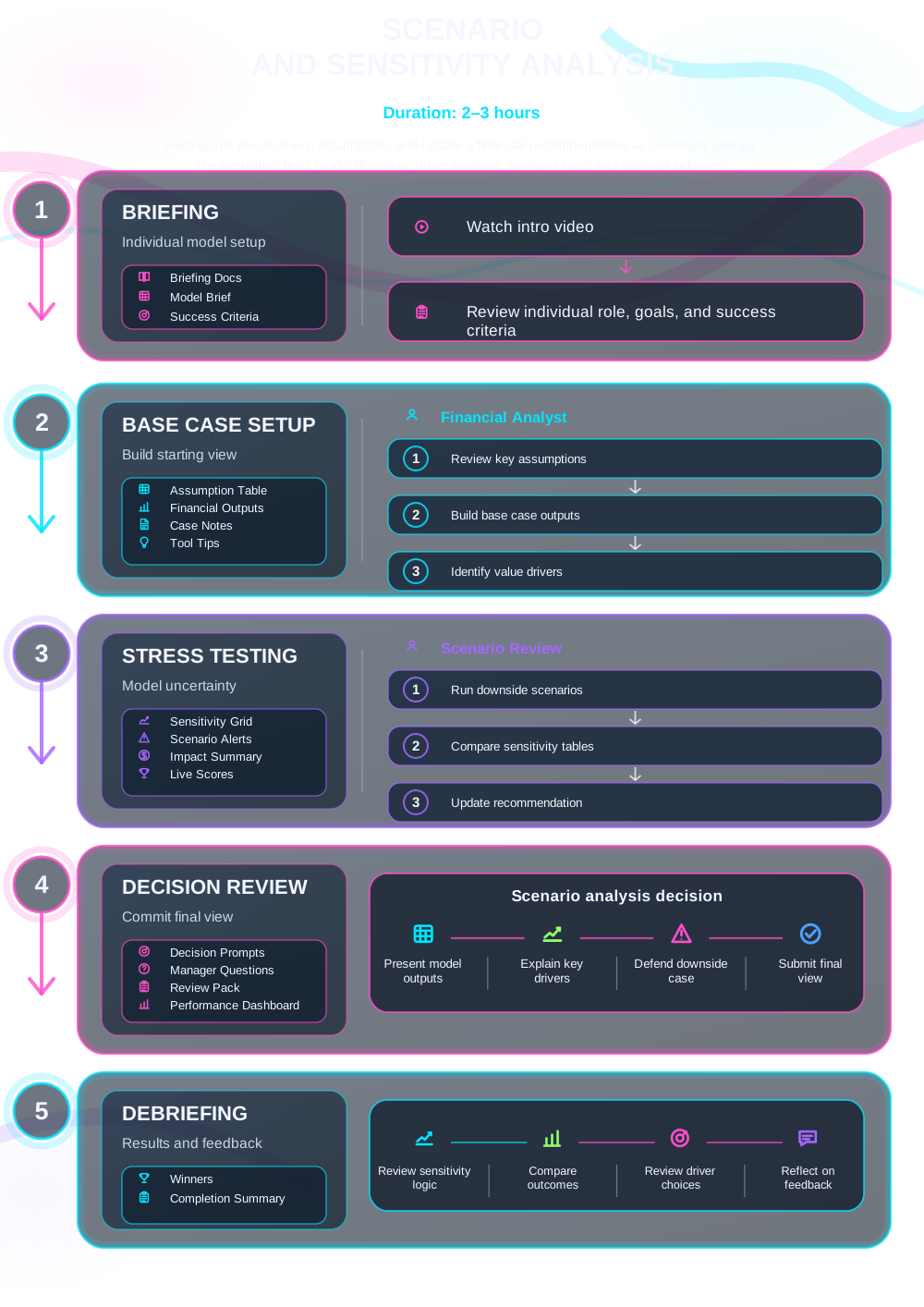

What Participants Do
In the simulation, participants will:
- Build an integrated financial model (income statement, balance sheet, cash flow) in Excel or provided software.
- Define and input assumptions for multiple strategic and economic scenarios.
- Run sensitivity analysis on critical variables (e.g., price, volume, cost of capital).
- Perform Monte Carlo simulations to assess probability-weighted outcomes.
- Create dynamic dashboards and tornado charts to visualize impact.
- Recommend a course of action based on scenario and sensitivity results.
- Present analysis to a simulated management or investment committee.

Learning Objectives
By the end of the simulation, participants will be able to:
- Differentiate between scenario planning and sensitivity testing.
- Identify the key business drivers that merit deep analysis.
- Construct financial models that accommodate multiple scenarios.
- Quantify and rank variables by their impact on outcomes.
- Interpret probabilistic output to support decision-making under uncertainty.
- Communicate complex analyses in clear, executive-ready formats.
- Apply scenario and sensitivity techniques to valuation, budgeting, and capital allocation.
How the Scenario and Sensitivity Analysis Simulation Works
This simulation can be run individually or in teams in academic or corporate contexts. Each cycle represents a stage of getting through a pressing financial situation.
1. Introduction and Case Background Receive a business case (for example, a new product launch, a project investment, or a M&A target).
2. Model Building Develop a baseline financial model with clearly defined input assumptions.
3. Scenario Development Define 3–5 distinct scenarios, altering multiple inputs in tandem to reflect realistic alternative futures.
4. Sensitivity Testing Use one-way and two-way data tables to isolate the impact of individual variables.
5. Probabilistic Simulation Apply Monte Carlo techniques to generate outcome distributions and probabilities.
6. Reporting and Decision Synthesize results into a dashboard and management summary.
Frequently Asked Questions
Assessment
Assessment of participant performance can be tailored according to the host institution’s objectives (business school, corporate training, assessment centre). Typical assessment criteria include:
- Correct model structure, appropriate scenario selection, error-free sensitivity setups.
- Quality of insight drawn from scenario comparisons and sensitivity outputs.
- Ability to explain probabilities, confidence intervals, and downside risks.
- Effectiveness in visualizing and communicating recommendations.