This simulation is perfect for undergraduate and graduate business students, early-career professionals in finance and analytics, and managers in any department who need to justify budgets and projects.

ROI Simulation
Experience the ultimate gamified simulation where participants learn to calculate, forecast, and maximize Return on Investment in high-stakes business scenarios.

ROI Simulation Overview
In the ROI Simulation, participants step into the role of financial analysts and strategic advisors across multiple industries, tasked with one critical objective: maximizing Return on Investment for stakeholders. This hands-on simulation replicates the intense pressure and multifaceted analysis required to evaluate projects, justify expenditures, and drive profitable growth in real companies.
Each round presents a new business case: from launching a new product line and evaluating marketing campaigns to assessing capital investments and major IT projects. Participants must analyze financial data, forecast cash flows, weigh risks, and build compelling business cases. They compete not just on the final ROI number, but on the robustness of their analysis, the persuasiveness of their communication, and the strategic alignment of their recommendations.
This simulation is ideal for university finance programs, corporate training workshops, and executive education, bridging the gap between theoretical financial formulas and the complex, judgment-driven reality of business investment decisions.

ROI Simulation Concepts
Participants work through realistic scenarios, which can be customized to emphasize or exclude specific topics depending on the learning goals. This modular structure allows the simulation to be tailored to any type of session. Key concepts include:
- Core ROI Calculation and Methodology
- Cash Flow Forecasting and Analysis
- Time Value of Money
- Risk Assessment and Sensitivity Analysis
- Cost-Benefit Analysis
- Capital Budgeting and Rationing
- Strategic Alignment and Justification
- Stakeholder Communication
- Intangible Benefits and Non-Financial Factors
- Post-Investment Review and Performance Tracking

Gameflow
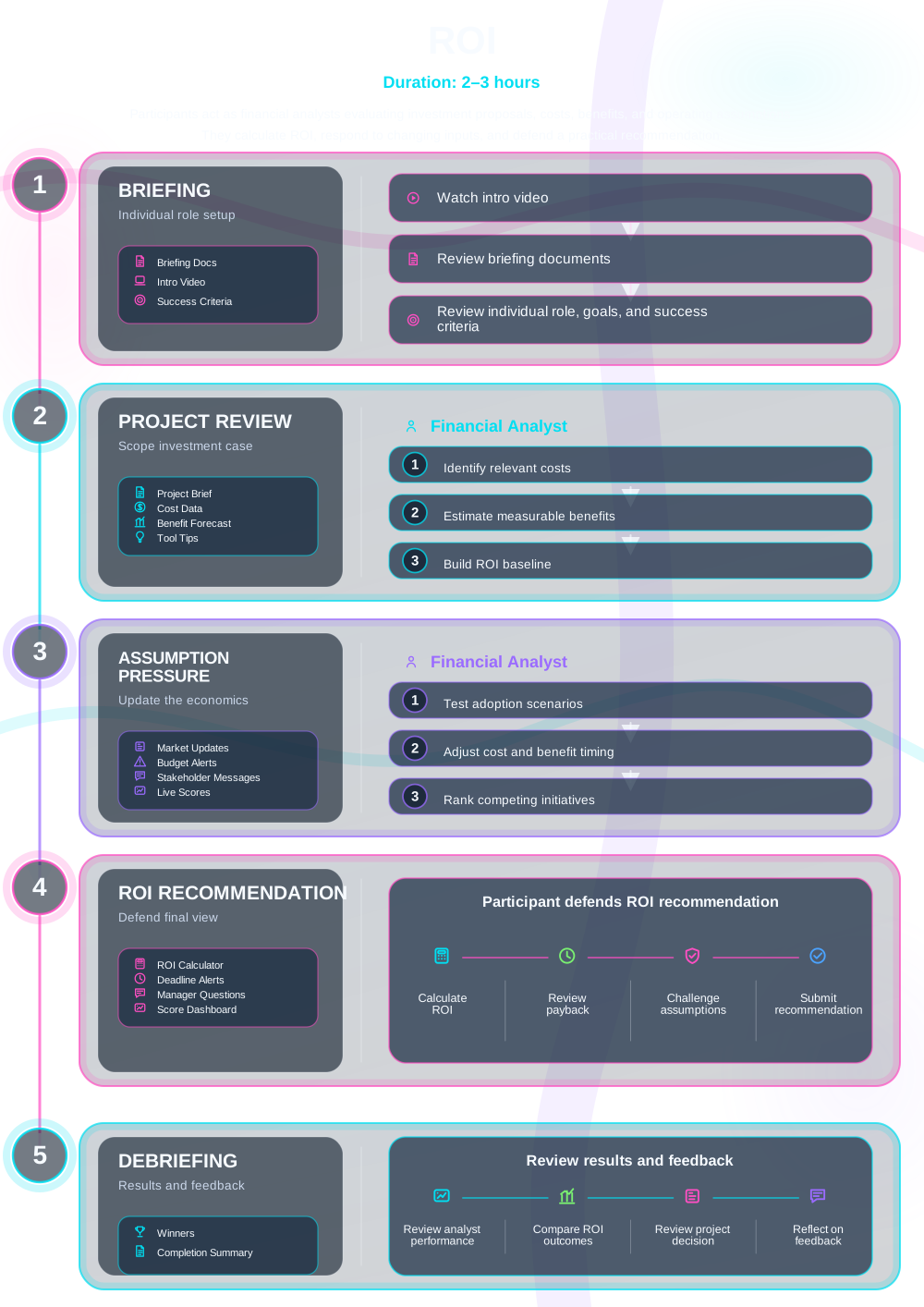

What Participants Do
In the simulation, participants will:
- Review scenarios, financial statements, market data, and project proposals.
- Create spreadsheets to forecast cash flows, calculate ROI, NPV, and IRR.
- Test how changes in key assumptions (sales growth, cost of capital) affect project viability.
- Decide whether to proceed with, modify, or reject proposed investments.
- Craft and present a compelling business case to secure approval from a simulated board or management team.
- Answer challenging questions and justify their assumptions under pressure.
- Evaluate the recommendations of other teams and provide critical feedback.
- Use round-by-round feedback to refine their analytical approach and strategic thinking.

Learning Objectives
By the end of the simulation, participants will be able to:
- Confidently calculate and interpret key investment appraisal metrics.
- Build a structured, defensible financial forecast to support an investment case.
- Critically assess business proposals by identifying key drivers, risks, and underlying assumptions.
- Communicate the financial and strategic rationale for an investment clearly and persuasively to non-financial stakeholders.
- Make principled capital allocation decisions under conditions of uncertainty and limited resources.
- Understand how investment decisions impact and are influenced by different areas of a business.
- Develop the analytical rigor and business acumen required for roles in FP&A, consulting, project management, and entrepreneurship.
How the ROI Simulation Works
This simulation can be run individually or in teams in academic or corporate contexts. Each cycle represents a stage of getting through a pressing financial situation.
1. Introduction and Briefing Participants receive a company profile and their first investment scenario with background data.
** 2. Analysis Stage** Using provided templates and tools, participants analyze the opportunity, build their financial model, and run scenarios.
3. Decision Submission Teams submit their final recommendation (Accept/Reject) along with key supporting metrics and a brief rationale.
4. Presentation and Negotiation Selected teams present their business cases to a mock "investment committee" (instructor or other teams), followed by Q&A.
5. Results and Feedback The simulation platform reveals the outcome of the decision based on the underlying model. Instant feedback is provided on the quality of the analysis, the chosen metrics, and the communication.
6. Debrief and Learning Recap The facilitator leads a discussion on key takeaways, common pitfalls, and the application of concepts to the real world. This cycle repeats with increasingly complex scenarios.
Frequently Asked Questions
Assessment
Assessment of participant performance can be tailored according to the host institution’s objectives (business school, corporate training, assessment centre). Typical assessment criteria include:
- Correct application of financial formulas and logical forecasting.
- The strength and justification of the inputs driving the financial model.
- Identification of key risks and the incorporation of sensitivity analysis.
- The alignment of the final recommendation with business goals and constraints.
- Clarity, structure, and persuasiveness of the written and oral business case.