This simulation is ideal for undergraduate and graduate business students, early-career accountants, finance professionals, and anyone in a role requiring a solid understanding of financial controls and data integrity.

Reconciliation of Accounts Simulation
The Reconciliation of Accounts Simulation plunges participants into a fast-paced role as a reconciliation specialist, where they must identify, investigate, and resolve discrepancies in real-time, ensuring the accuracy and reliability of financial data.

Reconciliation of Accounts Simulation Overview
The reconciliation process is a fundamental defense against errors, fraud, and financial misstatement. This simulation provides a dynamic, hands-on experience that moves beyond textbook theory.
Participants are placed in the accounting department of a simulated company, "Global Synergy Corp." Over multiple simulated periods, they are tasked with reconciling high-volume bank statements, general ledger accounts, and inter-company transactions under time pressure. They will encounter a variety of common and complex discrepancies, such as timing differences, missing transactions, data entry errors, and suspicious outliers.
By using a dedicated simulation platform, participants learn to prioritize tasks, utilize analytical tools, and communicate effectively with other virtual departments to clear reconciling items. This immersive experience transforms the often-mundane task of reconciliation into a critical and engaging business skill.

Reconciliation of Accounts Simulation Concepts
Participants work through realistic scenarios, which can be customized to emphasize or exclude specific topics depending on the learning goals. This modular structure allows the simulation to be tailored to any type of session. Key concepts include:
- Bank Reconciliation
- Account Reconciliation
- Inter-company Reconciliation
- Timing Differences
- Investigative Accounting
- Internal Controls
- Materiality and Risk Assessment
- Audit Trail

Gameflow
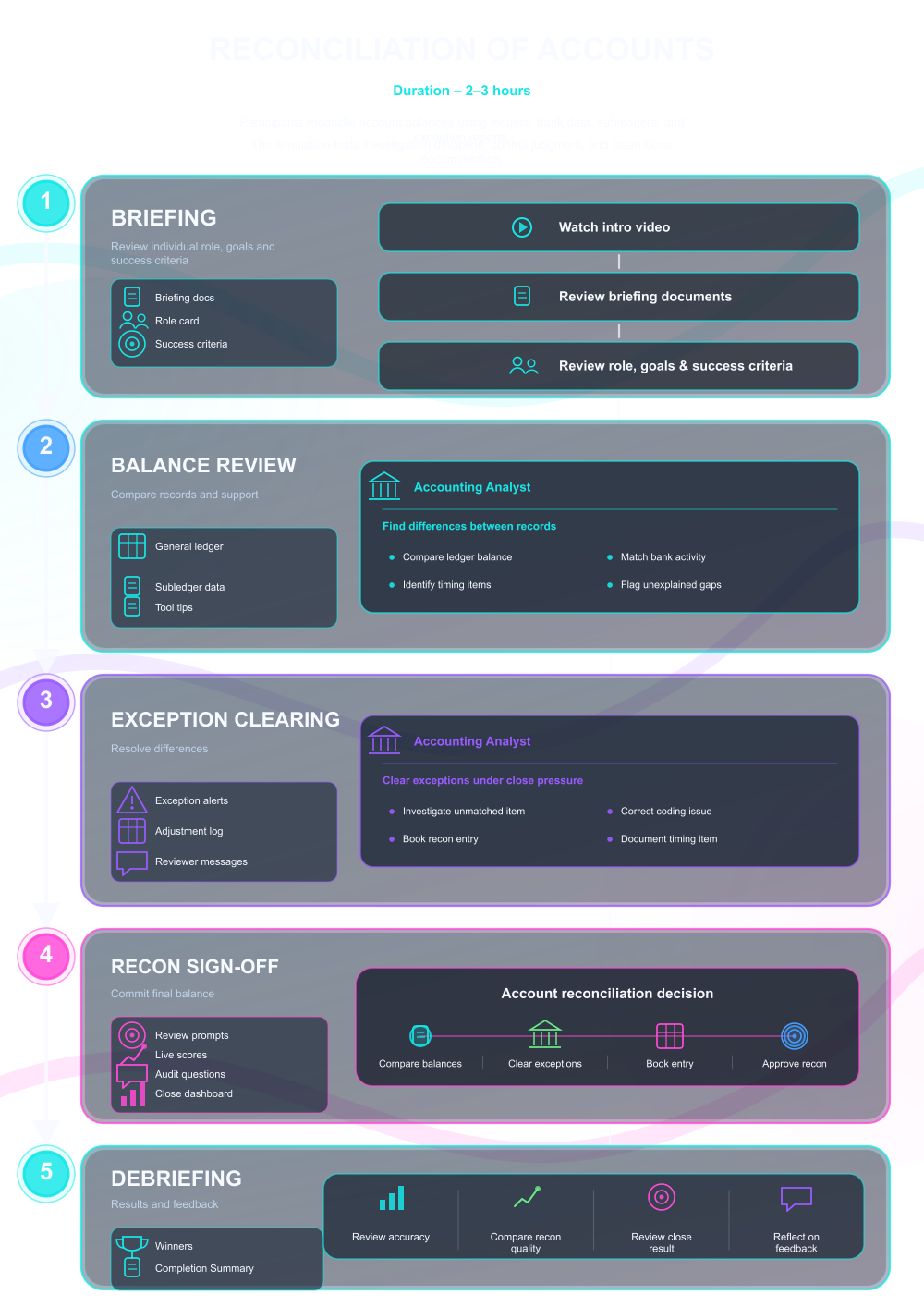

What Participants Do
In the simulation, participants will:
- Process and reconcile monthly bank statements against the company's cash book.
- Investigate and resolve discrepancies in general ledger accounts.
- Collaborate with virtual "colleagues" in the AP and AR departments to obtain missing information.
- Analyze large datasets to identify patterns and outliers.
- Document all investigation steps and final resolutions in a formal reconciliation report.
- Manage their time and workflow to meet strict reporting deadlines.
- Escalate potential fraud or significant control weaknesses to the virtual CFO.
- Progress through increasing levels of difficulty, from simple errors to complex multi-period issues.

Learning Objectives
By the end of the simulation, participants will be able to:
- Execute a complete and accurate bank and general ledger account reconciliation.
- Systematically identify, investigate, and resolve various types of accounting discrepancies.
- Apply professional judgment to assess the risk and materiality of reconciling items.
- Demonstrate the importance of reconciliation as a cornerstone of strong internal controls.
- Improve efficiency and accuracy when working with large sets of financial data.
- Communicate effectively to resolve issues that require input from other business units.
- Develop a clear and audit-ready documentation trail for all reconciliation work.
How the Reconciliation of Accounts Simulation Works
This simulation can be run individually or in teams in academic or corporate contexts. Each cycle represents a stage of getting through a pressing financial situation.
1. Introduction and Role Assignment Participants are introduced to their role as a Reconciliation Specialist at "Global Synergy Corp" and the simulation dashboard.
2. Receive Data Each simulation round, participants receive a new set of data: a bank statement, a general ledger extract, and supporting documentation.
3. Identify Discrepancies Using the simulation's tools, they compare records to identify mismatches and outliers.
4. Investigate and Resolve Participants drill down into transactions, send queries to virtual departments, and determine the root cause of each discrepancy (duplicate payment, missing deposit, data entry error).
5. Document and Report For each item, they log their findings and take corrective action. At the end of the round, they submit a formal reconciliation package.
6. Feedback and Scoring The platform provides immediate, detailed feedback on accuracy, efficiency, and the quality of documentation. A performance score is generated based on these metrics.
7. Progress Successful completion allows participants to advance to the next, more complex period, introducing new challenges and account types.
Frequently Asked Questions
Assessment
Assessment of participant performance can be tailored according to the host institution’s objectives (business school, corporate training, assessment centre). Typical assessment criteria include:
- Percentage of discrepancies correctly identified and resolved.
- Speed and workflow management in completing tasks.
- Completeness and clarity of the reconciliation reports.
- Instructors can view cohort-level data to identify common areas of strength and weakness across the class.
- Participants who achieve a passing proficiency score receive a digital certificate, validating their skills in account reconciliation.