It's designed for students and professionals pursuing careers in quantitative finance, algorithmic trading, data science in finance, and hedge funds.

Quantitative Trading Simulation
In this Quantitative Trading Simulation, participants design algorithmic strategies, build predictive models, manage live execution, and optimize portfolios based on statistical signals in highly dynamic financial markets.

Quantitative Trading Simulation Overview
Participants become quantitative traders navigating complex, data-driven markets. Each simulation round presents evolving challenges: shifting market regimes, new data releases, model decay, execution slippage, and competitive actions from rival algorithmic funds.
They must research alpha signals, develop and backtest trading algorithms, manage real-time execution, and dynamically allocate capital across strategies. The simulation emphasizes systematic, data-based decision-making, blending statistical rigor with practical market intuition. Participants learn to balance innovation, risk control, and technological infrastructure under pressure.
This simulation is ideal for advanced university finance programs, STEM Master's courses, data science bootcamps, and quantitative finance executive training. It makes the quantitative investment process tangible, showing how research, technology, and risk management integrate to drive performance.

Quantitative Trading Simulation Concepts
Participants work through realistic scenarios, which can be customized to emphasize or exclude specific topics depending on the learning goals. This modular structure allows the simulation to be tailored to any type of session. Key concepts include:
- Algorithmic Strategy Development
- Alpha Signal Research and Factor Modeling
- Backtesting and Strategy Optimization
- Market Microstructure and Execution Algorithms
- Portfolio Construction for Quantitative Strategies
- Real-Time Risk Management
- Model Validation and Decay Monitoring
- High-Frequency and Latency Considerations
- Data Sourcing, Cleaning, and Alternative Data Integration
- Performance Attribution and Analysis

Gameflow
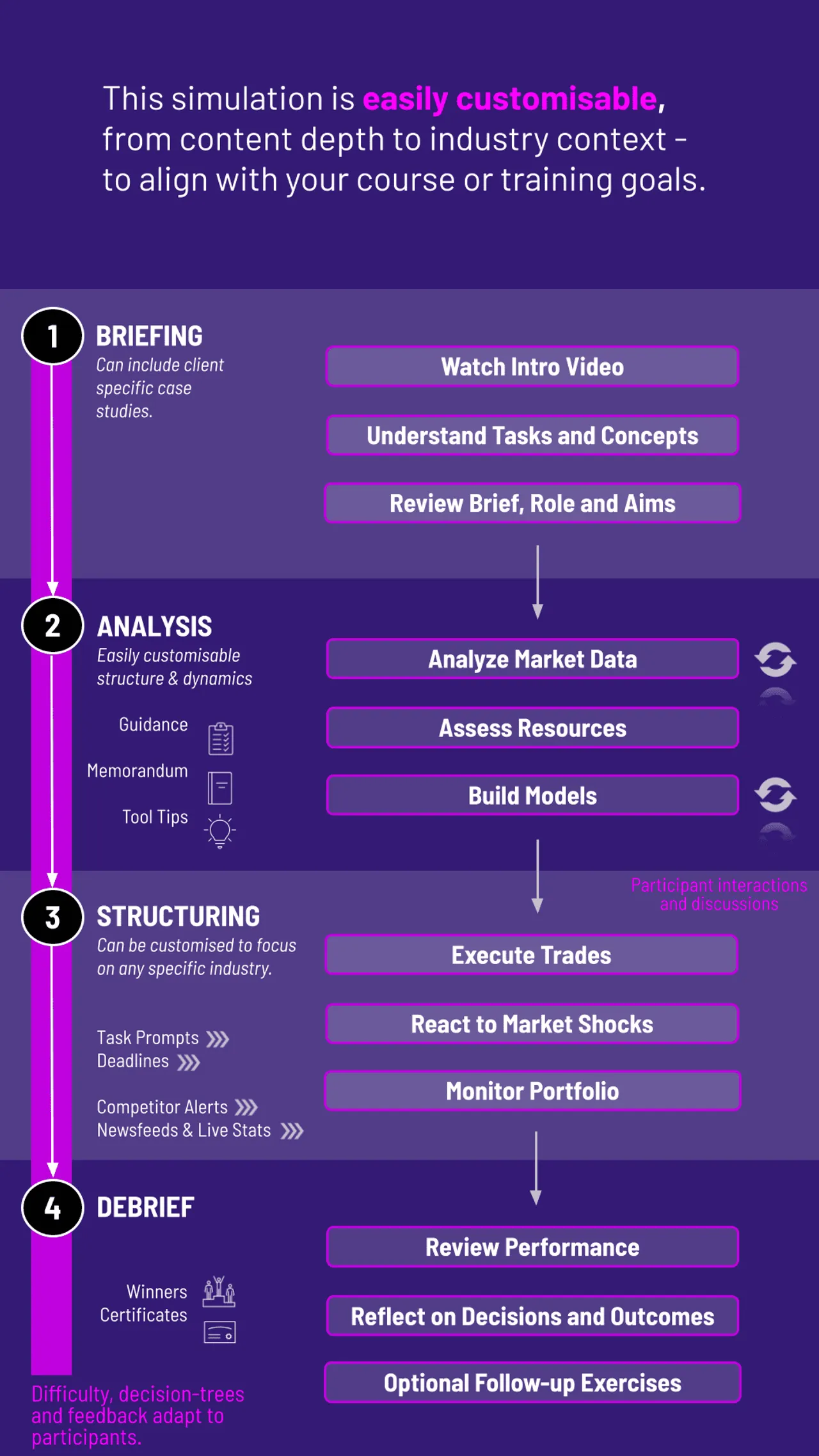

What Participants Do
In the simulation, participants will:
- Analyze financial datasets to identify potential predictive signals.
- Develop, code, and rigorously backtest trading algorithms.
- Allocate capital and manage a multi-strategy quantitative portfolio.
- Monitor live "market" feeds, manage order execution, and adjust strategies in response to real-time events.
- Diagnose underperformance, distinguishing between bad luck, model decay, and broken assumptions.
- Present strategy performance and research findings to a simulated investment committee.

Learning Objectives
By the end of the simulation, participants will be able to:
- Understand the end-to-end workflow of a quantitative trading operation.
- Apply a systematic process for researching, testing, and implementing algorithmic strategies.
- Evaluate trade-offs between strategy returns, risk, capacity, and turnover.
- Recognize common pitfalls in quantitative finance, such as overfitting and look-ahead bias.
- Interpret real-time market data and manage automated execution.
- Communicate quantitative concepts and performance results effectively to stakeholders.
- Develop judgment for when to trust a model versus when to intervene.
How the Quantitative Trading Simulation Works
This simulation can be run individually or in teams in academic or corporate contexts. Each cycle represents a stage of getting through a pressing financial situation.
1. Receive Market Brief and Data Participants access a historical and real-time simulated market data feed across multiple asset classes.
** 2. Research and Development** They explore data, hypothesize signals, and develop trading logic using the simulation's tools.
3. Backtesting and Validation Participants run their strategies through historical scenarios, analyzing performance metrics and robustness.
4. Live Trading Rounds Approved strategies go "live" in a simulated market that reacts to participant orders and randomized news shocks.
5. Monitor and Iterate Teams monitor live P&L, risk metrics, and execution quality, making adjustments between rounds.
6. Review and Present The session concludes with a performance review, attribution analysis, and strategy presentations.
Frequently Asked Questions
Assessment
Assessment of participant performance can be tailored according to the host institution’s objectives (business school, corporate training, assessment centre). Typical assessment criteria include:
- Risk-adjusted returns (Sharpe/Sortino ratios), maximum drawdown, consistency.
- Quality of signal research, backtesting discipline, and avoidance of overfitting.
- Adherence to risk limits, leverage usage, and response to drawdowns.
- Quality of trade execution and minimization of slippage/impact.
- Clarity in presenting strategy rationale and performance attribution.
- Additionally, peer reviews and final investment committee presentations can be integrated for a comprehensive evaluation.