A foundational understanding of finance, statistics, and programming is highly recommended. The simulation is designed for advanced undergraduates, MBA students, or finance professionals looking to transition into quant roles.

Quantitative Analyst Simulation
This simulation places you in the role of a Quant at a leading hedge fund, where you will design, backtest, and implement algorithmic trading strategies.

Quantitative Analyst Simulation Overview
The Quantitative Analyst Simulation is a hands-on, competitive platform that replicates the environment of a quantitative trading desk. Participants are tasked with building a profitable and robust portfolio from the ground up. They will move beyond theoretical finance and into the practical application of mathematical models, statistical analysis, and programming.
Starting with a virtual capital allocation, the participant's team will research financial instruments, develop predictive models, and write code to execute trades automatically. The simulation runs on a sophisticated engine that incorporates real-world market dynamics, including volatility clustering, liquidity constraints, and transaction costs. Participants will be judged not just on raw returns, but on the risk-adjusted performance of your strategies, forcing you to balance aggression with prudent risk management.
Although ideal for undergraduate and graduate finance courses, executive training, and corporate finance skill workshops, the simulation is modular and scalable, allowing instructors to vary complexity.

Quantitative Analyst Simulation Concepts
Participants work through realistic scenarios, which can be customized to emphasize or exclude specific topics depending on the learning goals. This modular structure allows the simulation to be tailored to any type of session. Key concepts include:
- Algorithmic Trading and Execution
- Statistical Arbitrage
- Factor Modeling and Smart Beta
- Time Series Analysis and Forecasting
- Portfolio Optimization (Markowitz, Black-Litterman)
- Backtesting and Strategy Validation
- Risk Metrics (VaR, Expected Shortfall, Drawdown)
- Machine Learning in Finance (Regression, Classification, Clustering)
- Stochastic Processes and Volatility Modeling
- Market Microstructure and Transaction Costs

Gameflow
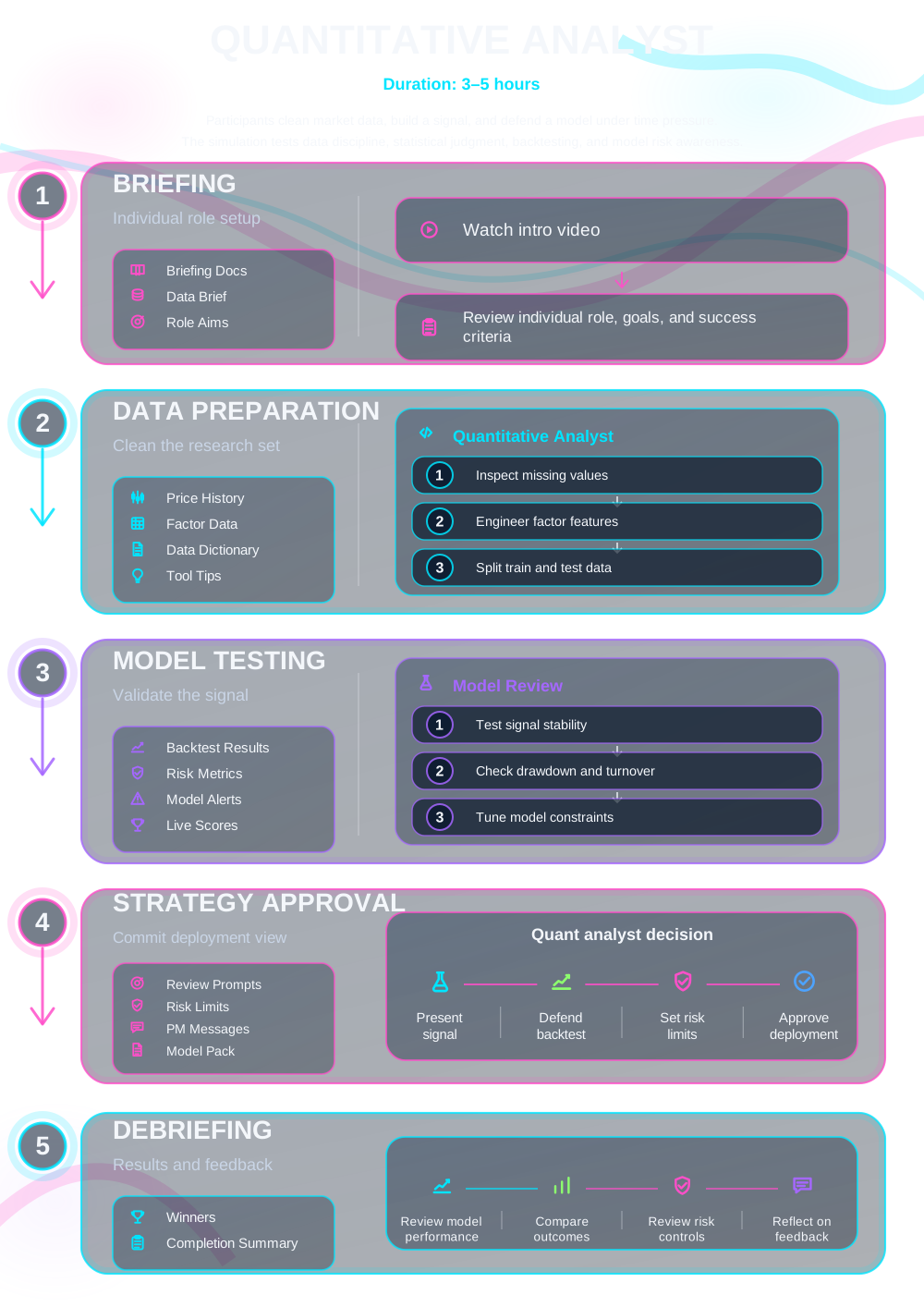

What Participants Do
In the simulation, participants will:
- Formulate a quantitative investment thesis based on market anomalies or statistical patterns.
- Code and refine algorithmic trading strategies (mean-reversion, momentum, factor-based).
- Rigorously test your strategies against historical data to evaluate their viability and avoid overfitting.
- Deploy your algorithms in a simulated live market environment that reacts to other participants' trades.
- Continuously monitor your portfolio's risk exposure and adjust strategies to stay within limits.
- Analyze your P&L attribution and key performance indicators to iteratively improve your models.
- Compete against other teams (quants) for the highest risk-adjusted returns.

Learning Objectives
By the end of the simulation, participants will be able to:
- Design and implement a fully systematic, rules-based trading strategy.
- Apply programming skills to solve quantitative finance problems.
- Construct a diversified portfolio optimized for risk-adjusted returns.
- Critically evaluate the performance of a trading strategy through rigorous backtesting and out-of-sample testing.
- Interpret and manage financial risk using industry-standard metrics.
- Understand the impact of transaction costs, slippage, and liquidity on strategy profitability.
- Communicate complex quantitative strategies and their results effectively to stakeholders.
How the Quantitative Analyst Simulation Works
This simulation can be run individually or in teams in academic or corporate contexts. Each cycle represents a stage of getting through a pressing financial situation.
1. Team Formation and Briefing Participants are grouped into quant teams, given a virtual capital allocation, and introduced to the trading platform and data universe.
2. Tool Familiarization Access the web-based platform with an integrated development environment, financial data libraries, and documentation.
3. Strategy Development Phase Teams research, code, and backtest their strategies using historical data. Instructors can monitor progress and provide guidance.
4. Live Trading Round The simulation begins with a live clock. Teams deploy their algorithms, which execute automatically based on their code. The market evolves, reacting to a built-in "market maker" and the aggregate orders of all teams.
5. Monitoring and Iteration Teams can monitor their live P&L, risk dashboard, and adjust their code between trading days to improve performance or manage new risks.
6. Debrief and Final Assessment The simulation concludes with a ranking based on a final score (combining returns, Sharpe ratio, and drawdown). A comprehensive debrief session analyzes winning strategies, common pitfalls, and key learning takeaways.
Frequently Asked Questions
Assessment
Assessment of participant performance can be tailored according to the host institution’s objectives (business school, corporate training, assessment centre). Typical assessment criteria include:
- Final Portfolio Score, based on a composite metric combining Sharpe Ratio, Total Return, and Maximum Drawdown at the end of the live trading period.
- Evaluation of the readability, efficiency, and robustness of the submitted code, including comments and a README file.
- Collaboration, division of work, integration of roles, and final coherence
- Rating by peers and self-reflection on approach and decisions