A foundational understanding of finance, statistics, and basic programming is recommended, though comprehensive guides and templates are provided to support all participants.

Quant Finance Simulation
Experience the high-stakes world of quantitative finance in a dynamic, hands-on simulation where participants build and deploy algorithmic trading strategies in a realistic market environment.

Quant Finance Simulation Overview
Our Quant Finance Simulation plunges participants into the role of a quantitative analyst at a hedge fund or proprietary trading firm. Over the course of the simulation, teams use mathematical models, statistical analysis, and programming tools to develop, backtest, and live-trade algorithms against simulated market data.
Participants must balance innovation with risk management, responding to stochastic shocks, shifting volatility regimes, and real-time P&L pressure. The simulation bridges advanced theory and practical application, offering a competitive yet collaborative platform to master the tools and decision-making processes of modern quantitative finance.
Although ideal for undergraduate and graduate finance courses, executive training, and corporate finance skill workshops, the simulation is modular and scalable, allowing instructors to vary complexity.

Quant Finance Simulation Concepts
Participants work through realistic scenarios, which can be customized to emphasize or exclude specific topics depending on the learning goals. This modular structure allows the simulation to be tailored to any type of session. Key concepts include:
- Algorithmic Strategy Development
- Statistical Arbitrage and Factor Modeling
- Market Microstructure and Order Types
- Backtesting and Overfitting Avoidance
- Stochastic Processes and Volatility Modeling
- Execution Algorithms and Slippage
- Risk Metrics
- High-Frequency Data Analysis

Gameflow
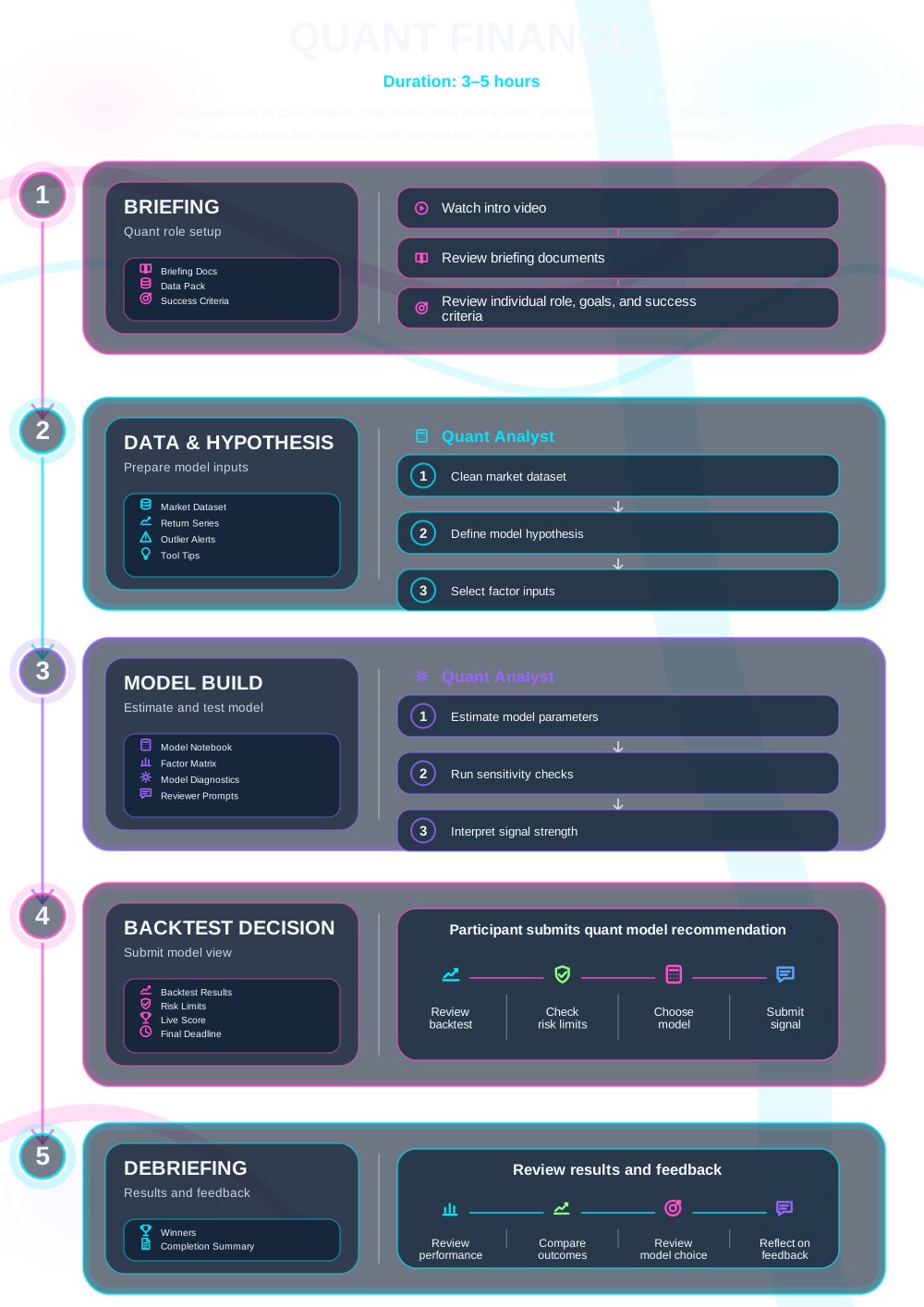

What Participants Do
In the simulation, participants will:
- Formulate a quantitative trading hypothesis based on provided financial datasets.
- Implement strategies in a controlled environment and rigorously test them on historical data.
- Fine-tune model parameters while applying strict risk limits and constraints.
- Execute strategies in a real-time simulated market with other participants, creating dynamic price action.
- Continuously monitor live performance, drawdowns, and market regime shifts to adjust or halt strategies.
- Defend their model's rationale, performance, and risk profile in a final fund manager review.

Learning Objectives
By the end of the simulation, participants will be able to:
- Understand the end-to-end lifecycle of a quant trading strategy, from research to execution.
- Apply statistical and mathematical models to real-world financial data.
- Develop critical risk management instincts specific to algorithmic trading.
- Enhance coding and data analysis skills within a financial context.
- Experience the psychological pressure and collaborative demands of a live trading environment.
- Evaluate the ethical considerations and market impact of automated trading.
How the Quant Finance Simulation Works
This simulation can be run individually or in teams in academic or corporate contexts. Each cycle represents a stage of getting through a pressing financial situation.
1. Preparation Teams receive software access, market data feeds, and documentation on the trading API.
** 2. Strategy Phase** Participants research, code, and backtest their core algorithm using a rich library of historical data.
3. Validation Instructors review initial backtests and risk reports before approving strategies for live trading.
4. Live Trading Session The simulation engine generates a multi-asset market with events. Teams run their algorithms, competing for returns while managing risk limits.
5. Mid-Session Review A market "shock" or regime change is introduced, forcing teams to adapt their models.
6. Performance Analysis and Review The session concludes with a detailed performance attribution report. Teams present their process and results to a panel.
Frequently Asked Questions
Assessment
Assessment of participant performance can be tailored according to the host institution’s objectives (business school, corporate training, assessment centre). Typical assessment criteria include:
- The technical performance of their algorithm
- The robustness of their backtesting and risk management process
- Their adaptability to changing market conditions
- Clarity and insight of their final strategy defense.