Participants gain practical skills in dual-bottom-line management, financial analysis for MFIs (like calculating Portfolio-at-Risk), strategic client selection, and responding to economic shocks, all within an ethical framework focused on poverty alleviation.

Microfinance Simulation
This simulation places participants in charge of a Microfinance Institution in a developing economy, making critical decisions to balance social impact with financial sustainability. Can you empower entrepreneurs while building a viable institution?

Microfinance Simulation Overview
The Microfinance Simulation is a dynamic, browser-based decision-making exercise that replicates the core tensions of running an MFI. Participants manage a portfolio of microloans to a diverse set of fictional clients—from street vendors and seamstresses to small farmers.
Each round represents a fiscal period where teams must allocate limited capital, set interest rates, manage operational costs, and respond to randomized real-world events like droughts, economic booms, or client emergencies. The goal is to maximize both Social Return (measured by clients lifted out of poverty, businesses created, and female empowerment) and Financial Return. It teaches that profit and purpose are not mutually exclusive but are interdependent for long-term success.
Although ideal for undergraduate and graduate finance courses, executive training, and corporate finance skill workshops, the simulation is modular and scalable, allowing instructors to vary complexity.

Microfinance Simulation Concepts
Participants work through realistic scenarios, which can be customized to emphasize or exclude specific topics depending on the learning goals. This modular structure allows the simulation to be tailored to any type of session. Key concepts include:
- Social Performance vs. Financial Sustainability
- Portfolio-at-Risk and Loan Loss Provisioning
- Operational Self-Sufficiency
- Interest Rate Setting and Yield
- Client Assessment and Credit Risk (without traditional collateral)
- Loan Officer Efficiency and Incentives
- The Impact of Macroeconomic/External Shocks
- Mission Drift in Microfinance

Gameflow
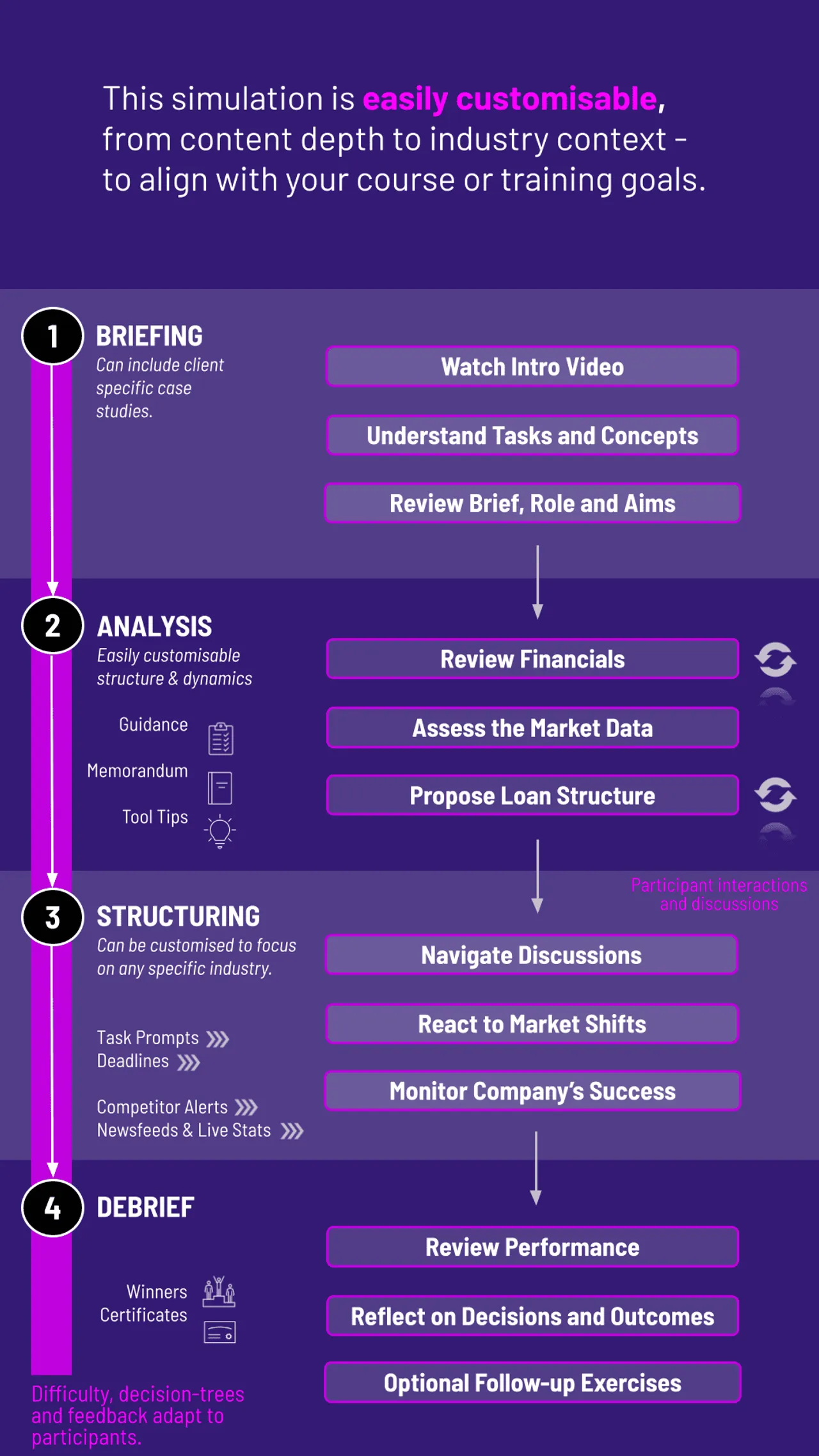

What Participants Do
In the simulation, participants will:
- Analyze profiles of potential micro-entrepreneur clients.
- Allocate loan capital across different risk-return client segments.
- Set interest rates that cover costs but remain fair and client-friendly.
- Hire and manage loan officers, balancing outreach with efficiency.
- React to unexpected events affecting clients or the institution.
- Interpret key MFI performance dashboards (financial and social).
- Strategize to grow their loan portfolio while controlling risk.
- Present a balanced scorecard of their MFI’s performance.

Learning Objectives
By the end of the simulation, participants will be able to:
- Articulate the dual-bottom-line mission of a modern MFI.
- Analyze the trade-offs between reaching the poorest clients and ensuring institutional viability.
- Calculate and interpret core microfinance metrics (PAR, OSS, Yield).
- Design a loan portfolio strategy that aligns with a chosen social mission.
- Evaluate how operational decisions impact both clients and the institution’s health.
- Develop a resilient strategy to handle external economic and climatic shocks.
How the Microfinance Simulation Works
This simulation can be run individually or in teams in academic or corporate contexts. Each cycle represents a stage of getting through a pressing financial situation.
1. Form Teams Each team operates as the management committee of an MFI.
2. Initial Setup Teams review starting capital, operational costs, and the initial market of client profiles.
3. Decision Rounds Over multiple rounds (representing 6-12 months each), teams make sequential decisions on client selection, loan terms, staffing, and potential new products.
4. Results and Analysis After each round, teams receive a detailed report showing their financial results, social impact metrics, and changes in their client base.
** 5. External Events** Randomly drawn "Event Cards" introduce realistic challenges and opportunities, forcing adaptive management.
** 6. Final Review** The simulation culminates in a final review period where teams assess their multi-period performance and present their strategy and outcomes, arguing whether they achieved an optimal balance.
Frequently Asked Questions
Assessment
Assessment of participant performance can be tailored according to the host institution’s objectives (business school, corporate training, assessment centre). Typical assessment criteria include:
- Depth and logic of scenario analysis
- Ability to adapt and revise valuations in light of news shocks or changes
- Collaboration, division of work, integration of roles, and final coherence
- Rating by peers and self-reflection on approach and decisions