This simulation is designed for accounting and finance students, early-career professionals in accounting firms or corporate finance departments, and anyone needing a practical understanding of ASC 842 or IFRS 16.

Lease Accounting Simulation
This Lease Accounting Simulation is an intensive, online simulation that places participants in the role of a financial analyst at a growing company.

Lease Accounting Simulation Overview
The introduction of ASC 842 and IFRS 16 has fundamentally changed how companies account for leases, moving nearly all leases onto the balance sheet. This seismic shift requires finance professionals, accountants, and analysts to possess a practical, hands-on understanding of the new standards beyond theoretical knowledge. Our Lease Accounting Simulation bridges this gap between theory and practice.
They are tasked with navigating the end-to-end process of lease accountin: from initial identification and classification to complex modification scenarios and final reporting. By working with realistic data and facing strategic decisions, participants gain the confidence and skills needed to apply ASC 842/IFRS 16 correctly in their careers, ensuring compliance and enhancing financial reporting transparency.
Although ideal for undergraduate and graduate finance courses, executive training, and corporate finance skill workshops, the simulation is modular and scalable, allowing instructors to vary complexity.

Lease Accounting Simulation Concepts
Participants work through realistic scenarios, which can be customized to emphasize or exclude specific topics depending on the learning goals. This modular structure allows the simulation to be tailored to any type of session. Key concepts include:
- Lease Identification
- Lease Classification
- Discount Rate Selection
- Initial Measurement
- Subsequent Measurement
- Lease Modifications and Remeasurement
- Financial Statement Impact
- Disclosure Requirements

Gameflow
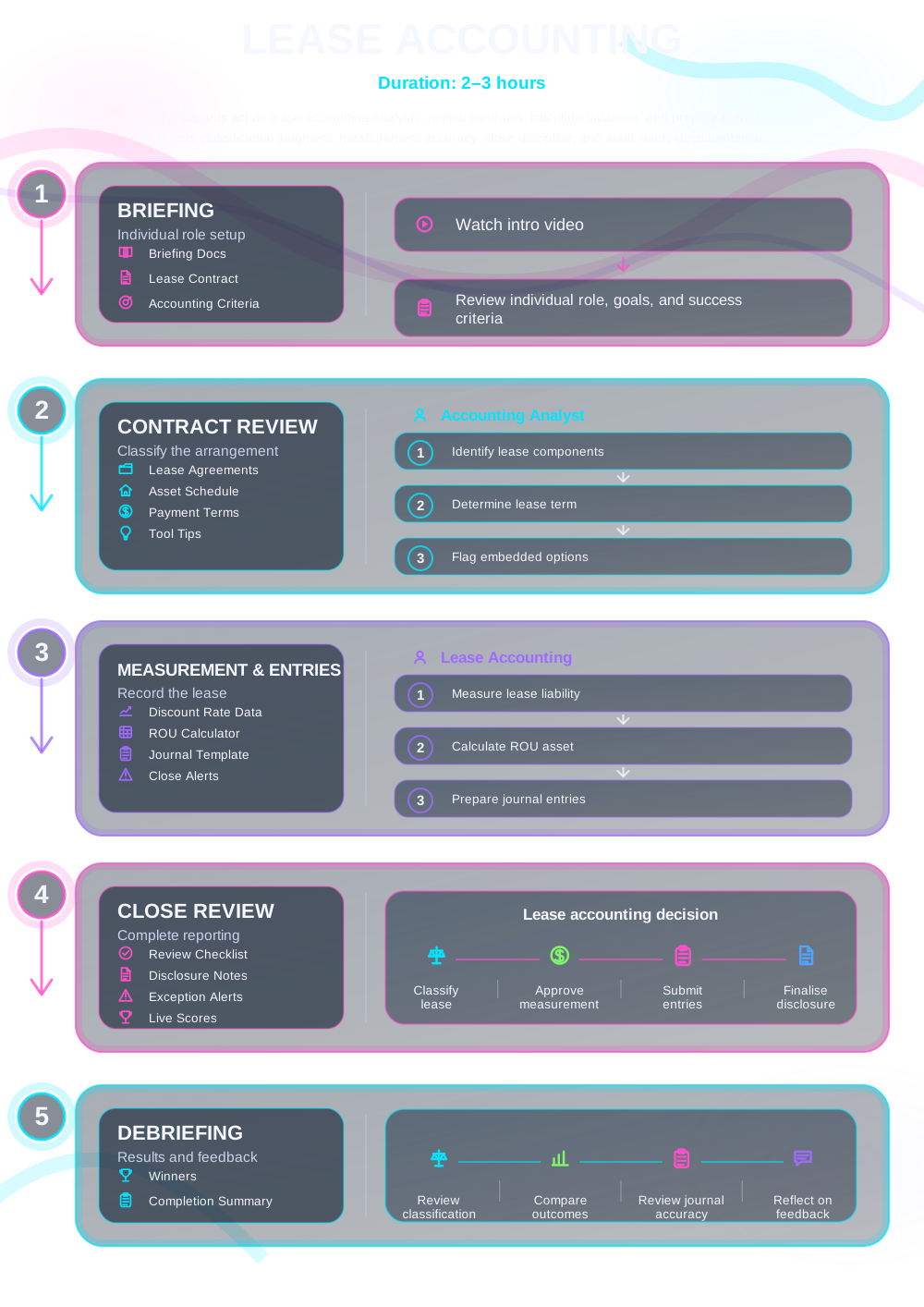

What Participants Do
In the simulation, participants will:
- Analyze a portfolio of real-world lease contracts for a simulated company.
- Identify and extract critical lease data, such as terms, payments, and options.
- Classify each lease correctly as either a Finance Lease or an Operating Lease.
- Calculate the initial ROU Asset and Lease Liability using present value techniques.
- Prepare journal entries for lease commencement, monthly payments, and amortization.
- Handle a mid-term lease modification, recalculating the updated liability and asset.
- Generate key financial reports and disclosures required under ASC 842/IFRS 16.
- Analyze and present the overall impact of lease accounting on the company's financial health.

Learning Objectives
By the end of the simulation, participants will be able to:
- Interpret and apply the core principles of ASC 842 and IFRS 16 to various lease arrangements.
- Demonstrate proficiency in the technical accounting for both Finance and
- Operating Leases from inception to termination.
- Evaluate the significant impact that lease capitalization has on a company's financial statements and key performance indicators (KPIs).
- Build a structured lease accounting model to calculate and record journal entries accurately.
- Develop critical thinking skills to address complex, real-world scenarios such as lease modifications and impairments.
How the Lease Accounting Simulation Works
This simulation can be run individually or in teams in academic or corporate contexts. Each cycle represents a stage of getting through a pressing financial situation.
1. Introduction and Case Background You are introduced to your role and the simulated company preparing for its first audit under the new lease standard.
2. Lease Analysis Phase You are given a set of lease contracts (for warehouses, vehicles, equipment) and must identify the leases and their key terms.
3. Classification and Initial Recording Using the provided data, you classify each lease and perform the initial calculations to record the ROU Asset and Lease Liability on the balance sheet.
4. Subsequent Accounting and Modifications Over several simulated periods, you record monthly journal entries. A trigger event then requires you to account for a lease modification, testing your understanding of remeasurement.
5. Reporting and Analysis You consolidate your work into a simplified set of financial statements and prepare the necessary note disclosures.
6. Debrief and Feedback A comprehensive debrief session is held, comparing different approaches and highlighting key learning takeaways.
Frequently Asked Questions
Assessment
Assessment of participant performance can be tailored according to the host institution’s objectives (business school, corporate training, assessment centre). Typical assessment criteria include:
- Participants’ journal entries and calculations.
- Correct lease classification, accurate PV calculations, and proper journal entries.
- Successful completion of all required steps, from initial analysis to final reporting.
- Quality of the financial analysis and the accuracy of the prepared disclosures.